
If a symptom shows up days or weeks after a dose change, does that clear the medicine? Many people treat timing like a verdict. Fast means the drug did it. Slow means something else did. That shortcut misses how side effects behave.
How quickly do side effects happen? There is no single interval. Some begin within minutes. Some show up over hours or the first few days after a start or a dose change. Some appear after about one to two weeks. Others show up only after weeks of use, or after a medicine is stopped.
Timing and how long a symptom lasts are clues for observation and contact. They do not, by themselves, prove that a medicine caused the symptom.
Empire Medical Wellness Editorial Team
Published 8 October 2026. Updated 8 October 2026.
Table of Contents
- How Soon Side Effects Typically Start
- How Long Side Effects Last and When They Change
- What Changes the Timing of a Side Effect
- Sorting Routine Concerns From Urgent Symptoms
- A Simple Log for Tracking Symptom Timing
- Questions to Bring to Your Clinician
How Soon Side Effects Typically Start
The useful question is which window fits the medicine and the kind of reaction, not “how many hours until every side effect.” Four patterns cover most of what adults notice after a prescription change.
| Onset window | Typical pattern | Example from published sources |
|---|---|---|
| Minutes to about 6 hours | Immediate allergic-type reactions (IgE-mediated); a previously sensitized person may react faster | Hives, swelling, vomiting, breathing difficulty, or fainting after a dose |
| Hours to first few days after starting or changing a dose | Early effects from direct drug activity | Metoclopramide: uncontrollable movements can begin as soon as treatment starts (NHS) |
| About 1 to 2 weeks | Antidepressant benefit usually begins; some side effects ease after a couple of weeks | NHS: benefit usually begins in 1 to 2 weeks and may take up to 8 weeks to be fully established |
| Weeks or longer, or after stopping | Delayed or cumulative effects; drug-specific | Confirm in current FDA labeling or MedlinePlus for the medicine involved; no general window assumed |
Immediate and early windows
IgE-mediated reactions are allergic-type responses in someone whose immune system already recognizes the drug. A clinical review of drug hypersensitivity describes these reactions as commonly beginning within minutes to 1 to 6 hours, with hives, swelling, vomiting, breathing trouble, low blood pressure, or anaphylaxis. A person who was sensitized before may react faster on a later dose.
Direct drug activity can also start early, without allergy. A Chelsea and Westminster NHS leaflet on taking medicines notes that side effects are often most noticeable soon after a medicine is started or the dose is changed, and that uncontrollable movements linked to metoclopramide can occur as soon as treatment begins. Early days are the stretch when a simple written note helps most.
The one-to-two-week window
Antidepressants are a clear case of benefit and side effects on different clocks. The NHS antidepressants guidance states that these medicines commonly take 1 to 2 weeks to begin having an effect and up to 8 weeks to work fully. Many side effects may ease after a couple of weeks, while some can continue. The same guidance notes that suicidal thoughts or urges to self-harm are uncommon but can occur when an antidepressant is started, so early follow-up matters if mood or safety changes. Readers comparing options can review depression medication as background, then bring timing questions to the prescriber.
Later windows
Delayed effects do not share one calendar. Half-life, dose, and the organ involved differ by drug. Check the current FDA prescribing information or the MedlinePlus entry for that medicine instead of borrowing a window from a different drug. A symptom that arrives late is not automatically unrelated, and a symptom that arrives early is not automatic proof.
Practical rule: Treat the first days after a start or a dose change as the main observation window, and still record anything new that appears later.
How Long Side Effects Last and When They Change
Onset answers “when did this begin.” Persistence answers “what is it doing now.” A clinician uses both.
Many effects are loudest in the first days, then settle as the body adjusts. For antidepressants, many side effects may ease after a couple of weeks, although some continue for as long as treatment goes on. A short-lived nuisance and a symptom that never lets up are not the same clinical problem, even if they started on the same day.
Half-life is the time the body takes to clear about half of a dose. A short half-life can mean effects fade within a day or two after the last dose. A long half-life can mean effects linger for days after stopping. That span is specific to the medicine, the dose, and how the kidneys and liver are working. Feeling well for a day after a dose does not close the book, and feeling unwell for a day after stopping does not prove the drug is still the cause.
People comparing schedules, including readers looking at tirzepatide dosing, still need the same three labels in a notebook:
- Improving: milder than last week, or present only part of the day.
- Stable or intermittent: same intensity, or it comes and goes without a clear climb.
- Worsening or disruptive: stronger than before, or it interferes with sleep, work, or school.
A symptom that outlasts the period the prescriber described, or that gets worse, is a reason for a routine review. If it is severe, that contact should be the same day, not the next scheduled visit.
No one should stop, cut, or restart a medicine to see whether a symptom disappears. That experiment can bring withdrawal, return of the original condition, or a new reaction. Any change belongs in a conversation with the prescriber. Persistence plus timing tells that clinician what to watch next. It does not authorize a home dose change.
What Changes the Timing of a Side Effect
People often assume a side effect should arrive on a fixed schedule, like a bus. The body is not a timetable. Timing reflects how fast the medicine enters, how fast it leaves, and whether the response is the drug's direct action or an immune response.
Picture a sink. The dose is water from the tap. The rise in the basin depends on how hard the tap runs and how fast the drain empties. A wide-open tap and a slow drain raise the level sooner. A slow tap and a fast drain may never reach the same level.
What moves the clock
- Route and formulation: Injected or intravenous medicines often act sooner than tablets. Extended-release forms stretch the curve.
- Dose and the speed of increases: A larger dose, or a faster step-up, can bring effects sooner than a slow increase.
- Clearance and half-life: Kidney and liver function change how long the drug stays around, which is why some effects linger after the last dose.
- Other substances: Prescription medicines, over-the-counter products, supplements, and alcohol can speed, slow, or intensify an effect. A guide to psychiatric drug interactions is a useful checklist before that conversation, not a reason to drop a medicine.
- Prior sensitization: A repeat exposure can produce a faster immune reaction than the first dose.
- Mechanism: Direct pharmacologic action often tracks blood levels. An immune response follows the immune system's own timing.
Before prescribing, the physician at Empire Medical Wellness reviews medical history, other medicines, pregnancy plans, and potential side effects. That review is where route, clearance, and interaction risk get matched to one person.
An early symptom is not proof the medicine caused it. A late symptom is not proof the medicine is innocent.
Global safety systems collect suspected reactions after medicines reach wider use, which can flag rare or delayed events that short trials miss. Those reports cannot prove that a drug caused one person's symptom. Exposure times, other illnesses, and outcomes are often incomplete. Timing supports clinical reasoning. It does not establish cause on its own.
Sorting Routine Concerns From Urgent Symptoms
Urgency follows the type and severity of the symptom, not the clock. A mild headache on day one can wait for a planned visit. Breathing trouble ten minutes after a dose cannot. A serious effect can also start as soon as treatment begins, not only after long use.
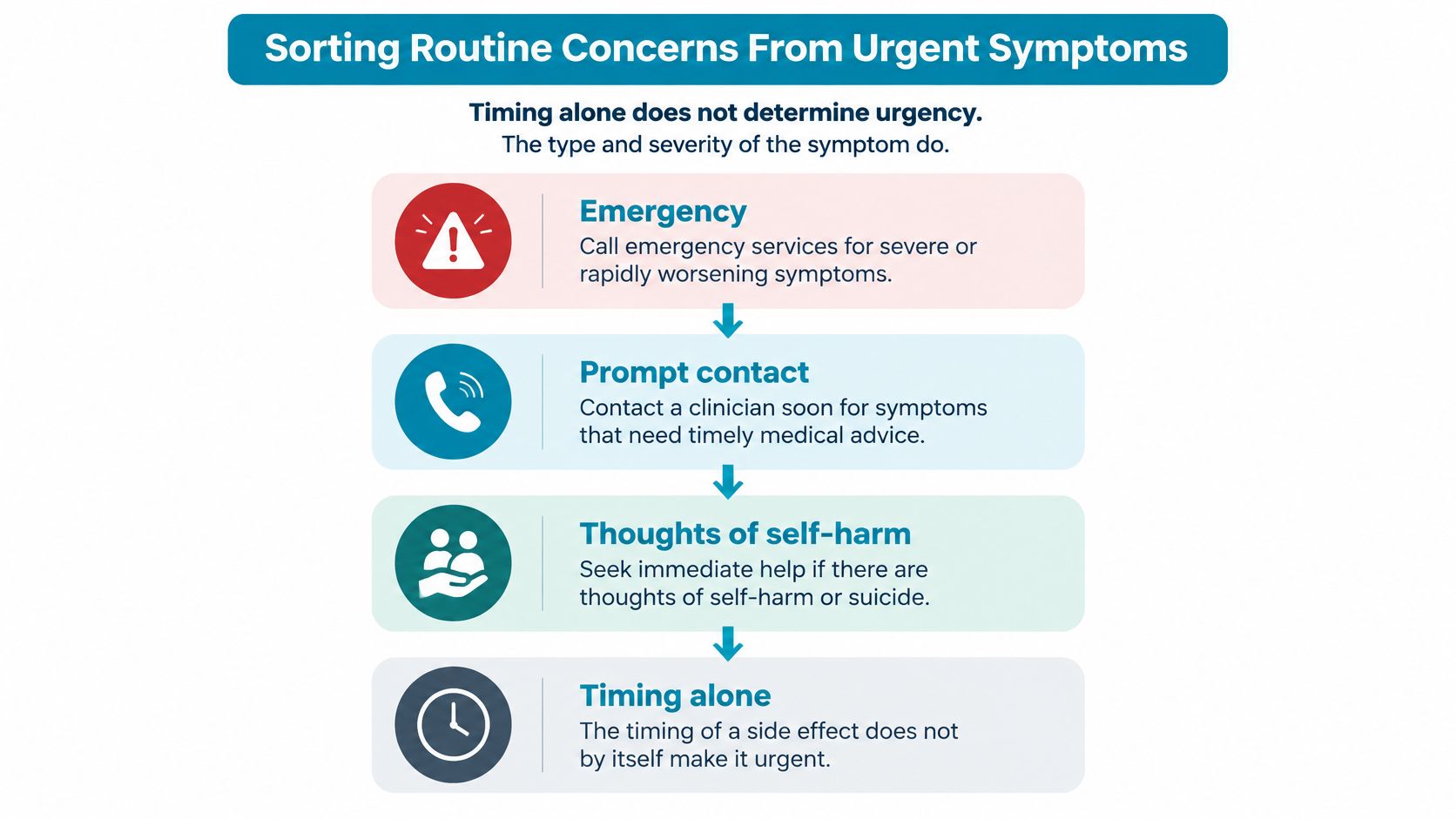
| Category | What it looks like | Next step |
|---|---|---|
| Emergency | Breathing difficulty; swelling of the face, lips, tongue, or throat; fainting; widespread or rapidly spreading rash or hives | Call 911 or go to the nearest emergency department |
| Prompt contact | Uncontrollable movements such as tics, tremors, muscle stiffness, or spasms | Contact the prescriber the same day; do not wait for a scheduled visit |
| Thoughts of self-harm | New, worsening, or urgent thoughts of self-harm or urges to self-harm | If someone is in immediate danger, call 911. In the United States, call or text 988 for the Suicide and Crisis Lifeline |
| Routine follow-up | Mild, stable, or improving effects that are tolerable | Write it in the log and raise it at the next scheduled medication review |
Emergency
Call 911 or go to the nearest emergency department for trouble breathing, swelling of the face, lips, tongue, or throat, fainting, or a rash or hives that is widespread or spreading fast. The NHS metoclopramide guidance describes serious allergic reactions that can develop rapidly, with throat or tongue swelling, an itchy raised rash, or difficulty breathing, and states that these symptoms need urgent care rather than routine watching. Do not use the Empire Medical Wellness website, email, or routine patient messaging for urgent or emergency concerns.
Prompt contact and self-harm
The same NHS page identifies uncontrollable movements, including tics, tremors, muscle stiffness, and spasms, as a potentially serious effect of metoclopramide that can happen as soon as the medicine is started. Contact the prescriber the same day. Similar movement symptoms on another drug deserve that same-day call, not a wait for the next slot. Background reading such as side effects of Ozempic does not replace that call.
Thoughts of self-harm are uncommon when an antidepressant is started, but they can occur. If someone is in danger, call 911. In the United States, call or text 988.
Routine follow-up
Mild effects that stay stable or improve, and that a person can tolerate, belong in the log and at the next scheduled review. When it is unclear whether a symptom is urgent, treat it as urgent and get help.
A Simple Log for Tracking Symptom Timing
Memory drops exact times within a few days. A clinician cannot rebuild the order of a missed dose, a new supplement, and a symptom that started "sometime last week" from a vague recollection. A short log preserves that order while it is still fresh. It works like a bank statement: it shows what happened and when, not what caused the balance to change.
Copy these fields into a notebook or a phone note.
| Field | What to record | Why it matters |
|---|---|---|
| Medicine and strength | Exact name, strength, and form, including any change | Identifies the exposure being evaluated |
| Start or change date | Date and time of the first dose or the dose change | Anchors the onset timing |
| Doses taken and missed | Dates and times of doses, including skipped or extra doses | Shows the exposure pattern |
| Other medicines and supplements | Everything taken alongside, including over-the-counter products | Helps screen for interactions |
| Symptom and onset | What appeared and how many hours or days after a dose | Supports timing-based reasoning |
| Duration and pattern | Constant, intermittent, improving, or worsening | Shows persistence |
| Severity and daily impact | Mild, moderate, or severe; effect on sleep, work, or school | Tracks tolerability over time |
| Illness or other exposures | New illness, diet changes, and alcohol or substance use when relevant | Helps separate other causes from medication effects |
A filled-in line reads something like: "Tuesday, 8 p.m., first dose. Thursday morning, mild nausea about 36 hours after the second dose. Better by Friday." Four short lines like that give a prescriber more to work with than a paragraph written from memory two weeks later.
How to keep it
- Start the record on the day of the first dose or the dose change.
- Write each dose time, including any missed or extra dose.
- Note onset in hours or days after a dose, not only the calendar date.
- Rate severity as mild, moderate, or severe, and note sleep, work, or school.
- Mark the pattern as constant, coming and going, or improving.
The details that most improve a later review are the exact start date, the dose and formulation, timing after each dose, other medicines or substances, symptoms that were already present, and whether anything changed after a supervised adjustment. A symptom that is uncommon, late, or missing from a short "common side effects" list can still be medically relevant. The WHO pharmacovigilance programme collects suspected reports after medicines reach broader populations so rare, delayed, or population-specific events can be spotted. Many suspected reactions never reach a regulator, which is one reason a prescriber reads the log alongside the clinical picture rather than treating any single entry as proof. A database cannot establish that a medicine caused one person's symptom.
For a first visit, patients should bring an updated medication list, including supplements and any side effects they have noticed. A psychiatric medication management worksheet can sit beside the log as a prompt for that list. The log supports the visit. It does not replace it, and it is not a reason to change or stop a medicine alone.
Questions to Bring to Your Clinician
Read the log out loud as questions. Each one gives the prescriber a decision, not a vague worry.
- Which side effects are expected at this stage, and how long should each last? Expected timing stops a normal adjustment from being treated like an emergency, and it stops a lingering problem from being waved off.
- What timing or change would mean I should call before my next visit? Agree on the threshold while everyone is calm.
- Does this timing fit this medicine, or should other causes be considered? Ask about illness, sleep, caffeine, alcohol, and new products in the same week.
- Should my other medicines, supplements, or alcohol use be reviewed for interaction? Bring the actual bottles or a photo of the labels.
- Is this symptom improving, stable, or worsening, and how will we measure that? Pick one marker, such as nights of sleep or days the symptom limited work.
- What is the plan if a side effect lasts past the expected adjustment period? The plan might be watchful waiting, a formulation discussion, or a different option. The prescriber chooses. The patient does not trial a dose change at home.
- What signs need urgent contact, and how do I reach help outside office hours? Emergency symptoms still mean 911 or the nearest emergency department, not a portal message. For suicidal crisis in the United States, call or text 988.
- When is the next review, and what would trigger an earlier one? Follow-up timing should match the treatment plan, the medicine, and progress, not a generic calendar.
When a routine visit is the right step
Routine follow-up fits when effects are persistent, bothersome, or unclear, or when the medication plan itself needs a look. Medication review visits discuss whether current treatment is helping, any side effects, and concerns about the plan. When medication is appropriate, follow-up assesses response and tolerability and whether treatment needs adjustment. Follow-up frequency and appointment length are based on the treatment plan, medication needs, and progress. Routine follow-up never replaces emergency care.
A first mental health appointment at Empire Medical Wellness is 50 minutes and focuses on symptoms, medical and treatment history, current medications, daily functioning, and goals. The patient receives an explanation of the clinical assessment, treatment options, and recommended follow-up. Mental health medication management and a mental health medication review are the visits where these eight questions belong. Cost questions can go to the fees and how it works page. Booking is through schedule an appointment.
These questions are for the clinician. No one should change, stop, or adjust a medicine based on a log, an article, or a guess about timing.
This article is educational and is not personal medical advice. It does not diagnose, set a dose, or replace care from a qualified clinician.
Sources: NHS guidance on antidepressants and on metoclopramide; NCBI Bookshelf review of drug hypersensitivity; Chelsea and Westminster NHS leaflet on taking medicines; MedlinePlus overview of drug reactions; World Health Organization pharmacovigilance programme.
Empire Medical Wellness offers private-pay, physician-led outpatient care for adults, including mental health evaluation and medication management when that care is appropriate. A medication review is a place to discuss whether treatment is helping, what side effects have shown up, and what should happen next, using the timing notes from home. Visit Empire Medical Wellness to see how visits work and to request an appointment.