
Search for medication for anger and irritability and you'll find lists. Fluoxetine. Risperidone. A mood stabilizer. Sometimes a beta blocker. Those lists aren't wrong about which drugs appear in research, but they answer the wrong question. No medication is approved to treat anger as a stand-alone symptom, and none has been shown to reduce irritability reliably across different groups of people, because irritability isn't one condition.
What decides the answer is the condition producing the irritability, how severe it is, what else is going on medically, and what non-drug care has already been tried. This guide works through that logic in order: the causes first, then the medication classes that appear in the evidence, then the benefits, risks, and follow-up that determine whether a trial of medication should continue.
By the Empire Medical Wellness Editorial Team. Published 8 October 2026. Last updated 8 October 2026.
Table of Contents
- Why Anger and Irritability Have No Single Medication
- Medication Classes Studied for Irritability and Aggression
- When Medication Is Considered and What to Ask
- Benefits, Risks and Warning Signs to Know
- Monitoring and Follow-Up Between Visits
- How the Practice Evaluates Irritability and Coordinates Care
- Sources
Why Anger and Irritability Have No Single Medication
Three words get used as if they were interchangeable. Irritability is a low tolerance for frustration, where small friction produces a reaction out of proportion to the trigger. Anger is the emotion itself, running from mild annoyance to rage. Aggression is behavior: what a person does to objects or to other people, and on some scales it includes self-injury.
Research measures them separately, and that separation matters more than most drug lists admit. A scale that tracks how easily someone is provoked is not the same instrument as one that counts aggressive acts, so improvement on the first doesn't guarantee improvement on the second.
A clinical review of medication options for irritability states the consequence directly: no medication has been shown to reduce irritability specifically and reliably across patients. Much of the evidence for antidepressants and other medicines comes from secondary analyses of trials that were treating depression, anxiety, or a related disorder. The review's recommendation follows from that finding. Evaluate and treat the underlying disorder rather than treating anger as a diagnosis in itself.
Episodic outbursts and persistent irritability
Pattern belongs in the evaluation. Episodic anger arrives in discrete outbursts with a clear before and after, often set off by a particular kind of provocation, and the person is settled in between. Persistent irritability is a background state that lasts days or weeks and colors everything, including sleep and appetite.
The two point in different directions. Episodic outbursts raise questions about triggers, impulse control, and consequences such as damage, injury, or legal trouble. Persistent irritability raises questions about mood, sleep, substances, pain, and medical illness. A clinician who doesn't establish which pattern is present is working with half the history, which is also why emotional dysregulation is assessed as a pattern over time rather than a single bad afternoon.
The table maps the contexts most often sitting underneath anger in adults, what a physician reviews in each, and why the medication question changes from row to row.
| Context | What the evaluation checks | Why the medication question varies |
|---|---|---|
| Depression with irritability | Mood symptoms, sleep, appetite, functioning, prior treatment | Antidepressants may be considered for the depression itself; irritability is not a separate labeled target |
| Anxiety-related irritability | Worry pattern, panic or tension, substance use, sleep | Treatment usually targets the anxiety disorder; evidence for anger alone is limited |
| ADHD | Attention, impulsivity, childhood history, school or work functioning | ADHD medicines are studied for ADHD; some labels warn about new or worsening hostility |
| Intermittent explosive disorder | Episode frequency, triggers, prior outbursts, injury or damage | Medication evidence is mixed; psychological treatment looked more effective in some comparisons |
| Substance or medication-related irritability | Timing of use, alcohol or drug intake, recent medicine or dose changes | The cause may be the substance or the medicine itself, so the first step is review, not adding a drug |
| Sleep disorders | Sleep duration, awakenings, daytime fatigue | Irritability often improves when the sleep problem is addressed; medicine decisions follow the evaluation |
| Acquired brain injury | Cognitive history, injury history, other medical conditions | Evidence is limited and population-specific; medicines are studied mainly in research settings |
One context deserves caution. The strongest evidence for any medication in this area involves irritability in autism spectrum disorder, and those trials enrolled children and adolescents. Assuming the same result applies to an adult with no such diagnosis, who is quick to anger, is a leap the studies don't support.
The useful question at a first visit isn't which drug suppresses anger. It's what is producing the anger, how often it happens, and what else changed around the time it started.
Medication Classes Studied for Irritability and Aggression
Nothing below is a menu. It's a map of what research and FDA labeling show as of 8 October 2026, and current details for any specific product belong on that product's FDA label. Two words matter throughout. On-label means an FDA-approved use for that drug. Off-label means any other use, which is legal and common in medicine but should be named as such, with the strength and limits of the evidence stated plainly.
A review of medication for aggression and intermittent explosive disorder makes the boundary clear. FDA labeling for antidepressants describes approved indications and required safety warnings, but anger itself is not a universal stand-alone indication. Research on impulsive aggression has examined selective serotonin reuptake inhibitors, including fluoxetine, along with mood stabilizers, and the reviews report that the evidence remains mixed and that no single intervention is conclusively superior. That review also found psychological treatments may have a slight advantage over medication in some comparisons.
Antidepressants and mood stabilizers
Antidepressants are the class many expect to be offered. When irritability is part of depression or an anxiety disorder, they can help with both the condition and the associated irritability. When anger is the only symptom, the evidence is thinner, and labeling matters: antidepressants are reported to produce irritability and hostility in some adults. A wider view of antidepressant treatment options helps readers see why the diagnosis, not the symptom, drives the choice.
Mood stabilizers sit in a similar position. Results vary by drug and by population, and after traumatic brain injury the record is sobering: one randomized trial found no demonstrated benefit for carbamazepine over placebo. Anger is an off-label use for these medicines, which doesn't make it wrong, but it does mean the evidence behind the choice should be explained rather than assumed.
Antipsychotics and agents studied after brain injury
Atypical antipsychotics have the deepest evidence base in this field, and it's narrower than it sounds. A 2023 Cochrane review of medications for irritability and aggression in autism found that second-generation antipsychotics probably reduce irritability compared with placebo over short-term follow-up of up to six months. Across 12 studies and 973 participants, the standardized mean difference was -0.90 (95% CI -1.25 to -0.55), a large effect supported by moderate-certainty evidence. The same review found no clear evidence that these medicines reduced aggression: one study of 77 participants produced an estimate of -0.44 (95% CI -0.89 to 0.01), rated very low certainty.
Drug-level figures are consistent with that. A 2024 systematic review of pharmacological interventions for irritability in autism reported risperidone across 6 trials, with 187 participants receiving risperidone and 204 receiving placebo, and a standardized mean difference of -0.857 (95% CI -1.263 to -0.451; P=0.0029). An FDA clinical review of risperidone covering an 8-week trial found 54% of participants were rated much improved or very much improved on risperidone, compared with 18% on placebo, a 36-percentage-point absolute difference that was statistically significant at p<0.001. Response rates depend on the population, dose, outcome scale, and trial duration, and these medicines carry sedation, movement, hormonal, and metabolic risks.
Labeling keeps its focus on the population studied. FDA labeling for aripiprazole and risperidone describes short-term, placebo-controlled trials in children and adolescents with tantrums, aggression, self-injury, or rapidly changing moods, not ordinary anger without that diagnosis. A review of medication for aggression after traumatic brain injury identified 10 studies, five of them randomized, covering methylphenidate, propranolol, and amantadine; it concluded that an amantadine trial may benefit adults with post-injury aggression or irritability, while larger and better-designed studies are needed.
A 2025 clinical review of pharmacological treatment for youth irritability adds the caution the numbers don't show. Pharmacological interventions had a large pooled effect, but studies were highly heterogeneous and tolerability wasn't assessed in the meta-analysis, and the review recommended considering nonpharmacological options first. The same review notes that FDA labeling for atomoxetine advises monitoring for emerging or worsening aggressive behavior or hostility.
| Drug class | Examples named in research | Where evidence appears | Labeling and evidence notes |
|---|---|---|---|
| Antidepressants (SSRIs and others) | Fluoxetine | Intermittent explosive disorder, depression, and anxiety studies | Mixed evidence; irritability and hostility are reported effects; anger is not a labeled indication |
| Mood stabilizers | Carbamazepine after brain injury; other agents vary | Aggression reviews and one post-injury randomized trial | Off-label for anger; carbamazepine did not beat placebo in that trial |
| Atypical antipsychotics | Risperidone, aripiprazole | Autism-associated irritability in children and adolescents | Labeled for that pediatric use; Cochrane SMD -0.90 for irritability; adult anger use generally off-label |
| ADHD medicines | Methylphenidate, atomoxetine | Methylphenidate in post-brain-injury research; atomoxetine labeled for ADHD | Atomoxetine labeling says monitor new or worsening hostility |
| Other agents after brain injury | Amantadine, propranolol | Post-injury aggression research, small trials | Off-label; an amantadine trial may help some adults; larger studies needed |
The same class can help one cause of irritability and worsen another. That's the argument for diagnosis over drug name, not against medication.
When Medication Is Considered and What to Ask
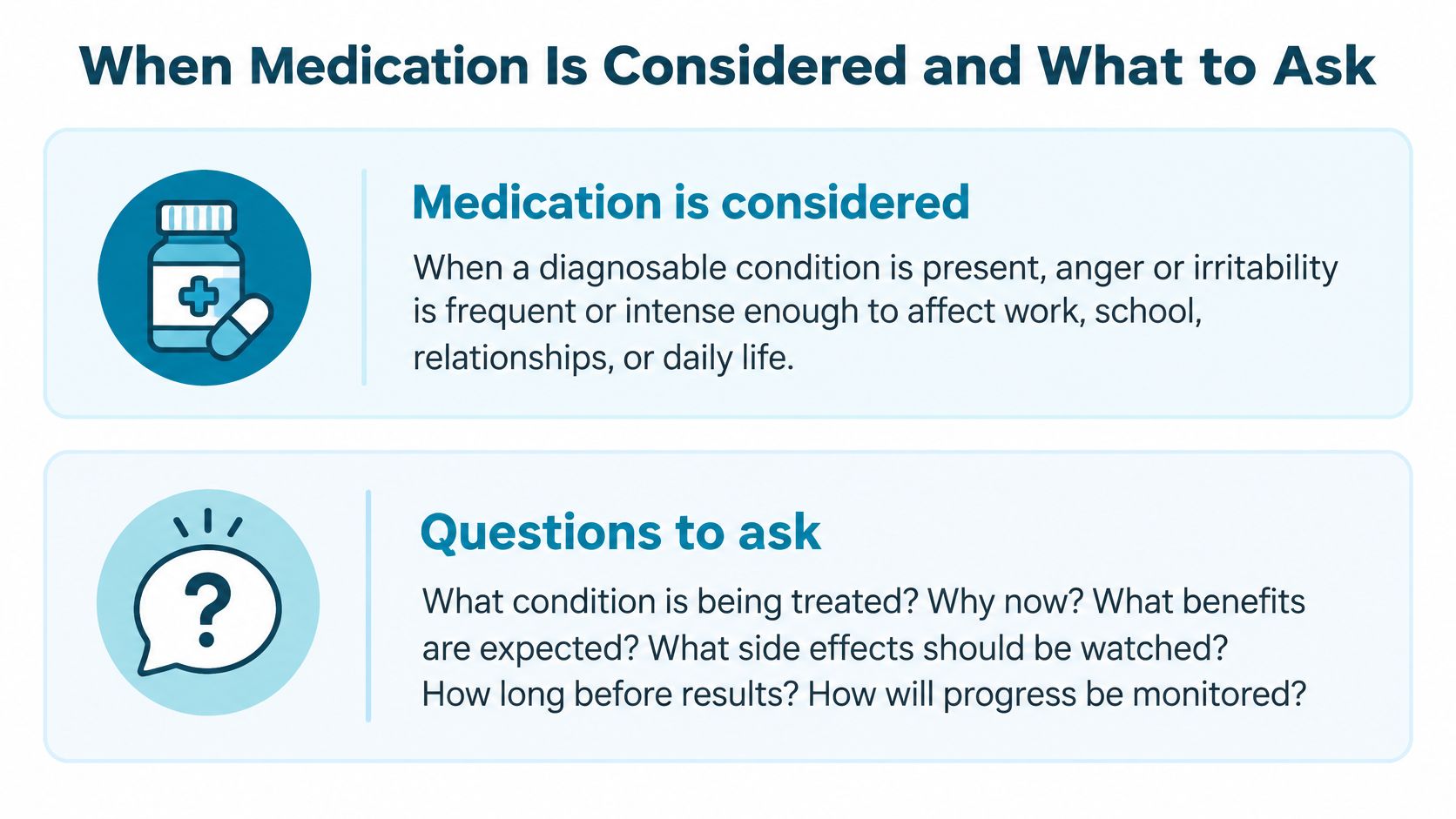
Medication is considered when four things line up, and a clinician is the one who judges whether they do. The first is a diagnosable condition; irritability by itself isn't a diagnosis and doesn't select a drug. The second is impact: anger or irritability frequent or intense enough to affect work, school, relationships, or physical safety. The third is insufficient response to other care, whether that means skills-based therapy wasn't enough, wasn't available, or doesn't fit the situation. The fourth is a judgment that expected benefit outweighs known risk for this particular person, given other conditions and other prescriptions.
Behavioral treatment is a partner in that sequence, not a formality before the "real" treatment. It addresses the triggers, routines, and communication patterns a drug doesn't reach, and for recurrent outbursts it's often started first or alongside medication.
What counts as an emergency
Acute agitation with danger to self or others is emergency care, not a scheduled appointment. Clinical guidance on assessing and managing acute agitation recommends first evaluating medical, neurologic, substance-related, and psychiatric contributors, and turning to medication when de-escalation and other interventions aren't enough. Oral treatment is preferred when clinically feasible, and single-agent therapy is favored over unnecessary combinations.
That guidance also flags the tradeoffs. Benzodiazepines and antipsychotics are commonly used for short-term control of severe agitation, but benzodiazepines can cause paradoxical disinhibition, particularly in children and adolescents, while antipsychotics require monitoring for sedation, movement disorders, metabolic effects, and cardiovascular risks.
If someone is at risk of harming themselves or another person, call 911 or go to the nearest emergency department. In the U.S., the Suicide and Crisis Lifeline is available by call or text at 988.
Questions worth bringing to a visit
A scheduled visit is where these get answered, and a written list keeps the conversation on the decisions rather than the drug name.
- What condition is being considered? Ask for the working diagnosis in plain words, plus what else is on the list and how it would be ruled in or out.
- Is this FDA-approved for that condition, or off-label? Ask the clinician to say which, then explain the strength and the limits of the evidence behind it.
- What does improvement look like, and when will we judge it? Agree on the target symptom and a review point before the first dose.
- Which effects should prompt a call? Ask specifically about activation, inner restlessness, sedation, and mood elevation.
- What interactions matter? Bring the full list, including over-the-counter products and supplements.
- Which non-drug options fit this problem? Sleep, alcohol use, skills-based therapy, and treatment of another condition can matter more than the drug choice.
- Who else is involved in care? If a therapist or another physician is treating you, ask whether coordination is possible with your authorization.
- What happens if things get worse? Get the after-hours instruction before you leave.
For a first visit, bring an updated medication list, including supplements and any side effects you've noticed. Readers who already take a mental health medicine and aren't sure it's helping can review what a medication review covers before the appointment.
Benefits, Risks and Warning Signs to Know
Benefit is real, and it's conditional. Some diagnosed conditions show reduced irritability with medication, and the size of that effect varies by drug, by condition, and by the population studied. The antipsychotic figures above come from children and adolescents with autism, which is a different starting point from an adult with depression and a short fuse. Benefit also depends on whether the person stays on the medicine, which depends on tolerability.
Risks cluster into a few groups worth knowing by name. Sedation is the most common and the easiest to spot. Metabolic changes include weight gain and shifts in glucose and lipids. Movement symptoms include tremor, stiffness, and restlessness. Emotional blunting is the flat, muted feeling some people describe on higher doses. Activation covers agitation, insomnia, and inner restlessness.
Activation and paradoxical worsening
The counterintuitive risk is that a medicine given to settle irritability makes it worse for a while. FDA prescribing information for antidepressants reports that anxiety, agitation, insomnia, irritability, hostility, aggressiveness, impulsivity, akathisia (severe inner restlessness), hypomania, and mania have been reported in adults taking these medicines. The labeling advises patients, families, and caregivers to watch especially closely when treatment begins or when the dose is increased or decreased.
Those symptoms don't prove a medication caused suicidal thinking, but the labeling notes they may be warning signs requiring prompt clinical attention. Follow-up therefore has to assess both improvement and any new or worsening anger, agitation, aggression, or mood elevation. Readers weighing that balance can review the pros and cons of medication for mental illness alongside the table below.
| What you notice | Category | What to do |
|---|---|---|
| Mild new drowsiness, nausea, or appetite change | Routine follow-up | Note it in the log and raise it at the next visit or through the practice's usual contact method |
| New or worse irritability, agitation, restlessness, or hostility after a start or dose change | Prompt clinician contact | Contact the prescriber the same day when possible; don't change the medicine alone |
| Sustained insomnia or severe inner restlessness (akathisia) | Prompt clinician contact | Report promptly; antidepressant labeling lists these effects |
| Fever, muscle twitching or stiffness, confusion, hallucinations, or unusual blood-pressure changes with a serotonin-affecting medicine or supplement | Emergency | Call 911 or go to the nearest emergency department |
| Thoughts of harming yourself or someone else, or violent behavior | Emergency | Call 911 or go to the nearest emergency department; call or text 988 for a suicidal crisis |
A rule that prevents most confusion: a new symptom in the first weeks is a reason to call, not a reason to stop the prescription on your own.
Monitoring and Follow-Up Between Visits
Monitoring is a shared record, not a test with a pass or fail result. It answers one practical question at every visit: is this treatment helping enough to justify what it costs in side effects and inconvenience?

The record starts before any change. It captures the targeted symptom, how often it happens, its intensity on a 0 to 10 scale agreed with the clinician, sleep, alcohol and other substance use, every medicine and supplement, and how work, school, home life, and relationships are going. That baseline is what makes a later comparison possible; without it, "better" and "worse" are impressions.
The National Institute of Mental Health guidance on mental health medications notes that adults taking antidepressants should be monitored particularly closely during the first weeks of treatment, and that monitoring matters after any medicine or dose change because response and adverse effects emerge at different times. NIMH also identifies serotonin syndrome as a rare but potentially life-threatening interaction involving antidepressants and other serotonin-affecting medicines or supplements, including some migraine medicines and St. John's wort. That's why the log lists every prescription, over-the-counter product, and supplement, so the interaction review is complete.
Medication review visits at Empire Medical Wellness discuss whether current treatment is helping, any side effects, and concerns about the medication plan. When medication is appropriate, follow-up assesses response and tolerability and determines whether treatment needs adjustment.
| Item | What to record | How often | When to bring it |
|---|---|---|---|
| Target symptom | Frequency, setting, and a 0 to 10 intensity agreed with the clinician | Daily or weekly | Baseline and every visit |
| Episode log | Date, trigger, duration, what helped, and any aggression or self-harm | Each episode | Every visit |
| Sleep | Hours slept, awakenings, daytime fatigue | Daily | Every visit |
| Alcohol and other substances | Type, amount, and timing relative to episodes | Daily or as used | Every visit |
| Medicines and supplements | Name, labeled strength, timing, missed doses | Whenever anything changes | First visit and every visit |
| Side effects | New or worse effects and when they began | As noticed | Every visit; urgent items immediately |
| Daily functioning | Work, school, household tasks, and relationships | Weekly | Every visit |
Update the log between visits and bring it to each appointment; a blank psychiatric medication management worksheet is a starting point, not a scorecard. Urgent entries get raised immediately rather than saved. What changes a plan is persistent symptoms, a new side effect, or a change in another medicine, and each of those leads to reassessment with the clinician rather than an adjustment made alone.
How the Practice Evaluates Irritability and Coordinates Care
A first visit at Empire Medical Wellness, a private-pay, physician-led outpatient practice, follows a sequence rather than a symptom checklist. The physician starts by mapping the symptom itself: whether irritability is episodic or persistent, how often it occurs, how intense it gets, and what tends to set it off. Next comes medical history, sleep, and functioning at work or school, because those three reshape the differential more often than people expect.
Previous treatment comes next, including what was tried, at what point, and why it stopped. Then the medication list, current and past, with supplements and side effects noted. When substance use could explain the symptom, it's reviewed directly and without judgment as part of the medical picture, since timing often settles the question.
The physician and patient then discuss response, side effects, safety, and goals together. Diagnostic clarification and ongoing medication management are separate tasks, which is why the first conversation often produces a clearer description of the problem before it produces a prescription. A medicine may be included only when it's clinically appropriate after that review, and mentioning a drug class here isn't a claim that any particular medicine is prescribed.
Coordination with an outside therapist or another treating clinician happens when it's useful and the patient authorizes it. Therapy itself is provided by outside clinicians rather than by this practice.
The scope is worth stating plainly. Empire Medical Wellness doesn't provide psychotherapy, inpatient care, detoxification, partial hospitalization, or intensive outpatient programs, and not every psychiatric condition is managed here. Adults who want their irritability evaluated as part of a broader mental health assessment can read about mental health medication management to see what the process involves.
Sources
- Cochrane review of medications for irritability, aggression, and self-harm in autism spectrum disorder, 2023.
- FDA clinical review of risperidone, including 8-week trial response data.
- Clinical guidance on the assessment and management of acute agitation.
- Systematic review of medication for aggression after traumatic brain injury.
- Systematic review of pharmacological interventions for irritability in autism, Molecular Autism, 2024.
- Clinical review of medication options for irritability.
- Systematic review of medication for aggression and intermittent explosive disorder.
- Clinical review of pharmacological treatment for youth irritability, 2025.
- FDA prescribing information for antidepressants, DailyMed.
- National Institute of Mental Health, mental health medications.
This article is educational and is not personal medical advice. It doesn't describe how to start, stop, or change any prescription, and nothing here is a recommendation for an individual reader. Decisions about medication belong with a licensed clinician who knows the full history.
Empire Medical Wellness provides private-pay, physician-led outpatient mental health evaluation and ongoing medication management for adults, including visits where irritability, mood, sleep, substance use, and current medicines are reviewed together. If anger or irritability is affecting work, relationships, or safety, a structured evaluation is a reasonable next step. Visit Empire Medical Wellness to see how evaluation, medication review, and follow-up are organized.