
OxyContin is extended-release oxycodone, a Schedule II opioid for severe, persistent pain when alternatives are inadequate. It's taken about every 12 hours, not as needed.
If two tablets contain oxycodone, does that make them interchangeable? No. The release pattern matters, and a tablet obtained outside a licensed pharmacy may not contain oxycodone at all. Understanding OxyContin opioid safety also means separating a prescribed medicine's effects from physical dependence, opioid use disorder, and counterfeit-pill exposure.
Table of Contents
- What OxyContin Is as an Opioid
- How OxyContin Differs From Other Opioid Forms
- How Extended-Release Oxycodone Acts
- Tolerance Dependence and Opioid Use Disorder
- Overdose Signs Naloxone and Counterfeit Pills
- Safer Long-Term Use Without Self-Changes
- When Confidential Outpatient Assessment Helps
What OxyContin Is as an Opioid
OxyContin is a brand, not a different active opioid from oxycodone. The active ingredient is oxycodone hydrochloride. The formulation describes how that ingredient is delivered, and extended-release means the tablet releases medicine over time rather than delivering it immediately.
The DailyMed OxyContin prescribing information identifies it as a Schedule II opioid analgesic for severe and persistent pain that requires an opioid and cannot be adequately treated with alternatives, including immediate-release opioids. An analgesic is a pain-relieving medicine. Schedule II is a federal controlled-substance category for medicines with accepted medical uses and a high potential for abuse, subject to strict prescribing controls.
What the approved use means
The indication is narrower than pain relief in general. OxyContin isn't intended for routine mild pain or occasional discomfort. The FDA prescribing information specifies oral administration every 12 hours and states that it isn't an as-needed analgesic.
A hypothetical example illustrates the distinction. An adult who has a short flare of pain might assume that any available pain tablet could serve as a rescue medicine. An extended-release product has different instructions and risks, so that assumption doesn't establish that OxyContin is appropriate.
Several terms help keep the product's role clear:
- Brand: OxyContin names a particular medicine.
- Active ingredient: Oxycodone produces the opioid effects.
- Formulation: Extended-release describes the delivery design.
- Approved purpose: Treatment of qualifying severe, persistent pain, not treatment of opioid use disorder.
An opioid prescription doesn't establish an addiction diagnosis. Conversely, an approved pain indication doesn't remove the medicine's potential for dependence, misuse, or overdose.
Side effects deserve clear language
OxyContin's prescribing information lists effects such as constipation, nausea, vomiting, dizziness, itching, and sleepiness. Confusion can also occur. Not every person experiences every effect, and a symptom's significance depends on its severity and the surrounding circumstances.
Excessive sleepiness and slowed breathing are serious safety concerns, not evidence that the medicine is working. A person who cannot be awakened or isn't breathing normally needs emergency help.
Practical distinction: A medicine can have an appropriate medical use and still require substantial safeguards.
This educational discussion provides no diagnosis, personal dose, or instruction to start, stop, or change medication. Tablet strengths identify available products, not suitable choices for an individual.
How OxyContin Differs From Other Opioid Forms
OxyContin compared with other oxycodone forms
| Product or finding | Release or exposure | Dosing interval or instruction | What it means |
|---|---|---|---|
| OxyContin | Extended-release oxycodone brand | About every 12 hours by mouth | For severe persistent pain when alternatives are inadequate; not as-needed |
| Immediate-release oxycodone | Faster release and shorter action | Often about every 4 to 6 hours | A different formulation; CDC prefers immediate-release opioids when starting opioid therapy for chronic pain |
| Label exposure example | 10 mg OxyContin every 12 hours compared with 5 mg immediate-release oxycodone every 6 hours | Similar total exposure and peak concentrations | A labeling comparison only, not a patient dose-conversion chart |
| OxyContin tablet strengths | 10, 15, 20, 30, 40, 60, and 80 mg extended-release tablets | Swallow whole on the prescribed schedule | Crushing, chewing, or dissolving can defeat the release design and raise overdose risk |
The strengths and OxyContin schedule above are identified in the FDA prescribing information. The FDA's pharmacokinetic labeling document reports that 10 mg of OxyContin every 12 hours produced exposure comparable to 5 mg of immediate-release oxycodone every 6 hours, including similar total exposure and peak concentrations.
That finding is not a dose-conversion instruction. It doesn't establish that products can be exchanged at home, and it doesn't explain how a clinician would switch a particular patient between medicines.
Release time isn't the same as elimination time
The same FDA pharmacokinetic document reports oral bioavailability of 60%–87%, an apparent elimination half-life of about 4.5 hours, compared with 3.2 hours for immediate-release oxycodone, and steady-state concentrations generally within 24–36 hours. These terms describe different parts of the medicine's movement through the body.
Bioavailability describes how much of an oral dose reaches circulation. Half-life describes how long the body takes to reduce the drug concentration by half. Steady state describes the balance reached during repeated administration when drug entry and elimination become relatively consistent.
An extended-release tablet can continue releasing medicine while the body is eliminating medicine already absorbed. Its release interval therefore shouldn't be interpreted as a guarantee that exposure remains unchanged throughout treatment.
The FDA's opioid safety timeline describes earlier oxycodone formulations as requiring dosing every 4 to 6 hours. That historical comparison explains the delivery difference, but it isn't personal prescribing advice.
A formulation is a clinical choice
The CDC opioid-prescribing guidance recommends immediate-release rather than extended-release or long-acting opioids when initiating opioid therapy for chronic pain, together with the lowest effective dosage. The choice requires more than matching a tablet name to a pain complaint.
A prescriber considers the pain pattern, other sedating medicines, prior opioid exposure, and kidney or liver function. A longer release pattern doesn't automatically mean a product is safer, stronger, or more suitable.
For readers comparing opioid names, the explanation of what fentanyl is addresses a different opioid. OxyContin and fentanyl aren't synonyms, and neither a familiar name nor a familiar-looking tablet establishes interchangeability.
How Extended-Release Oxycodone Acts
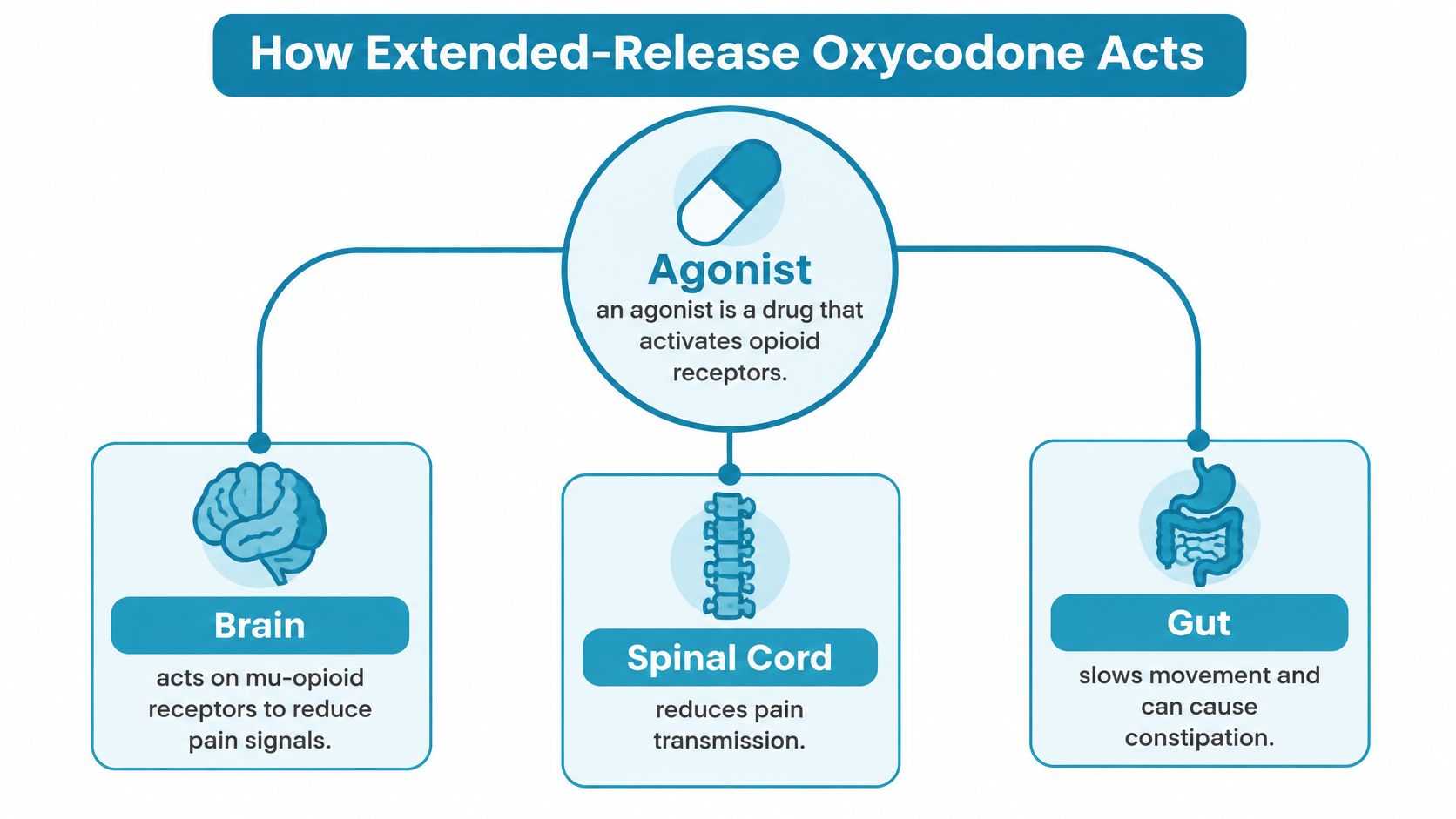
An agonist is a drug that activates opioid receptors. Oxycodone acts mainly at mu-opioid receptors, including receptors involved in pain signaling in the brain and spinal cord.
The prescribing information describes both the desired pain-relieving effects and effects on breathing and digestion. The same medicine that reduces pain transmission can reduce alertness, slow intestinal movement, and suppress the brainstem's drive to breathe.
The delivery design controls release, not every effect
An intact extended-release tablet is designed to work more like a slow drip than a cup emptied at once. The tablet's structure helps control how quickly oxycodone becomes available.
Breaking, crushing, chewing, or dissolving the tablet can disrupt that design. Rapid release can expose the body to a dangerous amount of oxycodone, including enough to cause fatal respiratory depression. Respiratory depression means breathing becomes too slow or ineffective to meet the body's needs.
Swallowing a tablet whole is a safety requirement, not merely a preference about how to take medicine.
The delivery mechanism also doesn't separate pain relief from other opioid effects. Constipation isn't unrelated to the medicine's action; opioid receptors in the gut help explain why intestinal movement can slow. Sleepiness and impaired thinking likewise deserve attention rather than being dismissed as unavoidable inconveniences.
Medical changes can alter exposure
The same prescription can have different consequences when a person's health or medication list changes. Liver disease can affect drug processing, while kidney disease can affect elimination. Older age and other medicines can also change how a person responds.
A clinician's reassessment therefore includes more than whether pain remains present:
- Alertness and breathing: New sedation or breathing concerns can signal harm.
- Digestive effects: Constipation and nausea can interfere with daily function.
- Medical changes: New illnesses may change the balance of benefit and risk.
- Other substances: Prescription medicines, nonprescription sleep products, and alcohol belong in the review.
The body may also adapt to repeated exposure. That adaptation doesn't authorize a person to increase the amount taken or shorten the interval.
A change in formulation or schedule belongs to the prescriber. A pharmacist can clarify product instructions, but difficulty swallowing or concern about a tablet's effect isn't a reason to alter its physical form.
Tolerance Dependence and Opioid Use Disorder
Tolerance, physical dependence, and opioid use disorder
| Term | What it describes | What it does not establish |
|---|---|---|
| Tolerance | A stable dose may relieve less pain or cause less sedation over time | Doesn't by itself mean addiction, and is never a reason for a reader to raise a dose |
| Physical dependence | The body adapts to regular exposure, so a sudden stop can cause withdrawal | Doesn't by itself establish opioid use disorder; it can occur with a prescribed opioid |
| Opioid use disorder | A clinical pattern that can include loss of control, craving, and continued use despite harm | Cannot be established from a prescription, a dose, or a person's appearance; requires a qualified clinician's assessment |
These distinctions matter because they lead to different clinical questions. Tolerance raises questions about changing effects. Dependence raises questions about adaptation and withdrawal. Opioid use disorder requires assessment of a broader pattern of behavior, impairment, and consequences.
The OxyContin prescribing information distinguishes tolerance and physical dependence from addiction. It also warns that patients can develop addiction during appropriately prescribed treatment, which is why neither a prescription nor adherence to a schedule answers every diagnostic question.
Withdrawal isn't a diagnosis of addiction
When physical dependence is present, abrupt discontinuation or a substantial reduction can trigger withdrawal. Symptoms can include anxiety, sweating, yawning, muscle aches, diarrhea, nausea, and poor sleep. Pain can also become harder to manage.
A person experiencing withdrawal shouldn't be labeled as having opioid use disorder on that basis alone. Equally, the absence of obvious withdrawal doesn't exclude problematic use.
Tolerance and withdrawal during medically supervised opioid treatment don't, by themselves, establish opioid use disorder. A clinician evaluates the circumstances rather than counting a prescription or observing someone's appearance.
The discussion of DSM-5 substance-use-disorder assessment provides additional diagnostic context. It isn't a substitute for an individual evaluation.
Abrupt stopping isn't automatically safer
Stopping chronic opioid therapy suddenly can cause withdrawal and destabilize pain management. A person's fear of dependence deserves a clinical conversation, not an unsupported instruction to discontinue treatment immediately.
The prescriber considers treatment response, adverse effects, other medicines, medical changes, and the person's goals. Any reduction needs an individualized plan rather than a self-directed schedule.
Physical dependence describes adaptation. Opioid use disorder describes a clinical disorder. Neither term should be used as a judgment about character.
Concern becomes especially relevant when use feels difficult to control, a person repeatedly takes more than intended, or opioid use continues despite meaningful harm. Severe pain and concerning use can coexist. A confidential assessment can examine both without assuming that one cancels out the other.
Overdose Signs Naloxone and Counterfeit Pills
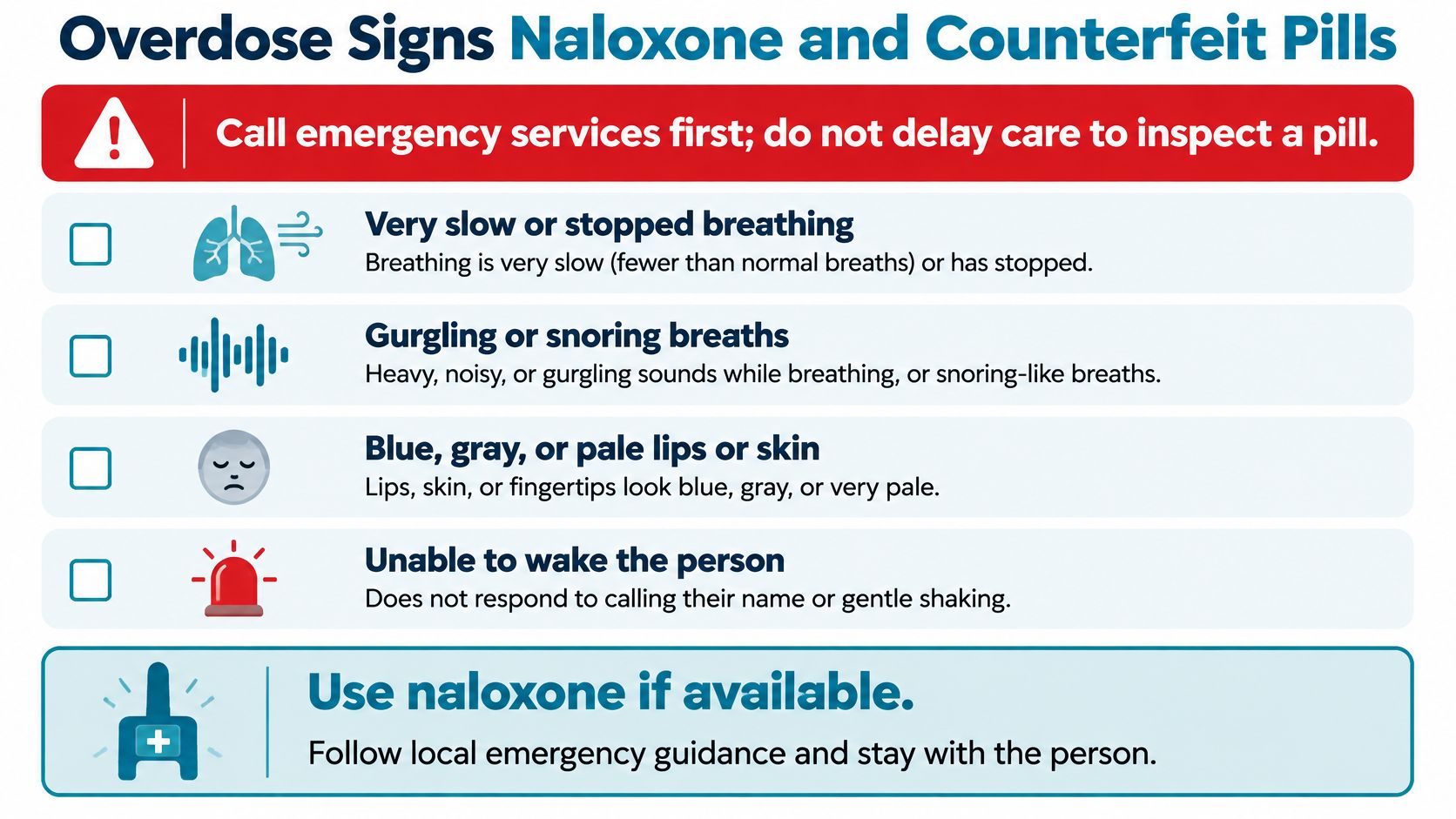
Very slow or stopped breathing, inability to awaken, abnormal gurgling or snoring breaths, or blue, gray, or pale lips or skin require emergency action. Call 911 immediately. Naloxone should be given if available, following the device instructions for use and repeat administration, while someone stays with the person until help arrives.
Naloxone temporarily reverses opioid effects. It doesn't replace emergency care, and an apparent improvement doesn't establish that the danger has passed. Pill identification must never delay the emergency response.
Opioid warning signs and the next action
| What is noticed | What it can mean |
|---|---|
| Very slow or stopped breathing, gurgling, or snoring breaths | Possible overdose emergency. Call 911 and give naloxone if available. |
| Cannot be woken or doesn't respond to voice or firm touch | Possible overdose emergency. Activate emergency care immediately. |
| Blue, gray, or pale lips or skin | Possible overdose emergency. Don't wait for additional signs. |
| Unexpected heavy sleepiness after a pill from an informal source | Possible counterfeit or contaminated pill. Inability to awaken or abnormal breathing requires emergency care. |
| Alcohol or sedatives taken with the opioid, with drowsiness | Added risk of dangerous breathing problems. Severe sedation or abnormal breathing requires emergency care. |
| Constipation, nausea, or mild sleepiness on a prescribed regimen | Effects that may need clinical follow-up. Worsening sedation needs prompt attention. |
Risk depends on more than the product name
The CDC's prescription-opioid safety information explains that overdose risk rises with dosage and that no dosage eliminates risk. Starting treatment, increasing exposure, and combining substances require particular caution.
Alcohol, benzodiazepines, sleep medicines, and other central-nervous-system depressants can compound oxycodone's effects on breathing. A prescribed sedative isn't automatically safe to combine with a prescribed opioid.
A pharmacist or clinician can explain naloxone access and device instructions to someone who might witness an overdose. The overview of naloxone and opioid-overdose response offers additional context for that discussion.
Authenticity cannot be established by appearance
Counterfeit pills create a different problem from the risks of a legitimately dispensed medicine. The DEA counterfeit-pill report describes a World Health Organization alert from February 2025 concerning falsified OxyContin 80 mg tablets found in Switzerland that contained no oxycodone and instead contained a likely nitazene compound.
That finding concerns falsified tablets, not all prescribed OxyContin. Nitazenes are synthetic opioids that may be substantially more potent than oxycodone.
Markings, color, packaging, and online seller claims can't reliably prove authenticity. Medication should come through a legitimate prescription dispensed by a licensed pharmacy. A tablet from a friend, an informal seller, or an unverified website should not be treated as authentic because it resembles a known product.
Safer Long-Term Use Without Self-Changes
Safer prescribed use requires ongoing attention, not just correct use on the day a prescription is filled. The prescriber needs to know whether the medicine still provides meaningful benefit and whether new risks have appeared.
The practical rules remain straightforward: tablets stay whole, medicine isn't shared, and breakthrough pain isn't a reason for self-escalation. OxyContin must not be crushed, chewed, dissolved, injected, or snorted.
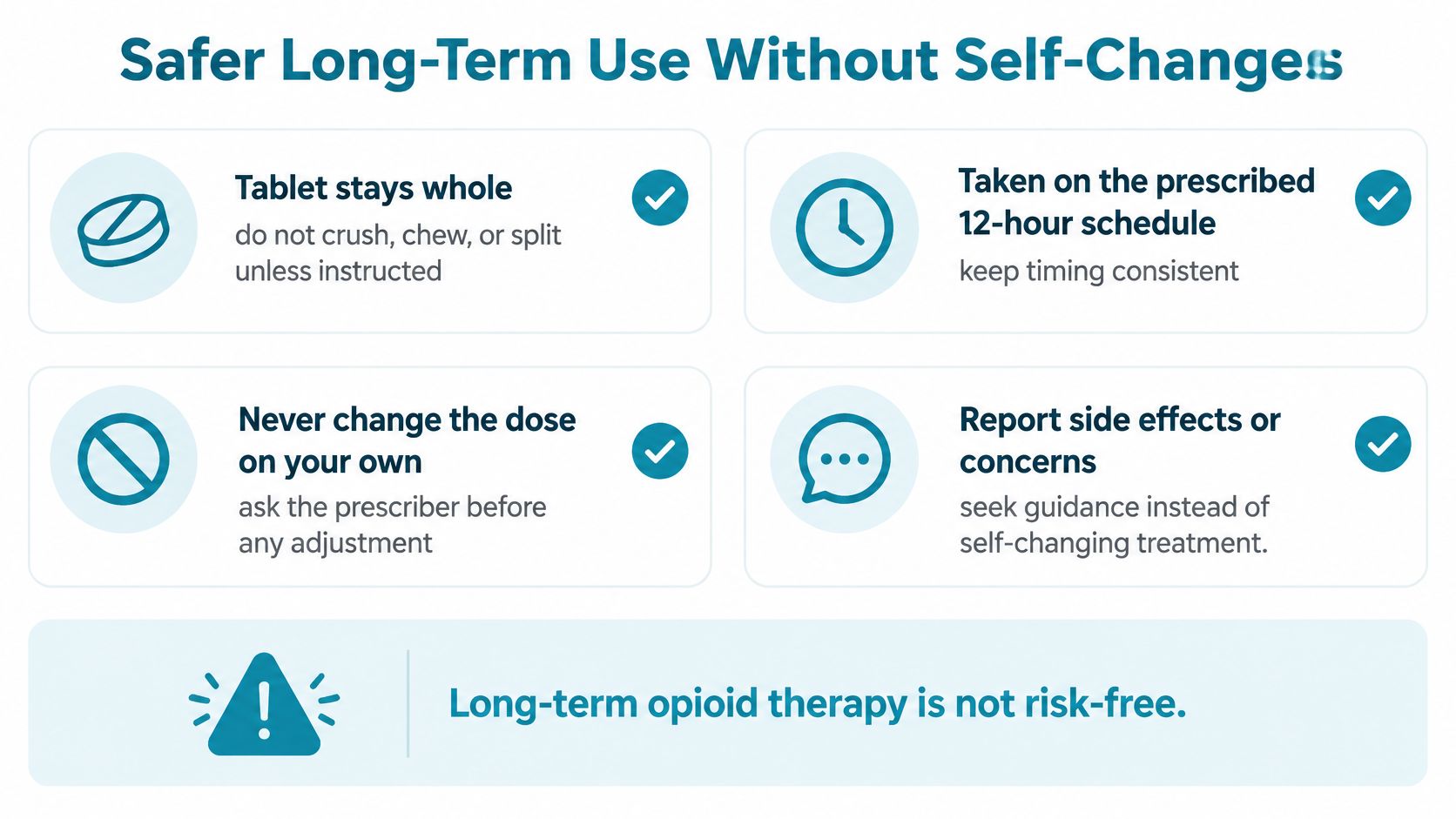
For OxyContin specifically, tablets must not be split or otherwise altered. An illustration's general wording doesn't override the product's swallowing instructions.
Storage and disposal are ordinary safeguards
Secure storage reduces the chance that another person will take the medicine accidentally or intentionally. A locked location is preferable to an accessible bathroom cabinet, countertop, handbag, or bedside drawer. Children, visitors, and pets should not be able to reach it.
Unused tablets shouldn't be saved for another person or left where someone else might find them. A pharmacist can identify an authorized take-back location or explain available mail-back options. Disposal is routine risk reduction, not an admission of misuse.
A useful home-safety checklist includes:
- Secure access: Store the medicine where only the intended patient or responsible caregiver can reach it.
- Original identification: Keep the pharmacy label available so the product and instructions remain clear.
- No sharing: Another person's pain doesn't make the prescription appropriate for that person.
- Planned disposal: Arrange safe removal of tablets that are no longer needed.
Follow-up should examine function and harm
Pain intensity is only part of the review. A prescriber also considers whether treatment supports meaningful activities, whether side effects interfere with daily life, and whether continued exposure remains justified.
The medication review should include alcohol, benzodiazepines, sleep medicines, and nonprescription products. New breathing problems, kidney or liver disease, or changes in alertness also deserve attention. Follow-up frequency is individualized; there isn't a universal adjustment schedule.
Questions for a clinical visit can remain specific:
- Benefit: Which daily activities are being used to judge whether treatment helps?
- Interactions: Which medicines or substances increase sedation or breathing risk?
- Preparedness: Should naloxone be available, and where can it be obtained?
- Unused medicine: Which authorized return or mail-back option is available?
If problematic opioid use is identified, an addiction-medicine assessment addresses a different question from pain prescribing. Information about buprenorphine in addiction medicine can support an informed discussion, but it doesn't establish that a particular medication is appropriate or that a patient should switch treatments independently.
When Confidential Outpatient Assessment Helps
An assessment can help adults who are concerned that opioid use, prescribed or otherwise, has become risky, difficult to control, or disruptive to daily life. A person doesn't need to arrive with a self-diagnosis. Uncertainty is a reasonable reason to seek an evaluation.
This is not a pain-clinic offer, and this article doesn't describe an Empire Medical Wellness OxyContin pain-prescribing service. The relevant service is confidential outpatient addiction-medicine assessment.
What an evaluation can clarify
Empire Medical Wellness begins with an assessment of the patient's current situation, medical risks, previous treatment, medications, and goals. The initial evaluation includes an explanation of appropriate options and next steps.
Useful preparation can include a current medication list, a description of opioid use, prior treatment information, and the concerns that prompted the appointment. The purpose is to establish an accurate medical picture, not to test whether someone uses the right diagnostic language.
The guide to a first addiction-medicine appointment explains the evaluation process. Evidence-based medication may be considered when clinically appropriate, but an appointment doesn't guarantee a prescription.

Illustrative image, not an identified Empire Medical Wellness patient or clinician.
The appropriate setting depends on medical need
Outpatient assessment doesn't mean every person should receive outpatient treatment. When detoxification, residential treatment, partial hospitalization, intensive outpatient treatment, or another level of support is clinically appropriate, Empire Medical Wellness can help coordinate the next step with trusted treatment partners.
Follow-up and coordination with other treating professionals can support a coherent plan when clinically useful and authorized. The assessment should clarify what can be addressed in outpatient care and what requires another setting.
Slow breathing or unresponsiveness requires emergency care, not an outpatient appointment. The emergency response is to call 911 and administer naloxone if available.
Sources
- DailyMed, OxyContin prescribing information, including approved use and boxed safety warnings.
- FDA, OxyContin prescribing information and pharmacokinetic labeling.
- CDC, opioid-prescribing and prescription-opioid safety materials.
- DEA, counterfeit-pill reporting describing the WHO falsified-OxyContin alert.
Byline: Empire Medical Wellness Editorial Team
Publication: 2026
Updated: 2026
This article is educational and isn't personal medical advice. Medication decisions require an individualized evaluation by the treating clinician.
Empire Medical Wellness offers confidential, physician-led outpatient addiction-medicine assessment for adults concerned about opioid use, medical risks, or recovery. For an evaluation of the current situation and appropriate next steps, visit Empire Medical Wellness.