
Does a medicine list explain whether treatment is helping, or only what was prescribed? A psychiatric medication management worksheet pairs labeled prescriptions with observed benefits, burdens, daily functioning, and questions for the next clinical decision. The blank tables below are an adult patient tool for appointment preparation, not a diagnostic test or a clinician's charting template.
Table of Contents
- Record Your Prescribed Medicines as Labeled
- Add Supplements, Over-the-Counter Products and Allergies
- Track Target Symptoms and Daily Functioning
- Log Observed Effects With Dates
- Note Access Barriers and Missed-Dose Concerns
- Three Questions to Bring to Follow-Up
- Bring the Record to Your Next Visit
- Sources, Review Status and Dates
Record Your Prescribed Medicines as Labeled
Copy these tables into a private notes app or print them for completion before the appointment. Each prescribed medicine needs its own row, including prescriptions from clinicians outside mental health care.
Prescribed medicines as recorded on labels
| Medicine name (as on label) | Prescribed dose and schedule | Prescriber | Purpose, if known |
|---|---|---|---|
| Medicine 1 | |||
| Medicine 2 | |||
| Medicine 3 | |||
| Medicine 4 |
Start with the exact medicine name on the pharmacy label, including combination products. Copy the prescribed dose and schedule without translating or simplifying them. Add the route, such as by mouth or by injection, when the label states it.
The prescriber column identifies the clinician responsible for that prescription. The purpose column can remain blank when the reason isn't clear. Guessing may make the record less useful than acknowledging uncertainty.
Keep the label and actual use distinct
This table records what was prescribed, not necessarily what was taken. Differences belong in the access and missed-dose table, rather than being substituted for the label instructions.
Recording rule: Copying a prescribed dose documents an existing prescription. It isn't advice to choose or change a dose.
Add rows as needed. Recently stopped medicines can be listed separately with the stop date and any known explanation from the treating clinician.
Before the first visit, Empire Medical Wellness asks for an updated medication list, pharmacy information, relevant laboratory results or records, and contact information for other clinicians involved in care. For background on a particular medication category, the practice's antidepressants guide offers a separate reading resource.
Add Supplements, Over-the-Counter Products and Allergies
A prescription list can be accurate yet incomplete. Cold remedies, sleep products, vitamins, herbal products, and medicines used only occasionally belong in the record too.
Supplements, over-the-counter products and allergies
| Product or allergy | Type | How often and how much | Reason or reaction noted |
|---|---|---|---|
| Product 1 | Over-the-counter, supplement or herbal | ||
| Product 2 | Over-the-counter, supplement or herbal | ||
| Product 3 | Over-the-counter, supplement or herbal | ||
| Allergy or intolerance 1 | Allergy or intolerance | Not applicable |
For products, copy the package name and record actual use, including occasional use. Include recently discontinued products and their stop dates when known. Eye drops, creams, and other non-tablet products shouldn't be overlooked.
For an allergy or intolerance, describe the observed reaction and approximate timing rather than assigning a new medical label. An intolerance is an unwanted effect that doesn't necessarily represent an allergy; the clinician can clarify how it should be recorded.
Make uncertainty visible
Medication reconciliation means establishing an accurate current list, comparing it with the list being used for care, and resolving differences. The NICE medicines optimisation guideline provides this definition and recommends documenting changes.
A hypothetical discussion question could concern whether an herbal sleep product interacts with an existing prescription. That question needs the full product name and the complete medicine list, not just the word “supplement.”
- Other exposures: Record alcohol and other substances without judgment.
- Unclear entries: Flag uncertain ingredients or amounts for pharmacist review.
- Product questions: Discuss proposed product changes with the clinician or pharmacist rather than treating nonprescription status as proof of safety.
Track Target Symptoms and Daily Functioning
Choose a small set of concerns in everyday language. Trouble falling asleep, worry before work, low energy, and difficulty concentrating are more useful starting points than an assumed diagnosis.
Target symptoms and daily functioning
| Target symptom or concern, in your words | Daily activities affected | Change since last visit | Date noted |
|---|---|---|---|
| Concern 1 | |||
| Concern 2 | |||
| Concern 3 | |||
| Concern 4 |
Fill in the concern first, then describe what happens during an ordinary day. The activities column might address work, school, household tasks, relationships, sleep routines, or leaving home. Use better, the same, worse, or unsure for change, with a short explanation when helpful.

Illustrative image, not an Empire Medical Wellness patient or a representation of psychotherapy services at the practice.
Separate a symptom from its practical impact
A baseline is the starting description used for later comparison. For a first visit, the change column can say that no earlier comparison is available. There's no need to reconstruct a precise history from uncertain memory.
In a hypothetical example, a person might report less worry while still avoiding work meetings. Another person might resume household tasks while continuing to feel low. These observations describe different aspects of progress, and neither should be erased to make the account sound consistent.
The NICE recommendations on structured medication review emphasize medicine effectiveness, safety, patient concerns, and agreement about documented changes. This UK guidance supplies a review framework, not a patient-specific treatment recommendation.
Identify what matters most
Mark whether each concern was an original treatment goal or appeared later. A new concern isn't automatically a medication effect, and an unchanged concern doesn't establish that a medicine has failed. The clinician needs the broader medical and treatment history to interpret both.
Useful details include:
- The activity affected: Describe a task or situation rather than writing only “functioning.”
- The direction of change: Record uncertainty when experiences differ across days.
- The personal priority: Identify the concern that most affects daily life.
- The comparison point: Keep the date attached to the observation.
A symptom can improve without daily life improving to the same degree. Both observations belong in the discussion.
This worksheet doesn't require diagnostic scoring or comparison with another person. Any clinical scale requested by the treating clinician is a separate assessment.
If appetite or weight changes are among the concerns, the practice's psychiatric medication and weight gain guide provides focused background. Recording such concerns doesn't establish their cause.
Log Observed Effects With Dates
Dates help a clinician examine the order of events. An observation made after a prescription change is worth recording, but timing alone doesn't establish that the medicine caused it.
Dated log of observed effects
| Date | Observed effect, in your words | Helpful, bothersome or unclear | Question for your clinician |
|---|---|---|---|
| Entry 1 | |||
| Entry 2 | |||
| Entry 3 | |||
| Entry 4 | |||
| Entry 5 |
Replace each entry label with the observation date. Include changes in sleep, appetite, energy, mood, concentration, restlessness, dizziness, sexual function, or other concerns. Note whether an effect comes and goes or persists, and include a recent prescription-change date when known.
Record observations without assigning a cause
A STAR*D analysis published in Neuropsychopharmacology described structured collection of depression symptoms and side-effect frequency, intensity, and burden at treatment visits. That clinical approach supports keeping response and unwanted effects visible together; it doesn't validate this patient worksheet as a treatment intervention.
An entry can describe something helpful and bothersome at the same time. A hypothetical observation might describe improved sleep alongside morning grogginess, with a question about how the clinician will evaluate that tradeoff.
- Medication decisions: The log isn't a reason to independently change, skip, or reschedule doses.
- New concerns: Significant new symptoms warrant prompt clinician contact rather than waiting to complete the worksheet.
- Urgent symptoms: Severe or sudden symptoms require urgent assessment, not a future appointment note.
The practice's depression medication guide provides condition-focused background without replacing individual assessment.
Note Access Barriers and Missed-Dose Concerns
Missed doses aren't always a matter of forgetting. Cost, refill timing, pharmacy access, travel, shift work, confusing instructions, and unwanted effects can all be relevant topics for discussion.
The record should describe what happened without blame. “Trouble obtaining the refill” gives the clinician different information from “medicine available but difficult to fit into the routine.”
Access and missed-dose discussion record
| Medicine or concern | What made use or access difficult | Pattern or dates noticed | Question and person to contact |
|---|---|---|---|
A useful entry identifies the obstacle, when it occurred, and whether it's ongoing. Approximate frequency is acceptable when exact dates aren't available, provided it's clearly labeled as an estimate. The purpose is to make the account understandable, not to grade adherence.
Describe patterns rather than inventing fixes
A clearly hypothetical example is a person whose prescribed evening medicine is frequently missed during work travel. The worksheet can capture the travel pattern and the uncertainty about what to do. It shouldn't supply a new dosing schedule.
Other details worth recording include:
- Refill access: Whether a prescription couldn't be obtained or a pharmacy question remains unresolved.
- Instructions: Whether the label and remembered verbal instructions seem different.
- Treatment burden: Whether an unwanted effect makes following the plan difficult.
- Communication: Whether another prescriber has changed a medicine and the current clinician may not know.
No blame, no guesswork: An accurate account of actual use is more useful than a record designed to appear perfect.
Missed-dose questions belong with the prescriber or pharmacist because the answer is medication-specific. This worksheet provides no instructions to skip, double, replace, or move a dose.
A concern about continuing treatment also belongs here. Hesitation, uncertainty about benefit, and difficulty accepting a burden deserve an explicit discussion rather than being recorded only as failure to follow instructions. The clinician can consider actual use when interpreting the response and planning the next conversation.
Three Questions to Bring to Follow-Up
A medication record becomes more useful when it supports a shared decision. Shared decision-making means that the clinician explains reasonable options while the patient contributes priorities, concerns, and preferences.
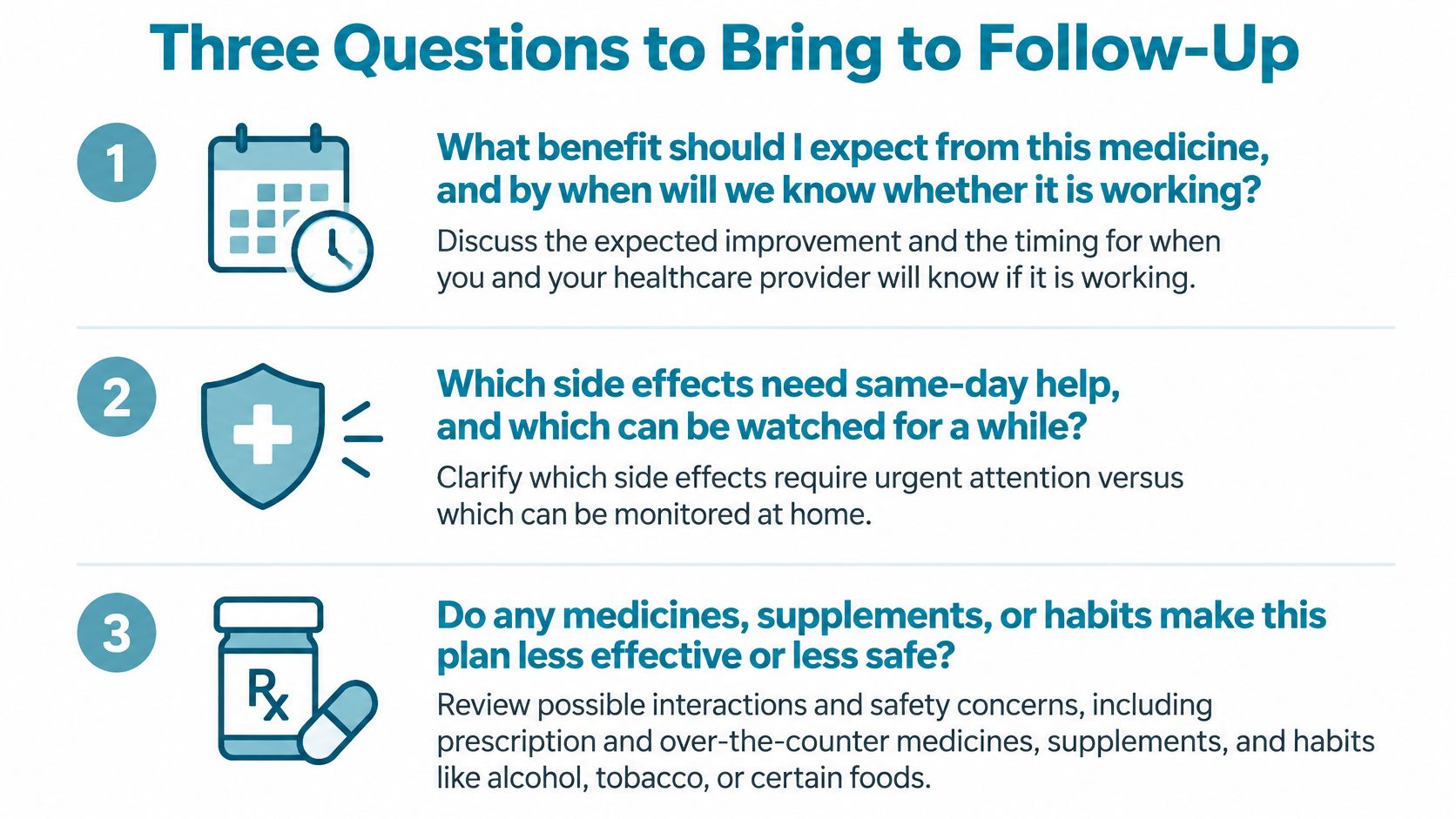
- What benefit should be expected from this medicine, and when will its effect be reviewed?
This connects treatment to an observable goal and a planned reassessment. - Which side effects require same-day help, and which can be observed under an agreed plan?
This clarifies whom to contact and what action the clinician recommends. - Could medicines, supplements, or habits make the plan less effective or less safe?
This brings the complete list and actual use into the safety discussion.
Follow-up answers
| Question | Clinician's explanation | Agreed next step and review point |
|---|---|---|
| Expected benefit and timing | ||
| Side effects and contact plan | ||
| Interactions and safety |
Document the next decision
SAMHSA's guidance on psychiatric medication and nonpharmacological treatments emphasizes understandable information about benefits, adverse effects, monitoring, discontinuation symptoms, and risks of abrupt cessation. A follow-up discussion should therefore address whether to maintain or reconsider treatment, not merely whether prescriptions were taken.
| Decision topic | Agreed plan |
|---|---|
| Benefit and burdens that matter most | |
| Monitoring needed, responsible clinician, and due date | |
| Next decision and what would prompt earlier review |
The NIMH mental health medications guide offers U.S. patient background on medication discussions and precautions. The practice's guide to the pros and cons of mental health medication addresses the broader benefit-burden conversation.
At Empire Medical Wellness, follow-up frequency and appointment length depend on the treatment plan, medication needs, and progress. An unchanged prescription can still represent an active, explained decision.
Bring the Record to Your Next Visit
The completed record should travel with the patient, not remain scattered across messages and remembered conversations. A printed copy or a privately stored device copy can keep the discussion focused on the concerns that matter most.

Illustrative image; the model isn't identified as an Empire Medical Wellness patient.
Prepare the materials and protect privacy
- Gather supporting items: Bring medicine labels or bottles and supplement packages so unclear names can be checked.
- Identify priorities: Mark the questions that need attention during the visit.
- Use a secure channel: Keep personal health information out of public comments, ordinary contact forms, and unsecured email.
- Clarify communication: Contact the clinician or pharmacist directly for medication questions, using the designated clinical communication process.
Empire Medical Wellness's first mental health appointment is 50 minutes and addresses symptoms, medical and treatment history, current medicines, daily functioning, and goals. The patient receives an explanation of the clinical assessment, treatment options, and recommended follow-up.
The mental health medication review guide explains what a review involves. The mental health medication management service page describes evaluation and ongoing care, while fees and how appointments work and appointment scheduling address practical arrangements.
An incomplete worksheet is still worth bringing. Blank fields can identify questions that need clarification rather than becoming a reason to postpone a conversation.
Sources, Review Status and Dates
Byline: Empire Medical Wellness Editorial Team
Publication date: Not yet published
Updated date: Not yet assigned
Clinical review: Pending. Qualified clinical review is required before publication. No reviewer is attributed until that person completes and documents the review.
Sources and scope
- National Institute of Mental Health: Mental Health Medications, linked above, provides U.S. patient education context.
- SAMHSA: Psychiatric medication and nonpharmacological treatment guidance, linked above, supports informed discussion of benefits, burdens, monitoring, and discontinuation.
- NICE: Medicines optimisation guidance and recommendations, linked in their relevant sections, provide UK definitions and a structured review framework.
- Neuropsychopharmacology: The STAR*D analysis linked above provides historical measurement-based care context. It isn't evidence that this worksheet independently improves outcomes.
- Centre for Clinical Interventions: The CCI Medication Record, from Western Australia, provides recording context only. The tables here use original wording and layout and aren't limited to bipolar disorder.
Publication checks
The existing medication-review guide remains the destination for understanding the review itself; this page serves the separate purpose of patient record preparation. A live-site check for overlapping titles and slugs, confirmation of citation details and image suitability, and qualified clinical review remain necessary before publication. Publication and update dates should reflect completed editorial actions, not planned dates.
Empire Medical Wellness offers physician-led mental health evaluation, medication management when appropriate, and follow-up care. Adults preparing to discuss medication benefits, burdens, and next steps can visit Empire Medical Wellness to learn about the practice. This article is educational and isn't personal medical advice.