
You start a psychiatric medication, or the dose changes, and the scale moves in a direction you didn't expect. That can feel discouraging fast. The right response is not to quietly stop the medicine. It's to set up a joint medication and weight review with the prescriber, bring your numbers, and decide what to monitor next.
Psychiatric medication and weight gain is real, but it's not uniform. Some medicines carry a much higher metabolic burden than others, and the first step is to separate a normal early change from a pattern that needs action. A careful review is safer than self-adjusting treatment, especially when the medication is helping mood, anxiety, psychosis, or sleep.
Table of Contents
- Why a Joint Medication and Weight Review Matters
- How Weight Effects Vary Across Psychiatric Medications
- Baseline Numbers and the First-Year Monitoring Schedule
- Preventing Gain Early and Treating Established Gain
- A One-Month Tracking Log and Questions for the Clinician
- What Not to Change on Your Own and When to Call Sooner
- Questions Patients Commonly Ask
Why a Joint Medication and Weight Review Matters
The most common mistake is treating a psychiatric medication like a simple on-off switch. It isn't. Weight change can show up after a new start, a dose change, or a switch, and the safest next step is a structured conversation with the prescriber, not an unsupervised change at home. A joint medication and weight review means the medication choice, the weight trend, appetite, sleep, blood pressure, and lab work are all considered together.
That matters because the issue is bigger than the scale. Antipsychotics can affect blood glucose, cholesterol, triglycerides, and blood pressure, so the goal is to look at the full metabolic picture, not just body size. The monitoring approach used in the medical literature starts with baseline history, weight, BMI, waist circumference, blood pressure, fasting glucose, and fasting lipids, then follows changes over time. A practical outline of that kind of review is available on the mental health medication review page.
Practical rule: bring concerns to the person prescribing the medicine before making any change on your own. The risk is not only weight gain, it's also relapse, withdrawal, or losing a medication that is otherwise working.
The right room for this discussion is usually the prescriber's office, with the patient in the center of it. A primary care clinician can also help track metabolic risk, especially when weight, glucose, or lipids are changing. What matters most is coordination. One clinician should be looking at the psychiatric benefit and the metabolic cost at the same time.
The article's purpose is simple. It's preparation for that conversation, not a substitute for it.
How Weight Effects Vary Across Psychiatric Medications
Not every psychiatric medicine behaves the same way. That point sounds obvious, but it gets missed in real life, and it leads people to assume the weight gain is either inevitable or imaginary. The evidence says neither is true. Weight effects differ by drug, duration of use, and patient factors.
The clearest example is antipsychotic medication. A large 2019 systematic review and network meta-analysis of 116 randomized studies involving 28,317 adults compared 32 oral antipsychotics, and the average weight effects were not uniform across the class. In that analysis, 12 of 26 drugs with usable weight data caused statistically greater gain than placebo, and the average differences ranged from 0.54 kg for haloperidol to 3.21 kg for zotepine (Lancet meta-analysis31135-3/fulltext)). Olanzapine, zotepine, and sertindole were among the medications associated with the greatest increases.
A second review found that antidepressant-associated weight gain also varies, and that many studies reported an increased risk of gaining at least 5% of baseline body weight during therapy (systematic review of cohort studies). That same body of evidence also found that bupropion was associated with weight loss in the reviewed studies, while other medications showed larger gains in some patients. The point is not that one drug is always “bad” and another is always “safe.” It's that the metabolic conversation has to be drug-specific.
Relative Weight Effect of Common Psychiatric Medications
| Medication | Class | Typical average weight effect | Notes for the review conversation |
|---|---|---|---|
| Olanzapine | Antipsychotic | Higher average gain | Often linked with substantial weight gain and metabolic monitoring needs |
| Clozapine | Antipsychotic | Higher average gain | Among the highest-risk options, especially over longer treatment |
| Quetiapine | Antipsychotic | Moderate to higher gain | Weight change can still be clinically meaningful |
| Risperidone | Antipsychotic | Moderate gain | Lower than the highest-risk agents, not weight-neutral |
| Aripiprazole | Antipsychotic | Lower average risk | Lower risk does not mean no risk |
| Ziprasidone | Antipsychotic | Lower average risk | Often discussed when weight effects matter |
| Bupropion | Antidepressant | Often neutral or weight loss in reviewed studies | Useful to discuss when weight is a major concern |
| Other antidepressants | Antidepressant | Variable | Duration, recovery of appetite, and the person's baseline all matter |
The same conclusion shows up in a large analysis of clinically relevant weight gain, defined as at least a 7% increase from baseline. In that review, 76.3% of people taking clozapine for more than 38 weeks met that threshold, compared with 36.9% on olanzapine, and 17.2% on aripiprazole (analysis of clinically relevant weight gain). Those numbers show why a lower-risk label is not the same as zero risk.
Population averages help with planning. They do not predict one person's outcome.
If the current regimen includes an antipsychotic or antidepressant and weight has changed, the useful question is not “Which drug causes weight gain?” It's “How much risk does this specific medication carry for this specific person, and what should be watched next?” That is the right conversation to have in a medication review, including discussion of antidepressants.
Baseline Numbers and the First-Year Monitoring Schedule
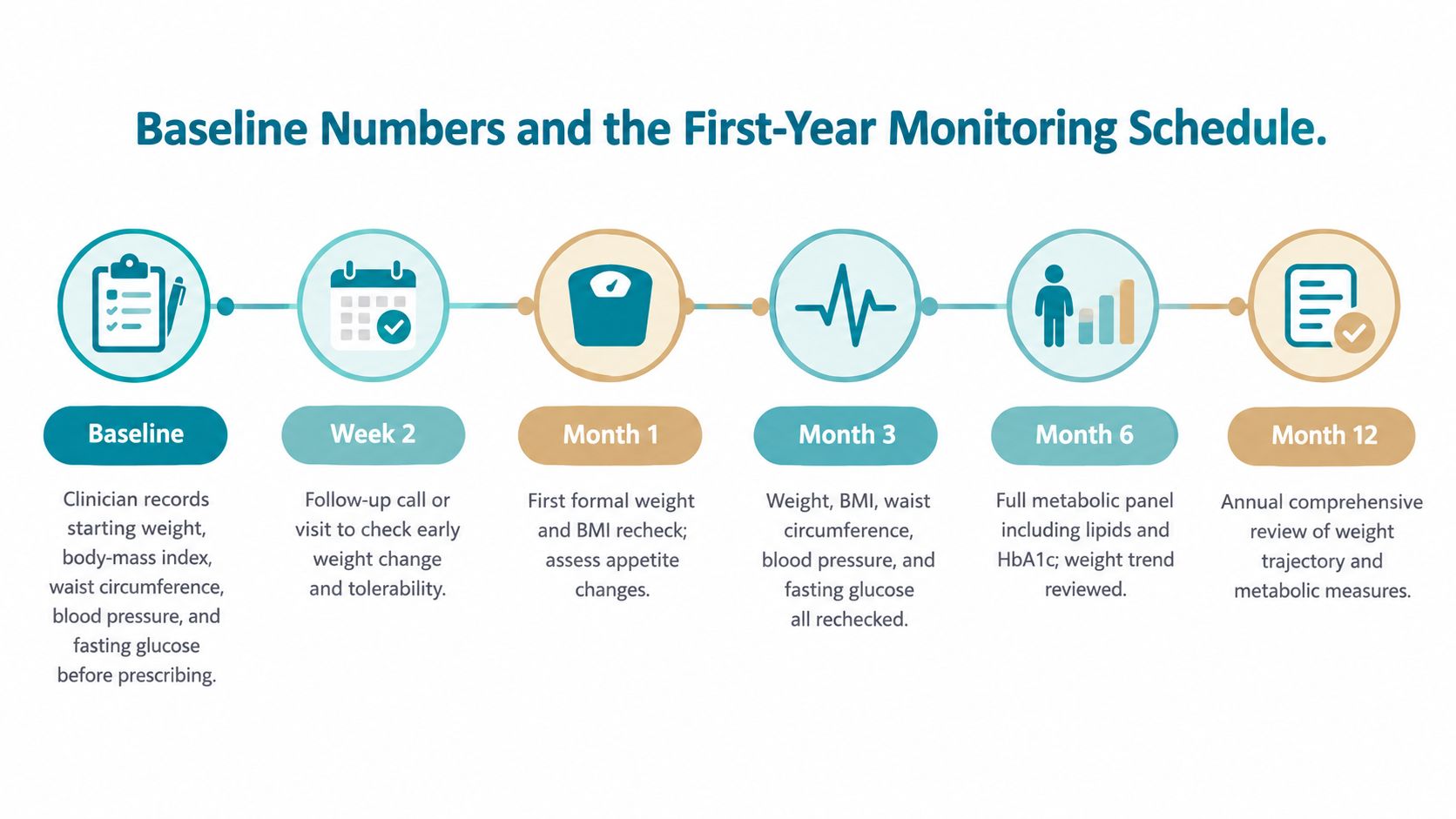
Good monitoring starts before the first dose, or as close to it as possible. Clinicians typically want a starting point for weight, BMI or body-mass index, waist circumference, blood pressure, and either fasting glucose or HbA1c plus fasting lipids. Those numbers help separate a short-term fluctuation from a meaningful metabolic shift.
The timing matters because early gain can happen fast. A clinical review describes a schedule of weight checks at baseline, 4 weeks, 8 weeks, and 12 weeks, then every 3 months after that (NCBI review). Another review of antipsychotic monitoring recommends reassessing weight, BMI, blood pressure, glucose, and lipids at 12 weeks, with weight every 3 months thereafter, blood pressure and fasting glucose annually, and fasting lipids every 5 years (metabolic monitoring review). The exact cadence can vary by medication and clinical judgment, but the principle is the same, catch change early.
What to bring to the appointment
Bring whatever you already have, even if it's incomplete. A home log, an after-visit summary, a patient portal screenshot, or a lab printout is useful.
- Starting weight and recent weights: the prescriber needs the trend, not just a single scale reading.
- Any recent blood sugar or cholesterol results: these help show whether the change is cosmetic, metabolic, or both.
- A list of current psychiatric and nonpsychiatric medicines: several drugs can affect appetite or metabolism.
- Notes about appetite, sleep, and energy: these often explain why weight changed before the labs do.
The point of gathering numbers is not to self-diagnose. It's to make the next review more accurate.
Preventing Gain Early and Treating Established Gain
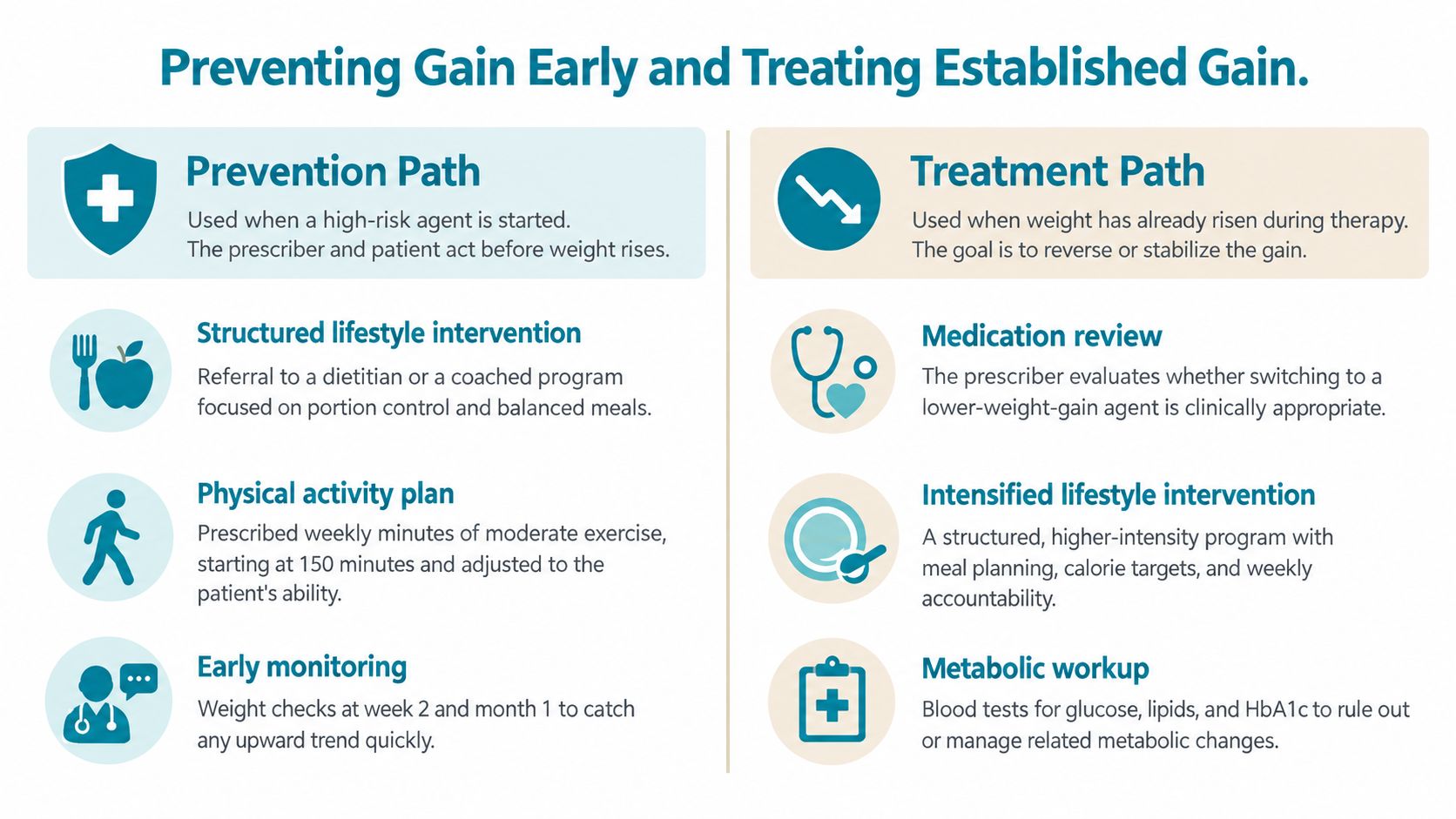
There are two different clinical paths. Prevention applies when a high-risk medication is being started. Treatment applies when the weight gain has already happened. They overlap, but they are not identical.
For prevention, the most effective foundation is still structured lifestyle support. That means a realistic eating plan, regular movement, sleep attention, and early weight tracking, not vague advice to “eat better.” It also means acting before a large gain accumulates. In a 2025 systematic review and meta-analysis, starting metformin at the same time as an antipsychotic reduced weight gain by about 4.03 kg compared with control, though the certainty was low to moderate (2025 prevention review). That is a clinician-led strategy, not a do-it-yourself fix.
For established gain, metformin remains one of the better-studied add-on options. An updated systematic review of 20 double-blind placebo-controlled studies involving 1,070 patients found a mean between-group weight difference of −3.32 kg and a BMI difference of −1.24 kg/m², with benefit usually maintained across 12 to 24 weeks (metformin review). A second meta-analysis of 6 randomized trials involving 732 patients found that metformin plus lifestyle intervention outperformed metformin alone, lifestyle intervention alone, or placebo.
What that means in plain language
Metformin can help, but it is not magic. It works best as part of a broader plan that includes food structure, activity, and metabolic monitoring. It also needs the prescriber to weigh renal function, pregnancy status, contraindications, and drug interactions.
Side effects matter too. In the randomized trial meta-analysis, nausea or vomiting occurred in about 14% and diarrhea in about 7% (metformin meta-analysis). That is one reason a clinician should guide the decision rather than turning metformin into a reflexive replacement for psychiatric medication review.
If the conversation is about a broader medication-and-metabolic plan, a physician-led visit can also cover weight-management options through obesity medicine care. The key is that the psychiatric prescription still has to be judged on psychiatric benefit and safety, not just the number on the scale.
For readers comparing online advice, a resource such as mushroom coffee weight loss evidence can be a useful example of how marketing claims should be separated from actual clinical evidence. The same standard should apply here.
A One-Month Tracking Log and Questions for the Clinician
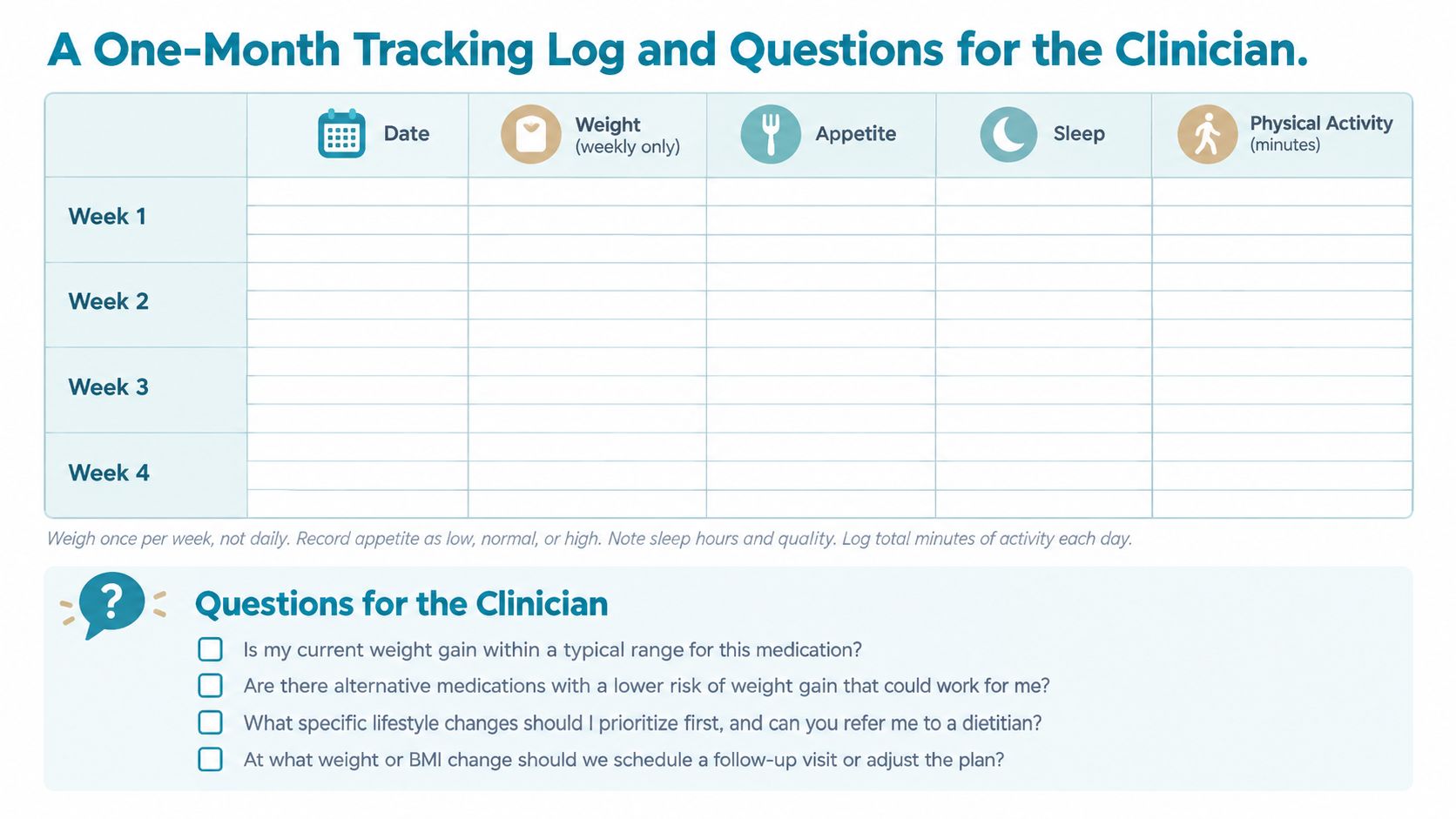
A simple one-month log helps the next visit go better. The point is not daily weigh-ins and obsession. The point is one weekly weight, plus a few consistent observations that make patterns easier to see.
Use this as a template.
One-month tracking log
- Week 1: weight, appetite, sleep, activity minutes, side effects
- Week 2: weight, appetite, sleep, activity minutes, side effects
- Week 3: weight, appetite, sleep, activity minutes, side effects
- Week 4: weight, appetite, sleep, activity minutes, side effects
Keep the notes brief. Record appetite as low, normal, or high. Track sleep hours and whether sleep feels restful. Write down total physical activity minutes for the day or week, depending on what's easiest to keep up.
Simple rule: the best log is the one that gets completed every week, not the one that looks perfect on day one.
Bring questions that force a useful answer. These work well:
- Is this weight change typical for this medication, or is it faster than expected?
- What baseline labs or measurements should be reviewed before the next decision?
- Are there lower-weight-gain alternatives that still fit the psychiatric goal?
- At what point would you want a medication review, a metabolic workup, or both?
That last question matters. Some situations call for medication review alone, some call for lab work, and some need both. A good visit makes that distinction clear.
What Not to Change on Your Own and When to Call Sooner
Weight gain is frustrating, but self-adjusting a psychiatric medication is a bad trade. Skipping doses, cutting pills, or stopping abruptly can bring back the very symptoms the medicine was controlling. If the medication is helping, the goal is to review it, not sabotage it.
A clinical review notes that a 5% increase above baseline during the first month should prompt reconsideration of therapeutic options or weight-management strategies (NCBI review). That does not mean the medicine should be stopped by the patient. It means the prescriber should be looped in early, while the change is still small enough to address.
Routine sooner follow-up makes sense if any of these happen:
- Rapid early gain
- New appetite increase or sleep disruption
- Persistently high home blood pressure readings
- Abnormal glucose or lipid results
Those are appointment issues, not emergencies.
Emergency care is different. Severe agitation, suicidal thoughts, confusion, fever with muscle rigidity, or symptoms concerning for serotonin syndrome or neuroleptic malignant syndrome need urgent medical attention right away. If there's any doubt about safety, emergency services are the right call.
For a medication-focused risk and benefit review, the pros and cons of medication for mental illness can help frame the discussion without pretending weight is the only issue. The better question is whether the treatment still makes sense overall.
Questions Patients Commonly Ask
Does the weight effect depend on dose?
Sometimes, but not reliably enough to assume a lower dose solves the problem. The medication, the length of treatment, and the person's baseline risk all matter. A prescriber should be the one to judge whether dose, timing, or a medication review is the right move.
How long does early gain usually last?
Early gain often shows up in the first several months, which is why the monitoring schedule starts right away. The trend can slow, stabilize, or continue, and the only honest answer is to follow the numbers rather than assume.
Does switching to a lower-risk medication usually help?
It can help, but it isn't automatic and it isn't risk-free. A switch only makes sense if the new drug still fits the psychiatric goal and the prescriber thinks the change is safe.
What if a lot of weight has already come on?
That calls for a joint medication and metabolic review, not shame. The next step is usually to review the current regimen, check metabolic labs, and decide whether lifestyle support, a medication add-on, or a different psychiatric option is appropriate.
If psychiatric treatment and weight are both part of the concern, the most useful next step is a clinician visit that reviews the medicine, the labs, and the timeline together. Empire Medical Wellness offers physician-led mental health medication review and follow-up for adults who need a careful, private conversation about what's helping, what isn't, and what needs monitoring. Visit Empire Medical Wellness to review the relevant service page and decide whether a medication discussion is the right next appointment.
Empire Medical Wellness Editorial Team
Published: 2026-10-08
Updated: 2026-10-08
Sources
- 2019 Lancet systematic review and network meta-analysis31135-3/fulltext)
- Systematic review of antidepressant-associated weight gain
- Metformin meta-analysis for antipsychotic-associated weight gain
- Updated systematic review of metformin for established gain
- 2025 prevention-focused review
- Clinical review on early monitoring
- Metabolic monitoring review
- Clinically relevant weight gain analysis
This article is educational and not personal medical advice. If symptoms feel urgent or unsafe, seek immediate medical care.