Naloxone is a safe, fast-acting medication that temporarily reverses opioid overdose by restoring breathing. It's an emergency bridge, so call 911 immediately, and remember that naloxone does not treat the underlying opioid use disorder.
You may be reading this because someone you care about uses opioids, has recently returned to use, or keeps medication at home after a prior overdose. Knowing what naloxone can and can't do helps you respond without judgment or delay. The medication can restore breathing, but emergency evaluation and ongoing medical care remain essential.
Byline: Empire Medical Wellness Editorial Team
Published: September 28, 2026
Updated: September 28, 2026
Table of Contents
- Recognizing an Opioid Overdose Emergency
- How Naloxone Works and Its Public Health Evolution
- Step by Step Administration and Rescue Breathing
- Comparing Nasal Spray and Injectable Formulations
- Navigating Access Costs and Pharmacy Availability
- Integrating Reversal into Long Term Addiction Care
- Caregiver Preparedness and Next Steps
Recognizing an Opioid Overdose Emergency
An opioid overdose can look like profound sleep, but it isn't ordinary sleep. The person may not respond when you call their name or tap their shoulder. Their breathing may be slow, shallow, irregular, or absent. Their lips or fingertips may look blue or gray, and their pupils may be unusually small.
A person doesn't need to show every sign. If opioid overdose is possible and the person is unresponsive or breathing abnormally, treat it as an emergency. Illicit fentanyl and other synthetic opioids can make the situation difficult to predict. You can learn more about fentanyl and overdose risk through this fentanyl education resource.
What to do first
Check responsiveness. Speak loudly and tap the person's shoulder. Don't waste time trying to determine exactly what was taken.
Call 911. Put the phone on speaker if possible. Tell the dispatcher that the person may have overdosed and give the location. Emergency responders need to know where to find you.
Give naloxone if an opioid overdose is suspected. Use the available nasal spray or injectable product according to its labeled directions. Naloxone works only when opioids are contributing to the emergency, but it's appropriate to give it when an opioid overdose is reasonably suspected.
Support breathing. If the person isn't breathing normally, follow the dispatcher's instructions for rescue breathing or CPR. Breathing support matters because naloxone can't supply oxygen while you're waiting for it to work.
Stay with the person. If they begin breathing but remain drowsy, place them on their side when practical and monitor them. Don't let them use more substances to overcome withdrawal or sedation.
Emergency rule: Naloxone can restore breathing temporarily, but it doesn't replace 911, observation, or hospital care.
Naloxone may cause a person who is physically dependent on opioids to wake abruptly and experience withdrawal, including agitation, nausea, sweating, or body aches. Those symptoms can be distressing, but the immediate priority is restoring adequate breathing and obtaining emergency help. Don't respond to agitation by abandoning the person or allowing them to take more opioids.
How Naloxone Works and Its Public Health Evolution
Naloxone is a competitive opioid receptor antagonist. Opioids can slow or stop the brain's signal to breathe. Naloxone competes for opioid receptors and can displace opioids enough to reverse opioid-induced respiratory depression, the medical term for dangerously slowed breathing. The FDA labeling states that intravenous onset is generally apparent within 2 minutes, with somewhat slower onset through intramuscular, subcutaneous, or intranasal routes (FDA naloxone labeling).
The effect is temporary. NIDA states that naloxone's effects last about 30 to 90 minutes, which can be shorter than the effects of many opioids (NIDA overdose prevention information). That difference explains why a person can appear better and then become sleepy or stop breathing again. Emergency services are still necessary even after the person wakes.
From clinical medication to community protection
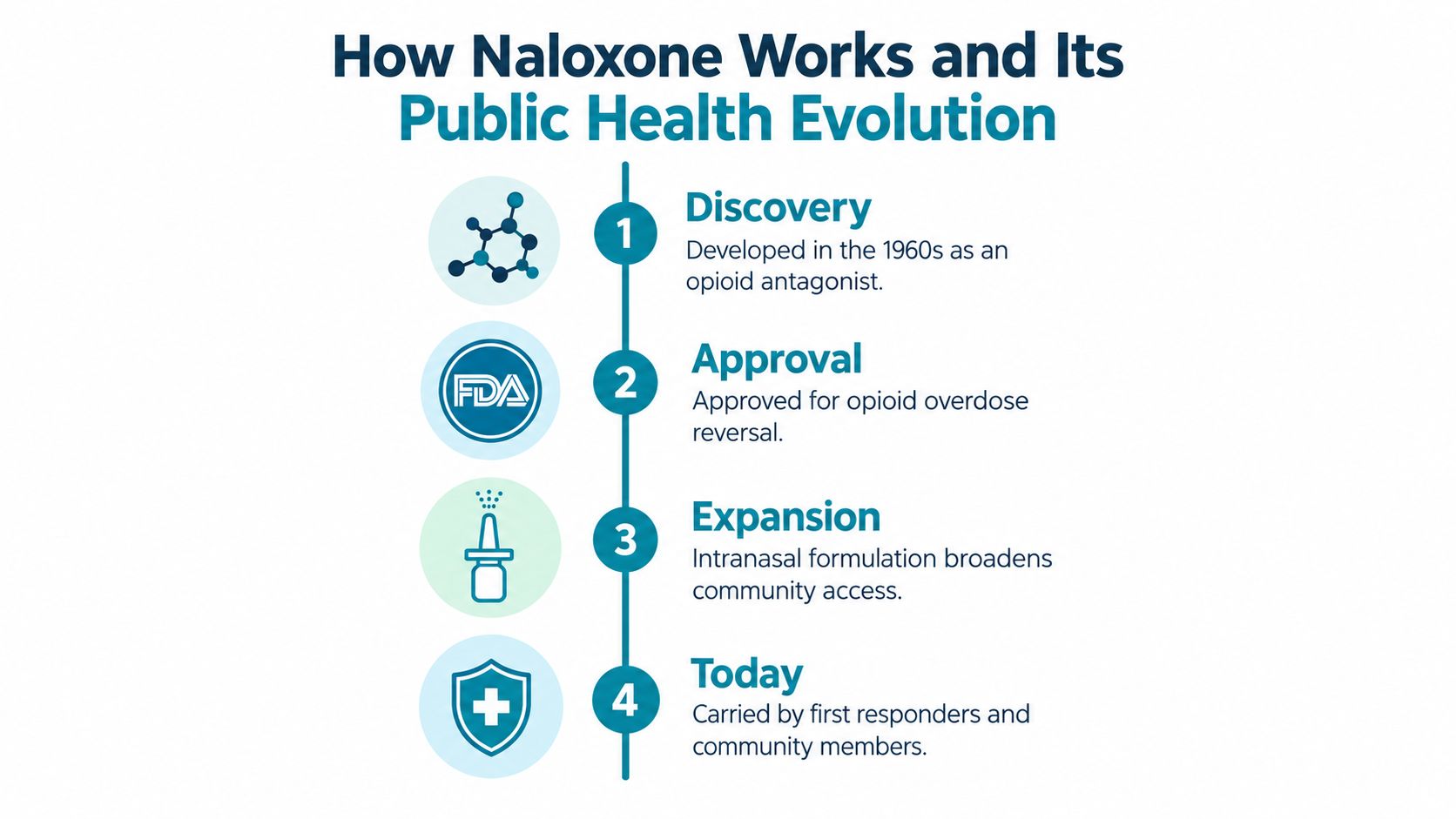
Naloxone has been used for more than half a century. It was patented in 1961, and the FDA approved it in 1971 for reversing opioid overdose, initially as an injectable medication for intravenous, intramuscular, and subcutaneous use (American Chemical Society history of naloxone).
For roughly two decades after approval, access was largely concentrated in hospitals and ambulances. The FDA approved Narcan nasal spray in November 2015, creating the first FDA-approved nasal spray formulation of naloxone. In March 2023, the FDA approved the first over-the-counter naloxone nasal spray, removing a prescription barrier (FDA approval announcement).
That history reflects a practical change in emergency care. A medication that once depended mainly on trained professionals can now be kept by family members, friends, and community organizations. CDC guidance says naloxone is available over the counter in all 50 states, and community-based programs may provide it at little or no cost (CDC guidance on reversing overdose).
The FDA reported more than 101,750 fatal overdoses in the 12-month period ending in October 2022, driven primarily by synthetic opioids such as illicit fentanyl. The CDC later reported a nearly 32% decrease in opioid overdose deaths by 2024, identifying increased access to naloxone products, including over-the-counter Narcan, as one contributing factor (FDA overdose prevention announcement). Naloxone isn't a cure for addiction, but broader access gives people more opportunities to survive an emergency and reach treatment.
Step by Step Administration and Rescue Breathing
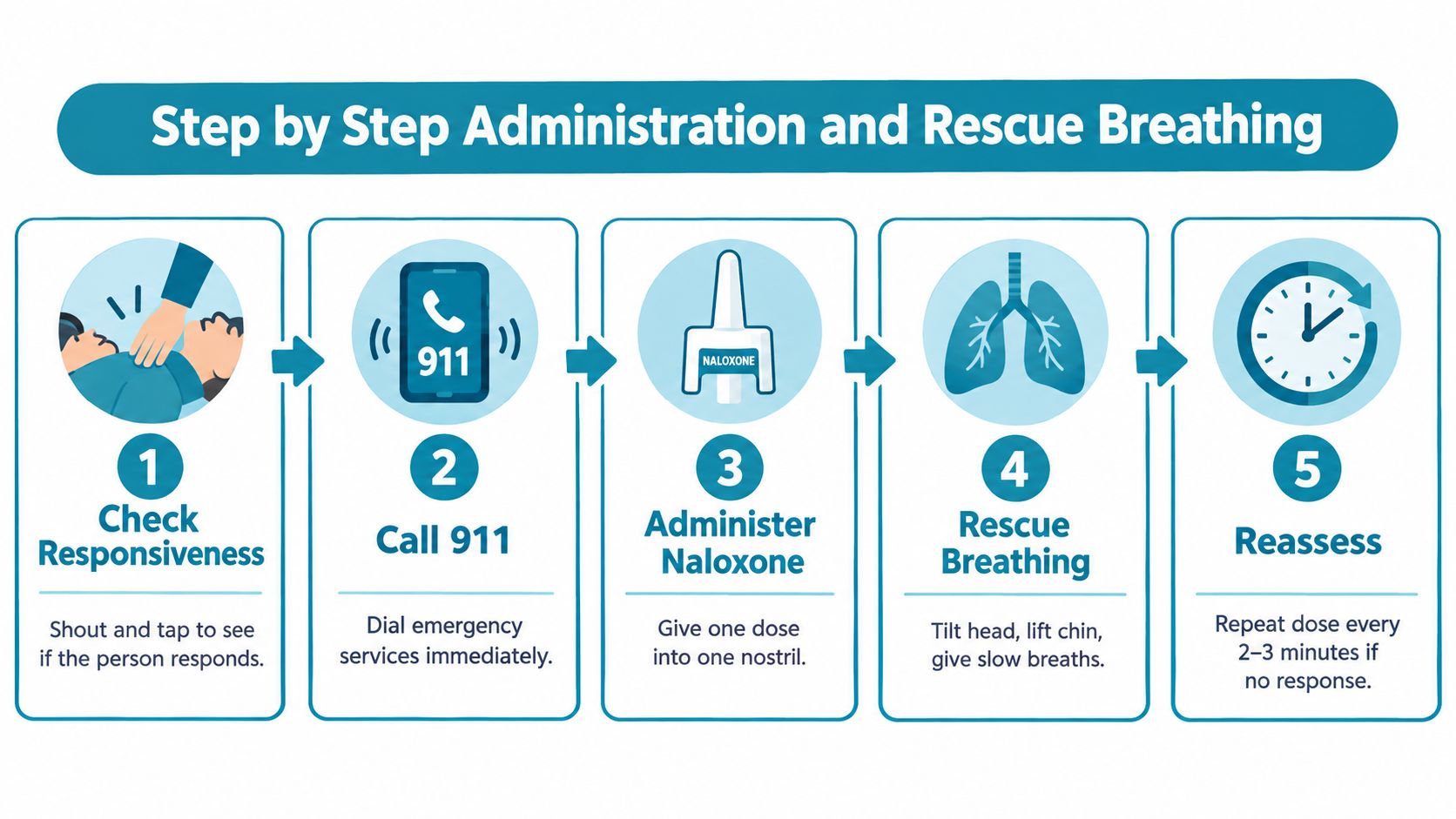
In an actual emergency, use the instructions on the product package and follow the 911 dispatcher's directions. The sequence below gives a general framework for a suspected opioid overdose.
The emergency sequence
Check responsiveness and breathing. Shout the person's name and tap their shoulder. Look for normal breathing. Gasping, snoring-like sounds, or very slow breathing aren't reassuring signs.
Call 911 immediately. Ask another person to call if someone is present. If you're alone, call first and use speakerphone so you can begin care while staying connected to emergency dispatch.
Administer naloxone. For a prepackaged nasal spray, remove the device from its packaging, place the tip in one nostril, and press the plunger as directed. Don't test or prime a prefilled device. If an injectable product is available, follow its specific label and training instructions.
Provide rescue breathing or CPR when needed. If the person isn't breathing normally, tilt the head back, lift the chin, and give slow rescue breaths if you're trained and able to do so. A dispatcher can guide you. If the person has no signs of normal breathing, follow instructions for CPR.
Reassess and repeat according to guidance. CDC guidance notes that normal breathing may return within 2 to 3 minutes after naloxone when the overdose is due to opioids (CDC overdose response guidance). If there's no meaningful improvement, administer another available dose according to the product directions and dispatcher instructions. Don't delay emergency care while waiting.
A person may wake quickly, remain confused, or continue breathing poorly. Keep monitoring them. If they vomit and are breathing, turn them onto their side to help protect the airway. Avoid forcing fluids, food, or other drugs.
The medication's temporary effect is one reason responders need to stay involved. A person can stop breathing again after naloxone wears off, especially if a longer-acting opioid or multiple substances are involved. If the person refuses help after waking, don't assume the risk has ended. Explain that recurrence is possible and let emergency professionals assess the situation.
For additional information about suspected overdose response, see this opioid overdose resource.
Comparing Nasal Spray and Injectable Formulations
Both FDA-approved forms are designed to reverse opioid overdose, but they require different handling skills. NIDA identifies injectable naloxone and prepackaged nasal spray as the two FDA-approved forms (NIDA overdose prevention information).
The best option for a household depends on what's available, who may administer it, and whether the caregiver has received training. In a stressful emergency, a simple device that someone recognizes may be easier to use than a formulation requiring preparation.
Naloxone formulation comparison
| Feature | Nasal Spray | Injectable |
|---|---|---|
| Administration | Delivered into one nostril using a prepackaged device | Requires injection using the product's labeled method |
| Training needs | Caregivers should learn how to position and activate the device | Caregivers need product-specific injection training |
| Preparation | Usually ready to use after removing packaging | May involve handling a vial, syringe, or prefilled device, depending on the product |
| Practical setting | Often convenient for home, travel, and community use | May be familiar in clinical or trained-response settings |
| Storage | Follow the product label and protect it from damage and unsuitable temperatures | Follow the product label and protect the medication and delivery equipment |
| After administration | Call 911, monitor breathing, and follow emergency instructions | Call 911, monitor breathing, and follow emergency instructions |
The FDA labeling for naloxone emphasizes route-specific differences in onset, while the emergency priorities remain the same: call 911, support breathing, administer naloxone, and monitor the person (FDA naloxone labeling).
Why withdrawal can follow reversal
Naloxone can rapidly remove opioid effects from receptors. Someone who is physically dependent may therefore experience sudden withdrawal. They may feel restless, nauseated, sweaty, achy, or angry. This reaction can seem alarming, but it doesn't mean naloxone caused the overdose or that the medication should be withheld during a suspected emergency.
Remain calm and keep the person away from additional opioids or sedatives. Withdrawal discomfort needs medical follow-up, but slowed or absent breathing is the immediate danger. Emergency clinicians can evaluate the person for recurrent respiratory depression, injuries, aspiration, or other substances.
Never use a formulation in a way the label doesn't describe, and don't improvise injection technique. Community training programs, pharmacists, clinicians, and local health departments can provide product-specific education.
Navigating Access Costs and Pharmacy Availability
Over-the-counter status answers one question, but not every access question. A product may be legally available and still be unaffordable, out of stock, excluded from a health plan, or restricted by quantity limits. Recent policy analysis describes uneven insurance coverage and cost-sharing, particularly for Medicare Part D beneficiaries and in states without requirements for over-the-counter coverage (Pew analysis of naloxone access policy).
Medicaid coverage also varies in practical ways. A 2025 JAMA Network Open study found that almost all Medicaid managed care plans in 40 states plus Washington, DC covered at least one naloxone formulation, while quantity limits and other restrictions differed. The study period also showed Medicaid naloxone prescriptions rebounding after a sharp drop in 2022, which illustrates why coverage on paper doesn't always produce consistent access (Boston University summary of the Medicaid coverage study).
Practical ways to look for naloxone
Ask a pharmacist: Request the available over-the-counter formulation and ask whether your plan covers a prescription product differently.
Contact community programs: CDC guidance identifies community-based naloxone programs and most syringe services programs as access points. Some distribute naloxone at little or no cost (CDC community access guidance).
Call a local health department: Public-health programs may know about distribution sites, training events, and current availability.
Ask an outpatient clinician: A physician can discuss overdose risk, prescribe or recommend naloxone when clinically appropriate, and help coordinate with outside treatment programs when authorized.
Access problems deserve a practical response, not blame. If cost or quantity limits prevent a person from keeping naloxone available, mention that barrier directly during a medical visit. A treatment plan that ignores affordability may fail at the point where protection is needed.
For more information about obtaining and using naloxone in outpatient care, review this naloxone access and care guide.
Integrating Reversal into Long Term Addiction Care
Naloxone protects against an immediate respiratory emergency. It doesn't reduce cravings, stabilize opioid use disorder, or address the medical and social conditions that make recurrence more likely. Long-term care requires a separate evaluation and a plan that can change as a person's goals, risks, and treatment response change.
A labeled composite example
Composite example, not an Empire patient: An adult returns to opioid use after a period of abstinence. The clinician treats reduced tolerance as a significant overdose risk, restores access to naloxone, reviews medicine follow-up, and revises the person's trigger plan rather than treating recurrence as a reason for discharge.
Reduced tolerance means the body may no longer adapt to an amount previously used. Illicit fentanyl can add further unpredictability because a person may not know whether it is present or how much exposure occurred. A lower-tolerance relapse-safety plan can include telling a trusted person about the risk, keeping naloxone immediately accessible, avoiding use alone, identifying warning signs, and arranging prompt follow-up. These are safety concepts, not individualized instructions for substance use.
Medication roles differ
Methadone, buprenorphine, and extended-release naltrexone are medications used in different clinical circumstances. They aren't interchangeable, and each has distinct initiation requirements, settings, benefits, and risks.
| Medication | General role | Key clinical distinction |
|---|---|---|
| Methadone | An opioid agonist used in medication treatment for opioid use disorder | Treatment involves specific program and monitoring requirements |
| Buprenorphine | A partial opioid agonist used to treat opioid use disorder | Initiation requires attention to current opioid exposure and withdrawal risk |
| Extended-release naltrexone | An opioid antagonist used as part of treatment for opioid use disorder | The person must be free of opioids before initiation to avoid precipitated withdrawal |
SAMHSA's TIP 63 guidance on medications for opioid use disorder describes these medications, their clinical roles, and treatment considerations. A qualified clinician must determine whether a medication is appropriate and how it should be initiated.
Naloxone and medication treatment address different problems. Naloxone reverses an acute opioid overdose. Methadone, buprenorphine, and extended-release naltrexone support ongoing treatment of opioid use disorder when clinically appropriate. Behavioral care, recovery planning, and coordination with other clinicians can complement medication without replacing medical assessment.
People who return to use need safety and care, not punishment. A physician-led addiction medicine visit can separate the emergency question from the longer-term question: Is the person breathing now, and what support can reduce the chance of another emergency?
Caregiver Preparedness and Next Steps
Preparedness is a form of care. Keep naloxone where family members, roommates, or trusted friends can reach it quickly, not hidden in a place nobody remembers. Review the package instructions, check the expiration date, and make sure the people most likely to be present understand that calling 911 comes first.
A short conversation can prevent hesitation later. Discuss what an overdose may look like, who will call emergency services, where naloxone is stored, and how the person would prefer routine follow-up handled. The conversation should protect dignity while making the emergency plan concrete.
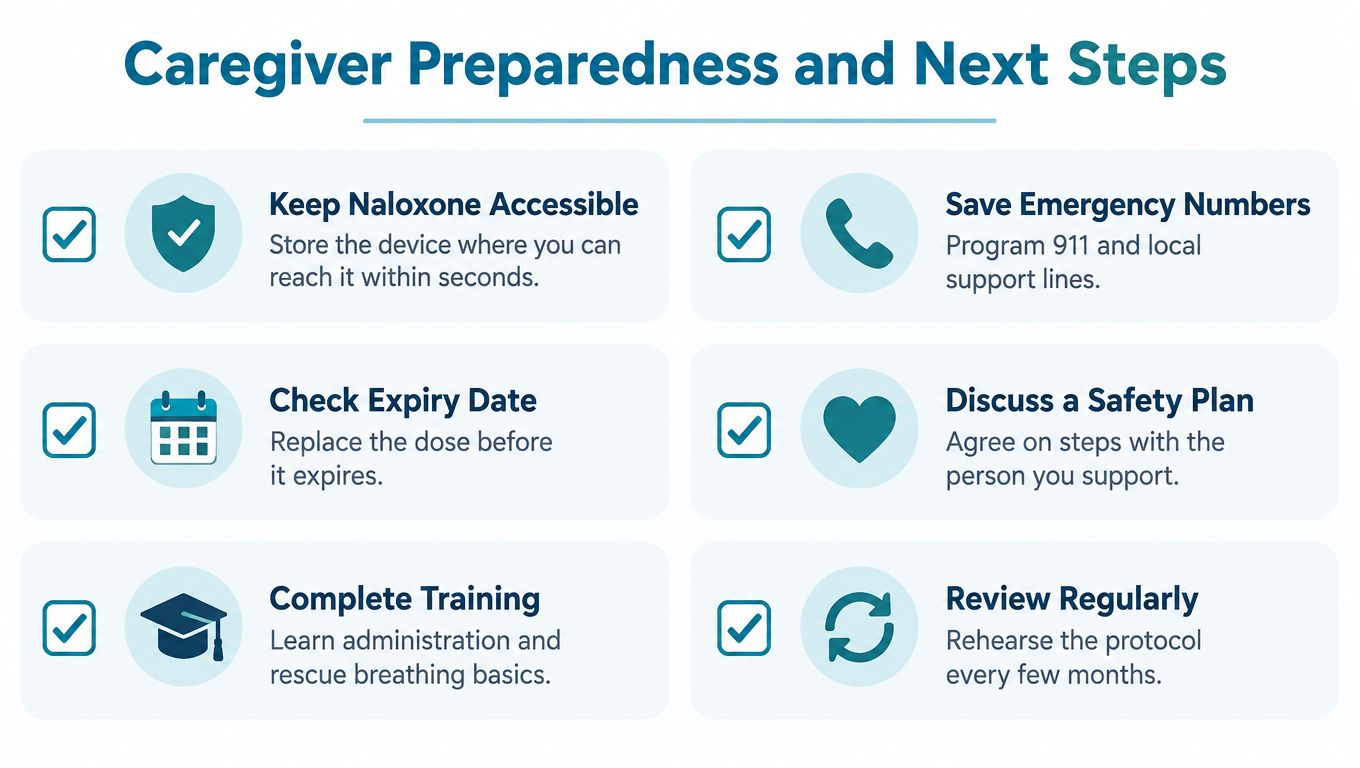
A simple readiness checklist
- Keep naloxone accessible: Store it where you can reach it within seconds.
- Check the expiration date: Replace it before it expires.
- Learn the basics: Review administration and rescue breathing with a qualified trainer.
- Save emergency numbers: Keep 911 easy to access and identify local support resources.
- Discuss a safety plan: Agree on emergency steps and routine follow-up with the person you support.
- Review regularly: Rehearse the response periodically so the sequence feels familiar.
If opioid withdrawal symptoms are causing concern after an emergency, this opioid withdrawal information can help you understand why medical follow-up may be needed. Call 911 for suspected overdose, absent or abnormal breathing, loss of responsiveness, chest pain, seizure, severe injury, or any situation that may be immediately life-threatening.
Empire Medical Wellness offers confidential, physician-led outpatient addiction medicine evaluation, evidence-based treatment when clinically appropriate, monitoring, recovery planning, and authorized coordination with outside clinicians or treatment programs. Visit Empire Medical Wellness to learn about outpatient care and determine whether a private consultation fits your needs.
This article is educational and isn't personal medical advice.
Sources
- FDA approval of over-the-counter naloxone nasal spray
- CDC guidance on reversing opioid overdose
- SAMHSA opioid overdose reversal information
- FDA naloxone prescribing information
- SAMHSA TIP 63 on medications for opioid use disorder