
Tirzepatide is dosed once weekly as a subcutaneous injection, starting at 2.5 mg for 4 weeks and then increasing by 2.5 mg at intervals of at least 4 weeks, with a labeled maximum of 15 mg once weekly. The part that surprises many people is that 2.5 mg is an initiation dose, not a maintenance dose, so most real dosing questions are less about where you start and more about how you escalate, what happens if you miss a dose, and when a restart needs prescriber review.
Byline: Empire Medical Wellness Editorial Team
Published: September 20, 2026
Updated: September 20, 2026
Table of Contents
- What Tirzepatide Is and Why Dosing Looks the Way It Does
- The FDA-Labeled Titration Schedule From 2.5 mg to 15 mg
- Brand, Indication, Formulation, and Dose at a Glance
- How Tirzepatide Is Given Each Week
- Missed, Delayed, or Restarted Doses in Real Life
- Side Effects, Dose Holds, and When to Call the Practice
- What the Labeled Schedule Does Not Allow
- Talking With a Prescriber and Next Steps
- Sources
What Tirzepatide Is and Why Dosing Looks the Way It Does
Tirzepatide dosing only looks simple until real life gets involved. Starting is the easy part. The harder questions usually come later, such as how fast to step up, what to do after a missed week, and when a gap means you may need a safer restart plan instead of picking up where you left off.
Tirzepatide is the active ingredient in two FDA-approved brand products. Mounjaro is approved for type 2 diabetes, and Zepbound is approved for chronic weight management. That difference matters because the brand name on the box is tied to a specific FDA label, indication, device presentation, and prescribing workflow. Same molecule, different approved use.
For adults exploring physician-led obesity care, Empire also maintains a background page on tirzepatide treatment that can help place dosing into the larger treatment discussion.
Why the schedule is weekly
The weekly schedule is built around two goals that have to be balanced at the same time. One is giving enough medicine to produce the intended clinical effect. The other is giving the body time to adjust, especially in the stomach and intestines, where nausea, vomiting, constipation, diarrhea, and reduced appetite often show up first.
A useful way to picture the schedule is as a staircase rather than a switch. Each increase changes exposure, and each hold gives your body time to show whether that dose is tolerable before the next step is considered. That is why the FDA label uses a gradual increase instead of fast jumps. For Zepbound, the prescribing information states that treatment begins at 2.5 mg once weekly for 4 weeks and may then be increased in 2.5 mg increments after at least 4 weeks on the current dose, up to a maximum recommended dosage of 15 mg once weekly, in the FDA prescribing information for Zepbound.
One short clarification helps prevent a lot of confusion. The 2.5 mg dose is used to start treatment and improve tolerability.
Why readers often get confused
Many dosing articles stop after the opening step-up schedule. Patients usually do not. The practical questions start once treatment is underway. If a higher dose causes stomach symptoms, should the dose be held longer? If an injection is delayed by travel, pharmacy access, or illness, when is it still a "missed dose" versus a possible restart issue? If someone was doing well, then stops for a few weeks, is the previous dose still the safest one?
Those are the parts of dosing that affect day-to-day care. They also explain why a label-based article has to do more than recite the starting dose. If you want broader background on incretin-related pathways, you can browse the 2026 GLP-2 guide for context. For actual tirzepatide dose decisions, the safest reference point remains the FDA-approved prescribing instructions and the prescriber who is applying them to your situation.
The FDA-Labeled Titration Schedule From 2.5 mg to 15 mg
The weekly tirzepatide schedule is not a race to 15 mg. Under the FDA label, it is a step-up plan built to balance two goals at the same time. First, give the medication time to work. Second, give the body time to adjust before the next increase.
That pacing is the part many readers need help with. The starting dose matters, but the day-to-day questions usually come later. People want to know what counts as a normal escalation, when it is reasonable to hold a dose longer, and what the labeled schedule does and does not permit after a missed week or a longer gap.
The labeled sequence itself is straightforward. Tirzepatide starts at 2.5 mg once weekly for 4 weeks. After that, the dose may be increased by 2.5 mg at a time, and each increase should happen only after at least 4 weeks on the current dose, according to the FDA prescribing information for Zepbound.
Here is the step-up pathway in plain terms:
- 2.5 mg
- 5 mg
- 7.5 mg
- 10 mg
- 12.5 mg
- 15 mg
A staircase is a useful way to picture it. Each dose level is one step. The label does not call for skipping steps or climbing faster than every 4 weeks. That structure exists because tolerability, especially stomach-related side effects, often determines whether someone can continue comfortably to a higher maintenance dose.
One point causes confusion over and over. 2.5 mg is a starting dose, not a maintenance target under the FDA label. For obesity treatment with Zepbound, the labeled maintenance doses are 5 mg, 10 mg, or 15 mg once weekly, and 15 mg once weekly is the maximum recommended dose. Intermediate doses such as 7.5 mg and 12.5 mg function as step-up doses on the way to a maintenance dose when a prescriber decides escalation is appropriate.
That also means every patient does not have the same endpoint. Some stay at 5 mg. Some move to 10 mg. Some tolerate and benefit from 15 mg. The right labeled dose is the one that matches the treatment goal and side-effect tolerance, not the highest pen strength available.
FDA-Labeled Tirzepatide Weekly Titration Schedule
| Week | Weekly Dose | Purpose / Notes |
|---|---|---|
| Weeks 1 to 4 | 2.5 mg | Initiation dose used to improve tolerability |
| After at least 4 weeks | 5 mg | First labeled maintenance dose and first escalation step |
| After at least 4 more weeks | 7.5 mg | Step-up dose if more escalation is prescribed |
| After at least 4 more weeks | 10 mg | Labeled maintenance option |
| After at least 4 more weeks | 12.5 mg | Step-up dose toward the highest labeled dose |
| After at least 4 more weeks | 15 mg | Highest labeled weekly dose |
Trial results help explain why this step-up design exists. In the obesity study published in The New England Journal of Medicine, higher maintenance doses were associated with greater average weight reduction in the trial setting. That finding supports why the label includes escalation beyond the starting dose, but it does not mean every individual should push upward on schedule if side effects are getting in the way.
Only a licensed prescriber should decide whether to remain at a dose longer than 4 weeks, increase to the next labeled step, or reconsider treatment after a dose interruption.
Brand, Indication, Formulation, and Dose at a Glance
Many dosing mix-ups start here. Tirzepatide is the molecule. Mounjaro and Zepbound are brand products that contain that molecule. Same active ingredient doesn't mean "same prescription in all contexts." Brand, indication, formulation, and pharmacy dispensing rules still matter.
If you're comparing obesity-focused and diabetes-focused product information, Empire's Mounjaro overview may be a helpful companion page. Use it for context, not to substitute one labeled product for another.
How to read the table
Look at four things separately:
- Brand: The product name on the prescription.
- FDA indication: The approved use tied to that brand.
- Available dose strengths: The strengths used in the weekly step-up pathway.
- Labeled maintenance range: The doses the FDA labeling identifies as maintenance options for that indication.
A practical caution matters here. Readers often assume that if two products contain tirzepatide, the names can be swapped casually. That's not how medication labeling works. The active ingredient may be the same, but the approved indication and product labeling still guide prescribing and dispensing.
Tirzepatide Brand, Indication, Formulation, and Dose Reference
| Brand | FDA Indication | Available Dose Strengths | Labeled Maintenance Range |
|---|---|---|---|
| Mounjaro | Type 2 diabetes | 2.5 mg, 5 mg, 7.5 mg, 10 mg, 12.5 mg, 15 mg | 5 mg to 15 mg once weekly |
| Zepbound | Chronic weight management | 2.5 mg, 5 mg, 7.5 mg, 10 mg, 12.5 mg, 15 mg | 5 mg, 10 mg, or 15 mg once weekly |
Formulation differences can affect device handling, but they don't change the central weekly dosing logic described above. Insurance coverage, prior authorization, and out-of-pocket costs can also differ by brand and indication, so prescribers and pharmacies usually verify the exact product rather than assuming the name doesn't matter.
How Tirzepatide Is Given Each Week
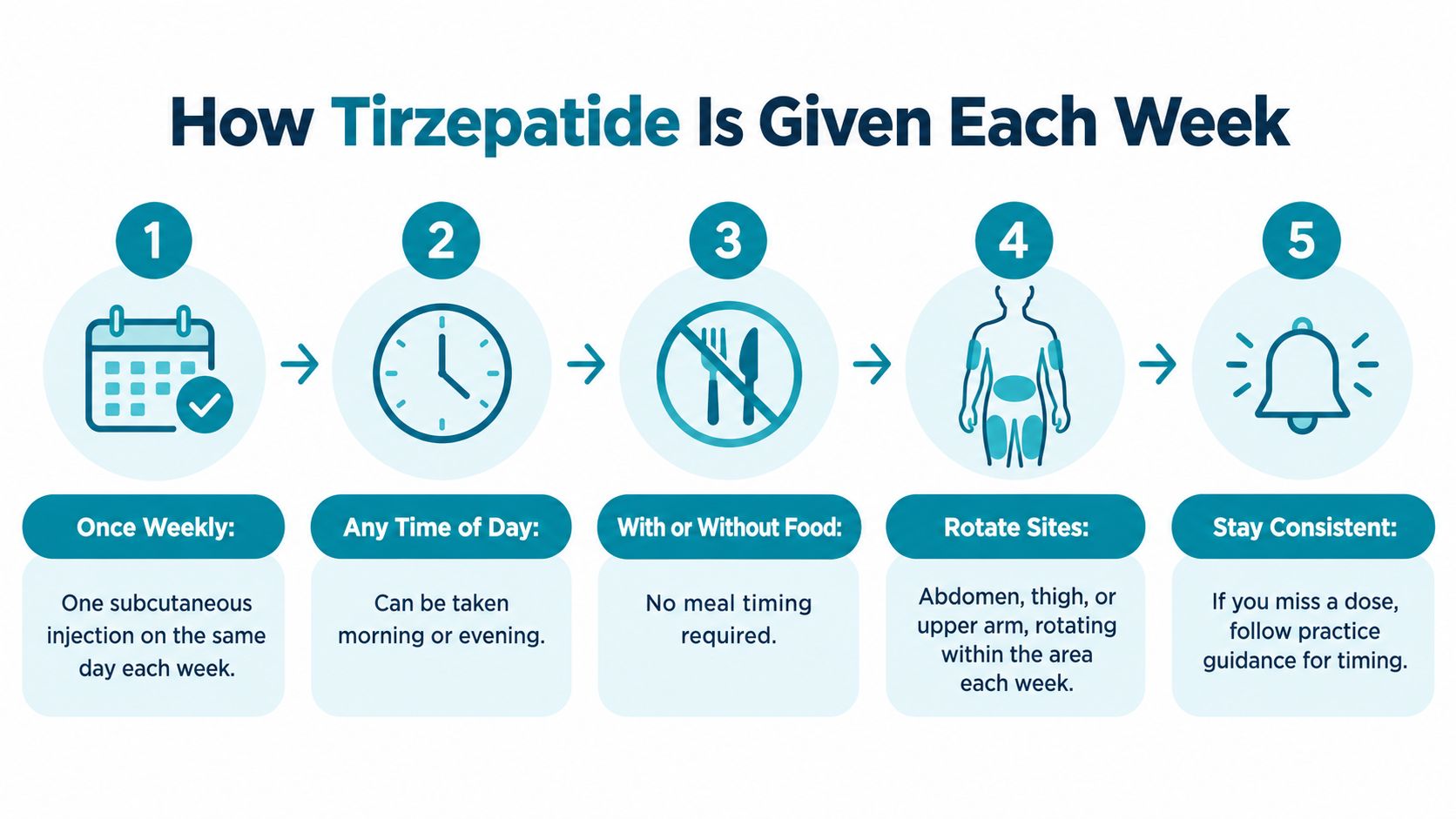
Tirzepatide is given as one subcutaneous injection each week. "Subcutaneous" means the medicine is injected into the fatty tissue just under the skin, not into a muscle or vein. The label allows dosing on the same day each week, at any time of day, and with or without meals.
Common injection sites
The usual injection sites are:
- Abdomen: Often easiest for self-injection.
- Thigh: Another common choice for self-administration.
- Upper arm: Sometimes easier if someone helps.
Rotate injection sites rather than using the exact same spot every time. That simple habit can reduce local irritation.
For a broader overview of this medication class in obesity care, the practice's GLP-1 medication page may help with terms and treatment context.
Basic weekly routine
A clear routine helps more than people expect.
- Pick one day: Many adults choose the same weekday each week.
- Inspect the product: If the solution doesn't look right, don't assume it's fine.
- Prepare the area: Clean the skin before injection.
- Inject as directed for the exact product: Device steps vary by presentation, so the product instructions matter.
- Track the dose date: A phone reminder or calendar note can prevent missed-dose confusion.
This short video can help some readers visualize the weekly injection workflow:
Storage and device handling should follow the exact package instructions for the specific product you were prescribed. That's another reason the brand name and formulation need to be confirmed before any dosing conversation.
Missed, Delayed, or Restarted Doses in Real Life
This is the part many patients need most. Starting at 2.5 mg is straightforward. Dosing questions usually come later, when life interrupts the schedule and you need to know whether to take a dose late, skip it, or ask about restarting.
The FDA-labeled missed-dose rule is simple once you picture the medicine on a weekly rhythm, like a standing appointment that repeats every 7 days. If you miss a dose, take it within 4 days (96 hours) if you can. If more than 4 days have passed, skip that dose and take the next one on your regular weekly day, as noted earlier in the prescribing information.
Missed-Dose Decision Rules From the FDA Label
| Time Since Scheduled Dose | What To Do | What To Avoid |
|---|---|---|
| Less than 4 days (96 hours) | Take the missed dose as soon as possible | Don't guess your next schedule. Resume the regular weekly plan after that |
| More than 4 days | Skip the missed dose | Don't try to "catch up" by taking the old dose late |
| Restart after a longer interruption | Contact the prescriber for reassessment | Don't automatically resume the prior dose on your own |
What that means in everyday situations
Here is the practical logic. The 4-day window is the FDA's line between a dose that is still close enough to your usual week and a dose that is late enough that trying to force it in can disrupt the schedule.
If you remember the next day, or even a few days later, you may still be inside that window. Take the missed dose, then continue with the weekly plan. If you are past 96 hours, skip it. Do not take two doses close together to make up for lost time.
For gaps longer than one missed dose, contact the prescriber for individualized restart guidance rather than resuming the prior strength.
That last point matters because tirzepatide dosing is not only about the number of milligrams. It is also about tolerance. After a longer break, a dose that felt manageable before may hit harder, especially if your last increase caused nausea, vomiting, poor intake, or dehydration.
A hypothetical example
Hypothetical composite example: An adult misses a weekly dose while traveling and remembers 2 days later. That fits the FDA missed-dose window, so the dose can be taken, then the weekly schedule resumes. A different adult goes a longer stretch without treatment because of refill problems and had significant nausea at the previous dose increase. In that situation, the safe question is not just "What was my last dose?" It is also "What dose is reasonable to restart now?"
Dose changes should stay with the prescriber. That includes delaying an increase, stepping back to a lower dose, or restarting after a gap.
Side Effects, Dose Holds, and When to Call the Practice
Most discussions of tirzepatide dosing are too simple about side effects. In care, the question usually isn't "Does this medicine ever cause nausea?" It does. The question is whether symptoms are expected, manageable, or concerning enough that the prescriber needs to hear about them before the next dose.
Common effects during dose escalation
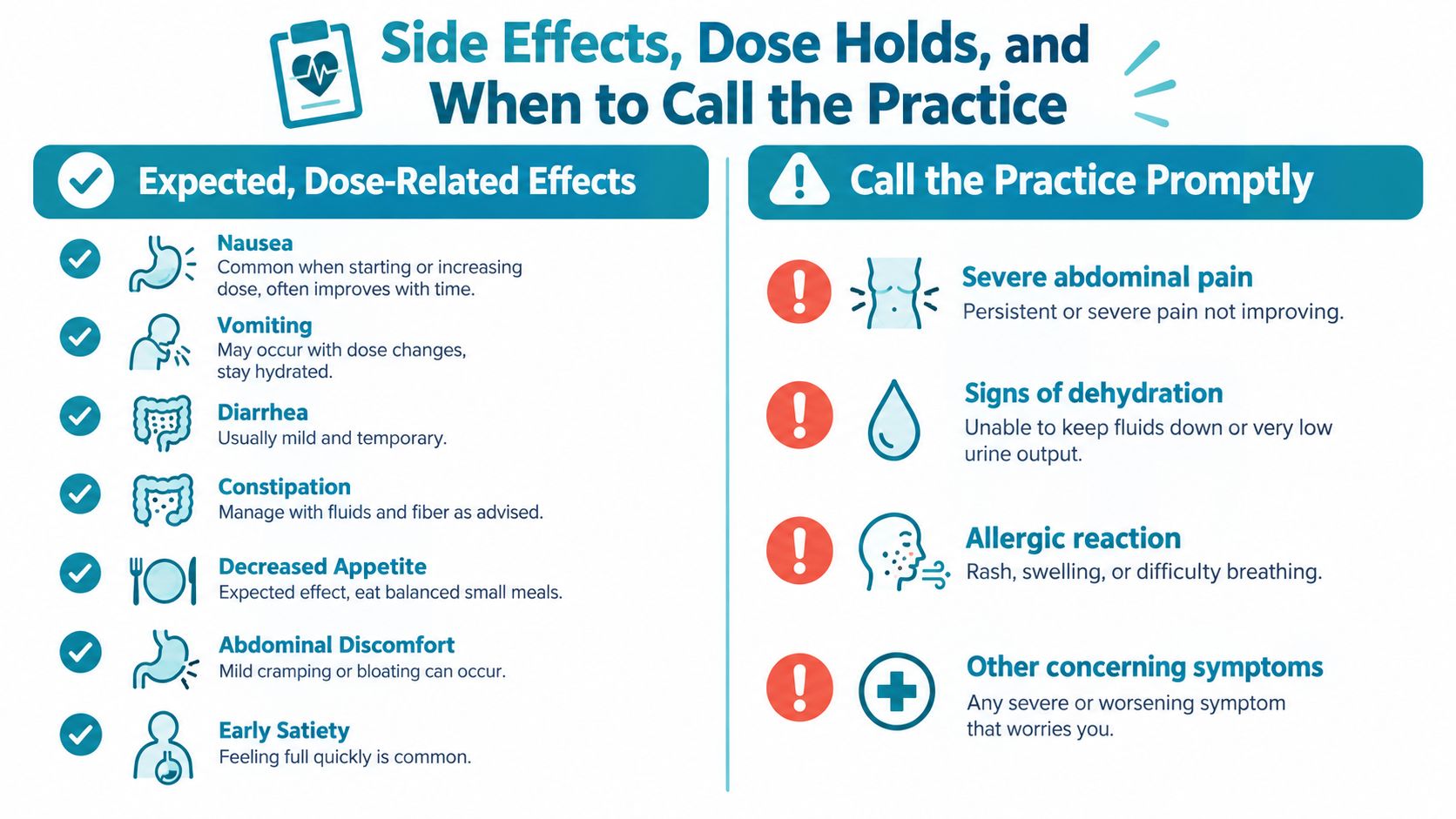
Expected dose-related effects often involve the digestive system. These may include:
- Nausea: Often more noticeable when starting or increasing the dose.
- Vomiting: Important because it can interfere with hydration.
- Diarrhea or constipation: Both can occur during adjustment.
- Decreased appetite and early satiety: Feeling full sooner is common.
- Abdominal discomfort: Mild cramping or bloating can occur.
The FDA's slow step-up schedule exists partly to reduce the chance that these symptoms become severe enough to derail treatment.
A useful companion resource is the practice's page on tirzepatide side effects, which discusses symptom patterns in more detail.
When a prescriber may hold or delay escalation
A prescriber may decide not to increase the dose on schedule if symptoms are limiting. That's especially relevant when vomiting persists, oral intake falls, or dehydration becomes a concern. The point of titration isn't to force a climb to the maximum. It's to find a tolerated labeled dose.
Clinical common sense: If the current step isn't going well, pushing higher usually isn't the answer.
Hypothetical composite example: An adult develops nausea after an escalation. The prescriber confirms the exact product, reviews hydration and symptom severity, considers other possible causes, and checks the current label before deciding whether to hold the current dose longer or delay the next increase.
Red flags that shouldn't wait
Prompt same-day contact or urgent evaluation is appropriate for symptoms such as:
- Severe abdominal pain: Especially if it may radiate to the back, with or without vomiting.
- Signs of dehydration: Trouble keeping fluids down or very low urine output.
- Possible allergic reaction: Facial swelling, rash, or trouble breathing.
- Gallbladder-type pain or visual changes: These warrant timely medical review.
Call the prescribing practice before adjusting the dose on your own. If symptoms feel severe or urgent, seek urgent or emergency care.
What the Labeled Schedule Does Not Allow
The safest way to read tirzepatide dosing is to treat the FDA label like a set of guardrails. It tells you the approved weekly lane, the size of each step up, and the maximum weekly dose. Once advice moves outside those guardrails, the question changes from "What is the schedule?" to "Is this still an approved use of the schedule?" For the practices below, the answer is no.
That matters because real-life dosing questions usually show up at the edges. A person misses a week, gets sick during titration, or wants to make up for a gap by taking more. Those are exactly the moments when internet shortcuts can sound practical but drift away from labeled use.
Practices that fall outside the labeled schedule
| Non-labeled practice | Why it is a problem |
|---|---|
| Escalating faster than every 4 weeks | The label uses slower stepwise increases so the body has time to adjust, especially to stomach and bowel side effects. |
| Jumping straight to a higher dose after a lower one or after time off | Higher doses are meant to be reached in sequence, not skipped to like climbing past rungs on a ladder. |
| Taking more than 15 mg in a week | This exceeds the FDA-labeled maximum weekly dose. |
| Splitting one weekly dose into smaller doses across the week | The approved regimen is once weekly, not divided dosing. |
| Using daily or twice-weekly tirzepatide dosing | More frequent dosing is not part of the labeled schedule. |
| Restarting after a prolonged gap without prescriber review | A long interruption can change the safest next step, including whether reassessment or a lower restart dose is needed. |
Why "catch-up" dosing is a common mistake
A missed or delayed injection often makes people want to compensate. The label does not create a catch-up system where you double, stack, or speed up doses to get back on track. Weekly tirzepatide works more like a paced schedule than a balance due account. If timing gets off, the safer plan is usually to use the label's missed-dose rules and, after a longer gap, ask the prescriber how to restart.
That point is easy to miss because online discussions often blend three different situations into one. Missing a dose by a short window is not the same as stopping for weeks. Delaying escalation because of side effects is not the same as choosing your own higher dose. The label separates those situations for a reason.
Altered products add another layer of dosing risk
The FDA has also issued safety communications about compounded GLP-1 products and dosing errors. That matters here because concentration, measuring instructions, and product presentation may differ from FDA-approved branded pens. A dosing plan that sounds simple on paper can become unsafe if the product itself is not standardized.
Semaglutide and tirzepatide are also not interchangeable. They are different medicines with different FDA-labeled products and dose pathways. A prescriber has to match the exact drug, the indication, the current dose history, and any interruption before advising the next injection.
Talking With a Prescriber and Next Steps
A good tirzepatide dosing visit is specific. Bring the exact brand name, your current dose, and the date of your last injection. Those details shape almost every safe next step.
What to review at an appointment
A focused visit usually includes:
- Current treatment details: Brand, dose strength, and last injection date
- Tolerability: Nausea, vomiting, constipation, diarrhea, abdominal pain, appetite changes
- Other medications: Especially other glucose-lowering drugs or incretin-based medicines
- Upcoming plans: Travel, procedures, surgery, or anything that may interrupt weekly dosing
- Pregnancy plans or major health changes: These can affect medication decisions
For adults pursuing obesity treatment in a private-pay medical setting, Empire describes its weight-loss care approach separately from addiction medicine and mental health services. Those service lines stay distinct.
Questions worth asking
Some of the most useful questions are simple:
- If I'm tolerating this dose poorly, should escalation be delayed?
- If I miss a dose during travel, what counts as the safe window?
- If I've had a longer gap, do I need reassessment before restarting?
- How should other medications or upcoming procedures affect the plan?
Routine follow-up during titration is often tied to the timing of dose changes. Since labeled step-ups occur no more often than every 4 weeks, that's a common point for reassessment. After a stable maintenance dose is reached, follow-up becomes more individualized.
When to contact the practice sooner
Contact the prescribing practice promptly for:
- Severe or persistent nausea or vomiting
- Abdominal pain that seems significant or unusual
- Possible dehydration
- Visual changes
- Injection-site reactions that are worsening
- Pregnancy or pregnancy planning
- Any symptom that makes you think the next dose may not be safe to take without guidance
Only a prescriber should change treatment. That includes increasing, holding, stepping back, or restarting tirzepatide after a gap.
Sources
- FDA prescribing information for Zepbound 2024 label
- FDA prescribing information for Zepbound 2025 label
- FDA prescribing information for Zepbound 2026 label
- SURMOUNT-1 trial in The New England Journal of Medicine
- Zepbound product monograph missed-dose instruction
Empire Medical Wellness provides physician-led obesity medicine for adults who want careful evaluation, medication monitoring when appropriate, and clear follow-up rather than self-directed dose changes. If you're researching tirzepatide dosing and want to discuss the exact product, missed-dose questions, or whether a restart needs reassessment, you can learn more at Empire Medical Wellness.
This article is for education only and isn't personal medical advice.