
Mounjaro's FDA-labeled adult schedule starts at 2.5 mg once weekly for 4 weeks, then increases to 5 mg once weekly, with further 2.5 mg increases no sooner than every 4 weeks, up to a maximum of 15 mg once weekly. Only a licensed prescriber should decide whether treatment is appropriate or change your dose.
What makes mounjaro dosing harder than it first appears is that the right question isn't, “How quickly can I reach the highest dose?” The more useful question is, “Which product, indication, formulation, and dose does my prescriber consider appropriate, and how well am I tolerating each step?”
This guide explains the current FDA-labeled adult schedule, the difference between Mounjaro and other incretin medicines, what the label says about missed doses, and which symptoms belong in routine follow-up versus urgent medical evaluation. It's educational information for adults researching physician-led obesity care, not individualized dosing advice.
Table of Contents
- What Mounjaro Dosing Means and Who Decides It
- Mounjaro Brand Tirzepatide Ingredient and Approved Uses
- FDA Labeled Starting Dose and Stepwise Titration Schedule
- How to Take Mounjaro Once Weekly
- Missed Dose Guidance and When to Contact Your Prescriber
- Side Effects Monitoring and Safety Precautions to Discuss
- Plateaus Maintenance and Next Steps with Physician Led Care
What Mounjaro Dosing Means and Who Decides It
What does a Mounjaro dose describe, and who should decide when it changes?
Mounjaro is the brand name for tirzepatide, a prescription medicine given by subcutaneous injection, meaning under the skin. The current FDA prescribing information describes an adult schedule that begins with 2.5 mg once weekly for 4 weeks. This is an initiation dose, not a therapeutic dose for glycemic control. After that period, the labeled schedule uses 5 mg once weekly, followed, when appropriate, by 2.5 mg increases no sooner than every 4 weeks, up to 15 mg once weekly. These details are stated in the current FDA prescribing information for Mounjaro.
The gradual schedule works like easing a vehicle onto a faster road. A prescriber reviews the labeled pathway with your medical history, current medicines, treatment response, and tolerability. A dose that fits the label may still be unsuitable for a particular person.
Why the starting dose is different from a maintenance dose
The initial 2.5 mg dose introduces the medicine gradually. It should not be read as the dose expected to provide the full treatment effect, and it is not the first therapeutic glycemic-control dose described by the label. Five milligrams once weekly is the first adult maintenance option in the labeled schedule.
A maintenance dose is the amount a prescriber chooses to continue after initiation and, when appropriate, escalation. Reaching the maximum is not the goal for every adult. Some people may continue at a lower dose when their response and side effects support that choice. Only the prescriber managing treatment should make that decision.
Practical rule: Treat a dose change as a prescribing decision, not a self-management adjustment.
Dosing also belongs within a broader care plan. Physician-led care may include a medical and metabolic assessment, review of weight history and relevant health factors, medication discussion when clinically appropriate, monitoring, and planning for long-term maintenance. Information about GLP-1 medical care can explain how that process is organized, but an online article cannot determine eligibility or replace an evaluation.
Mounjaro Brand Tirzepatide Ingredient and Approved Uses
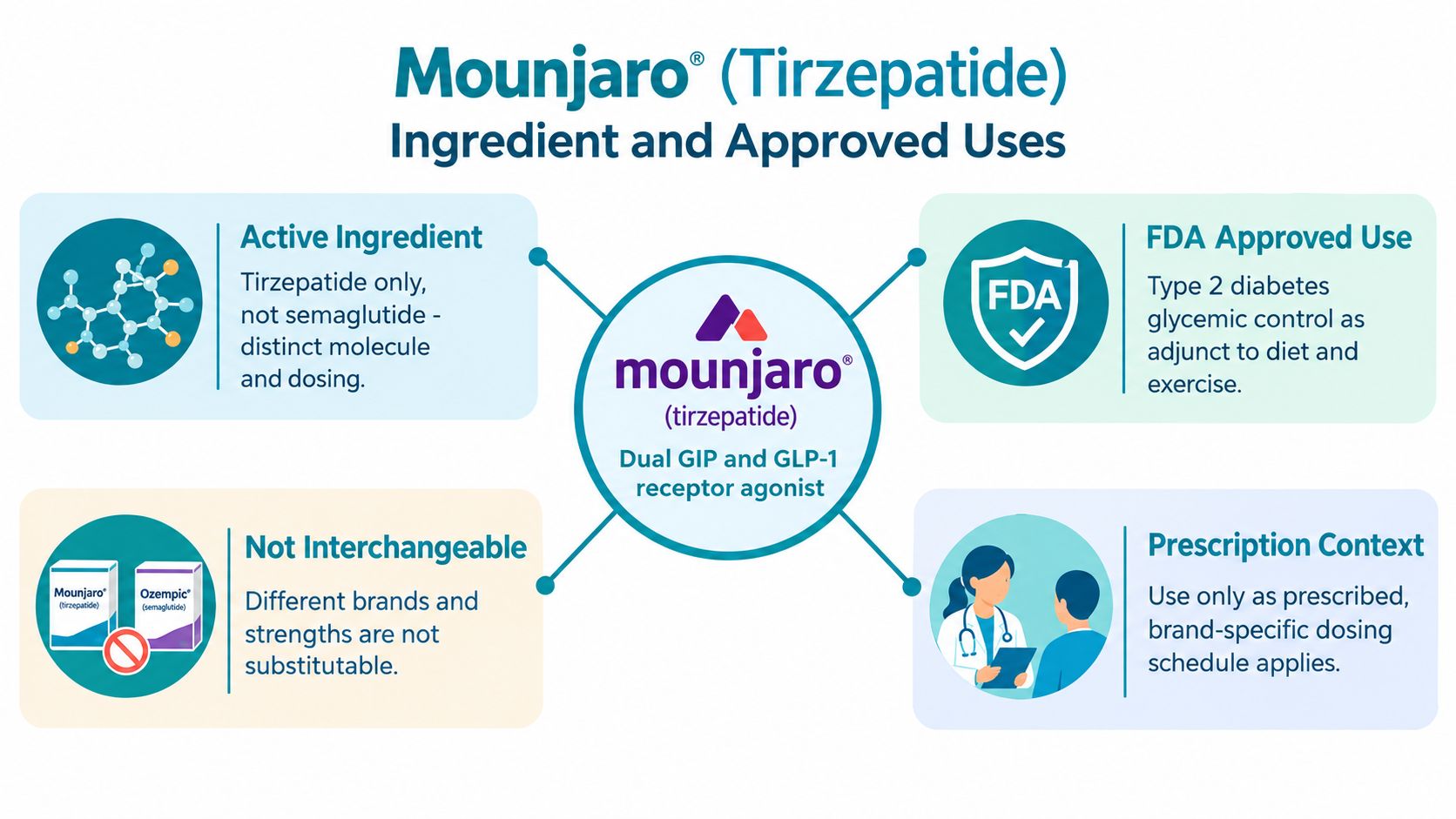
Mounjaro and tirzepatide describe related but different things. Mounjaro is a brand, while tirzepatide is its active ingredient. Tirzepatide acts on GIP and GLP-1 receptors, but the fact that another medicine affects an incretin pathway doesn't make the medicines interchangeable.
Semaglutide and tirzepatide are different incretin medicines. Their brands, formulations, indications, strengths, and FDA labeling can differ. A person shouldn't transfer a dose from one product to another or assume that the same number of milligrams has the same meaning across products.
Product, indication, formulation, and dose
Before discussing a schedule, a prescriber should identify four elements:
| Question | Why it matters |
|---|---|
| Which product? | Mounjaro, another tirzepatide product, and semaglutide products don't have interchangeable dosing. |
| Which indication? | FDA labeling can differ according to the condition being treated. |
| Which formulation? | Delivery system and available strengths belong to the product label. |
| Which dose? | A dose must be interpreted within that product's specific titration schedule. |
The current Mounjaro label identifies its adult use for improving blood sugar control in adults with type 2 diabetes as an adjunct to diet and exercise. Eligibility for any treatment, including treatment discussed in obesity care, requires a licensed prescriber to review the person's health history and the relevant FDA-approved product and indication.
That review should include contraindications, pregnancy plans, other glucose-lowering or incretin medicines, and upcoming procedures. It should also clarify whether a person is already using a medicine that could overlap with Mounjaro. The prescribing information doesn't support treating brand names and doses as interchangeable shortcuts. For additional context about the active ingredient and clinical discussion, see the page on tirzepatide treatment.
FDA Labeled Starting Dose and Stepwise Titration Schedule
How does the FDA-labeled Mounjaro schedule move from a starting dose to longer-term dosing? The adult pathway begins with 2.5 mg once weekly for 4 weeks. The prescribing information identifies this as an initiation dose, not a therapeutic glycemic-control dose. After that period, the labeled adult dose increases to 5 mg once weekly.
If additional treatment is appropriate, the prescriber may raise the dose in 2.5 mg increments. Each increase requires at least 4 weeks on the current dose. Available adult strengths are 2.5 mg, 5 mg, 7.5 mg, 10 mg, 12.5 mg, and 15 mg per 0.5 mL. The maximum adult dose is 15 mg once weekly. These details come from the current FDA Mounjaro prescribing information.
Mounjaro adult dose reference by label
| Dose strength | Purpose in titration | Minimum time on dose | Notes |
|---|---|---|---|
| 2.5 mg once weekly | Initiation | 4 weeks | Initiation dose, not a therapeutic glycemic-control dose |
| 5 mg once weekly | First maintenance option | At least 4 weeks before any increase | A prescriber may continue, increase, or reassess based on response and tolerability |
| 7.5 mg once weekly | Step-up dose | At least 4 weeks | Increase only in a 2.5 mg step |
| 10 mg once weekly | Step-up or maintenance dose | At least 4 weeks before any further increase | The appropriate maintenance dose varies by clinical context |
| 12.5 mg once weekly | Step-up dose | At least 4 weeks | Not automatically required |
| 15 mg once weekly | Maximum adult dose | No higher adult dose in the label | Reaching the maximum isn't required for every adult |
The label permits administration once weekly at any time of day, with or without meals. That timing flexibility does not allow more frequent dosing or earlier escalation. It only describes how the weekly schedule may be arranged.
Dose changes are clinical decisions, not automatic steps on a calendar. If side effects make the next increase difficult, a prescriber may keep an adult at a lower dose or reassess the plan. The label provides the framework, while the clinician applies it after reviewing response, tolerability, other medicines, and relevant safety factors. For a plain-language overview, review the Mounjaro dosage information alongside the current prescribing information and the instructions for the specific prescription.
How to Take Mounjaro Once Weekly
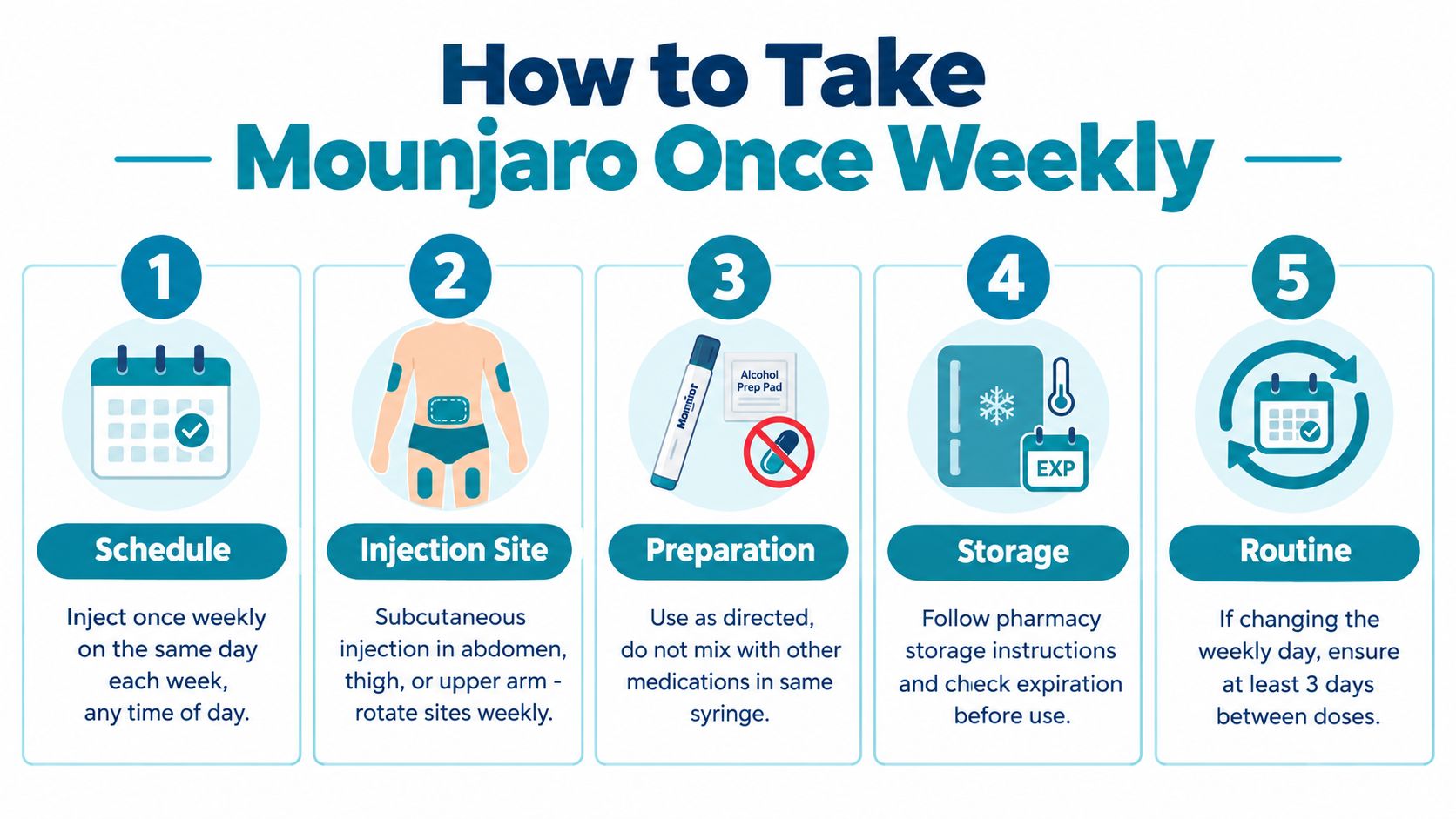
Mounjaro is administered as a subcutaneous injection once weekly. The FDA label permits dosing at any time of day, with or without meals. Many people find it easier to associate the injection with a consistent day, but the schedule should follow the current prescription and the Medication Guide.
Injection-site choices and product handling should come from the official instructions for the specific device or presentation dispensed to you. Don't assume that instructions for a different injectable medicine, pen, vial, or formulation apply to Mounjaro.
A preparation checklist for your prescriber visit
Use questions like these to reduce avoidable confusion:
- Product identity: What exact brand and formulation are prescribed?
- Weekly schedule: Which day should be treated as the regular injection day?
- Storage: What storage instructions apply to the supplied product?
- Handling: How should the device or container be checked before use?
- Other medicines: Should any glucose-lowering or incretin medicines be reviewed before treatment?
- Follow-up: How will response, side effects, and future dose decisions be assessed?
If you're considering a change to your weekly day, ask before making it. The FDA labeling includes a minimum separation rule for doses, and changing days without accounting for that interval can place injections too close together.
This video can provide general visual context, but it doesn't replace the instructions for your prescription or a clinician's explanation:
Missed Dose Guidance and When to Contact Your Prescriber
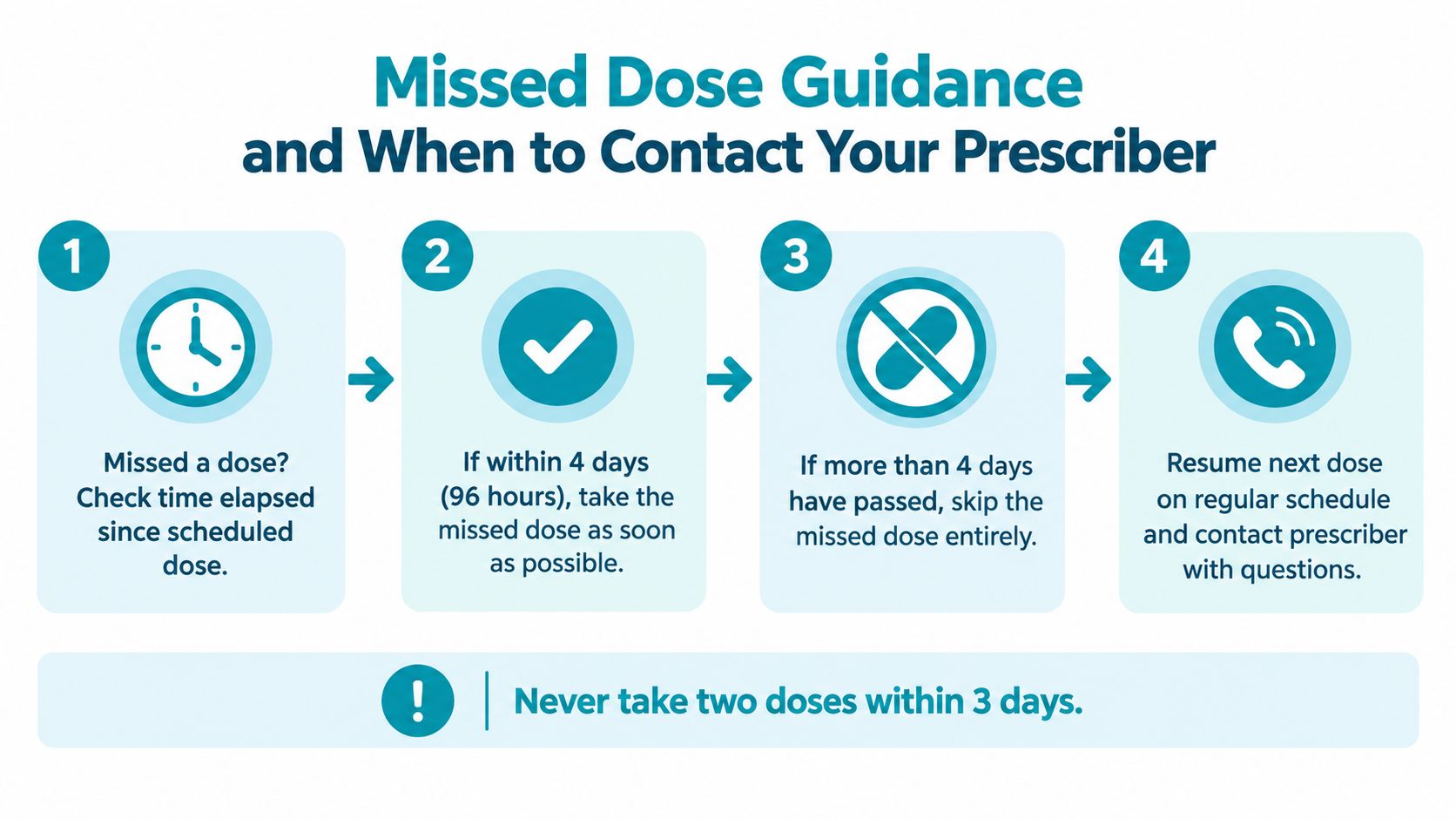
A single missed injection and a longer treatment interruption aren't the same situation. For one missed Mounjaro dose, the FDA label says to take it as soon as possible within 4 days, or 96 hours, after the scheduled dose. If more than 4 days have passed, skip the missed dose and take the next dose on the regular schedule. Two doses must not be taken within 3 days, or 72 hours, of each other. See the FDA missed-dose labeling for the operational rule.
A simple missed-dose decision path
- Check the elapsed time. Count from the scheduled injection time as directed by the product information.
- Within 4 days: The label says the missed dose may be taken as soon as possible.
- More than 4 days: Skip that dose and return to the regular weekly schedule.
- Check spacing: Never take two doses within 3 days of each other.
The label gives clear direction for one missed dose, but people often need help with repeated missed injections. Travel, gastrointestinal side effects, refill delays, and affordability problems can create gaps longer than one week. After several missed doses, the question may no longer be whether to take one late injection. It may be whether the prescriber needs to reassess the dose or consider a lower dose before returning to a prior maintenance plan.
Don't independently restart at a previous dose after a prolonged interruption. Contact the prescribing clinician and explain how many injections were missed, when the last dose was taken, what dose was being used, and whether symptoms occurred during the gap. That information helps the clinician decide whether the existing plan remains appropriate.
When to call: A repeated missed-dose pattern, a long interruption, or uncertainty about restarting deserves prescriber review rather than guesswork.
Side Effects Monitoring and Safety Precautions to Discuss
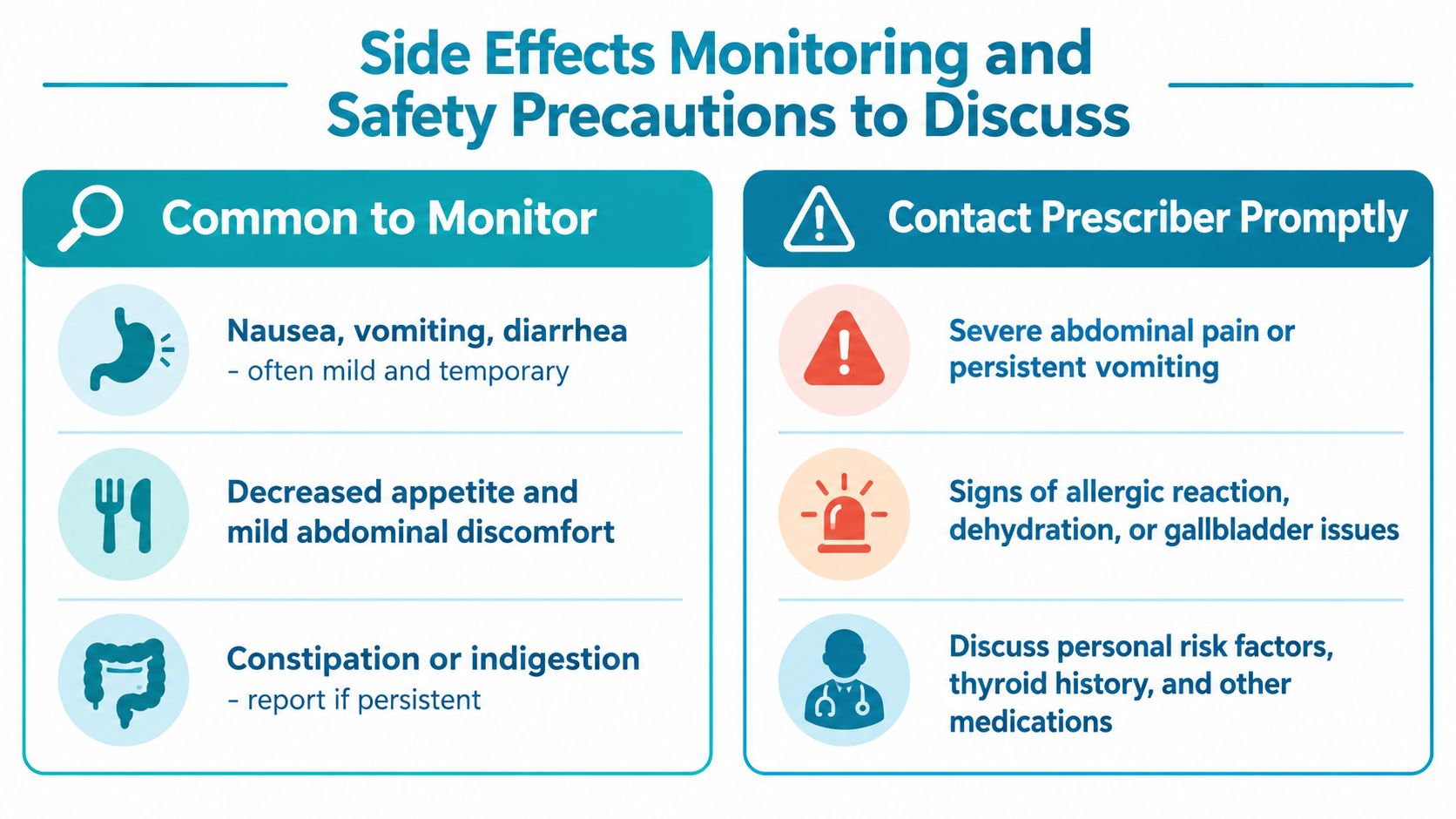
Which symptoms can be watched at home, and which require prompt medical advice? With Mounjaro, gastrointestinal effects such as nausea, vomiting, diarrhea, decreased appetite, constipation, indigestion, and abdominal discomfort are symptoms patients commonly discuss with clinicians. Persistent, worsening, or disruptive symptoms should be reported rather than managed alone, especially when they affect hydration, nutrition, or daily activities.
After a dose change, monitoring includes more than weight or blood sugar response. The practical question is whether the person can continue the prescribed plan safely and comfortably. A licensed prescriber sets follow-up timing based on the medicine, indication, response, tolerability, and relevant health factors. The FDA prescribing information and Medication Guide provide product-specific safety information. For monitoring context specific to this medicine, see this overview of Mounjaro side effects.
Common symptoms versus urgent concerns
| Situation | Examples | Appropriate response |
|---|---|---|
| Common symptoms to monitor | Nausea, diarrhea, vomiting, decreased appetite, constipation, indigestion, or mild abdominal discomfort | Track severity and duration. Report symptoms that persist or disrupt normal activities during routine follow-up |
| Prompt prescriber contact | Ongoing vomiting, symptoms of dehydration, significant abdominal symptoms, or possible gallbladder concerns | Contact the prescribing clinician promptly for assessment |
| Urgent or emergency concern | Severe abdominal pain, signs of a serious allergic reaction, or rapidly worsening symptoms | Seek urgent medical evaluation. Use emergency services if symptoms are severe or life-threatening |
Safety review should include personal risk factors, thyroid history, pregnancy plans, and other medicines. Tell the prescriber about other glucose-lowering medicines and incretin therapies before starting treatment or changing a dose.
Planned procedures also deserve advance discussion. Medication instructions may depend on the procedure, anesthesia or sedation plan, and overall medical history. FDA communications about GLP-1 medicines and NIDDK guidance on weight management offer general background, but a prescriber must determine the appropriate plan for an individual.
Plateaus Maintenance and Next Steps with Physician Led Care
A weight-loss plateau doesn't automatically mean treatment failure. Independent summaries of tirzepatide data describe plateaus commonly appearing around weeks 24 to 36, and continued treatment at the maximum tolerated dose may maintain more weight loss than lower-dose or placebo maintenance in SURMOUNT-MAINTAIN-type data, as summarized by Compound Review's tirzepatide dosing discussion. This evidence shouldn't be converted into a promise about an individual's result.
A prescriber may reassess adherence, calorie intake, protein intake, resistance training, side effects, and the current dose before deciding whether any change is warranted. A plateau can call for holding steady, adjusting the broader plan, or reconsidering treatment. It doesn't automatically call for escalation.
Questions to bring to follow-up
- What exact product and indication are being treated?
- Is the current dose being used for initiation, escalation, or maintenance?
- Are symptoms limiting continued titration?
- Have any injections been missed or taken too close together?
- Should other medicines, pregnancy plans, or procedure timing change the plan?
- What would make a plateau a reason to reassess rather than increase the dose?
Adults seeking structured, physician-led obesity care can review Empire Medical Wellness weight-loss services and decide whether a clinical consultation fits their needs. Empire describes care that may include medical assessment, individualized weight-management planning, medication discussion when clinically appropriate, monitoring, and long-term maintenance planning.
Empire Medical Wellness offers private-pay, physician-led obesity medicine for adults who want an evaluation, clear treatment decisions, and follow-up based on response and tolerability. Visit Empire Medical Wellness to review the practice's obesity-care information and available appointment details. This article is educational and isn't personal medical advice. For severe abdominal pain, signs of a serious allergic reaction, severe dehydration, or another life-threatening symptom, seek emergency medical care.