
Symptoms of alcohol withdrawal can range from anxiety, tremor, sweating, insomnia, nausea, palpitations, and increased blood pressure within hours to hallucinations, seizures, and delirium tremens over days. Severe withdrawal can be life-threatening and may require emergency care.
You may be reading this after reducing your drinking, missing your usual drinks, or waking up with shaking, sweating, poor sleep, or an uneasy feeling that is hard to explain. Alcohol withdrawal isn't always a neat sequence. Mild and severe symptoms can overlap, and a person who feels “just anxious” may also have important changes in heart rate, attention, orientation, or perception.
This guide explains what symptoms of withdrawal from alcohol can mean, how they may evolve, which signs require urgent help, and how clinicians assess safety. It doesn't diagnose you or provide a self-detox plan. If severe symptoms are present, call emergency services or go to an emergency department rather than trying to manage the situation alone.
Table of Contents
- What Symptoms of Withdrawal From Alcohol Mean and When to Act
- Why Withdrawal Happens After Heavy Drinking Stops
- Common Symptoms by Timeline and Severity
- Severe Withdrawal Red Flags Including Delirium Tremens and Seizures
- How Clinicians Assess Withdrawal and Monitor Safety
- Risk Factors That Make Withdrawal More Dangerous or Harder to Recognize
- When to Seek Emergency Care and Next Steps for Support
What Symptoms of Withdrawal From Alcohol Mean and When to Act
After a person who has been drinking heavily for a prolonged period suddenly stops or sharply reduces alcohol, the body can enter withdrawal. About 50% of people with alcohol use disorder who stop or substantially reduce drinking develop withdrawal symptoms, according to the NCBI clinical overview of alcohol withdrawal.
Symptoms may start within 6 to 24 hours after the last drink. Early changes can include poor sleep, shakiness, restlessness, nausea, sweating, a racing heart, low mood, and a general sense of illness. The course can shift during the next hours or days. A neat checklist can mislead: mild anxiety and severe confusion do not always occur in a fixed order, and they can overlap.
A person may report feeling anxious while overlooking changes in attention, orientation, perception, pulse, or blood pressure. Structured observation helps reveal those changes. Hallucinations, severe confusion, a seizure, fever, unstable vital signs, or an inability to stay awake require urgent or emergency evaluation.
Safety rule: Hallucinations, severe confusion, a seizure, fever, unstable vital signs, or an inability to stay awake require urgent or emergency evaluation.
Early symptoms can be uncomfortable without predicting a safe course. Hallucinations and seizures are less common, but they can signal progression to a dangerous state. Delirium tremens is the most severe form of withdrawal and is a medical emergency.
A private outpatient assessment typically reviews the time of the last drink, prior withdrawal complications, vital signs, current symptoms, and whether someone can be safely observed at home. Empire Medical Wellness addiction medicine care describes outpatient medical assessment and monitoring. Emergency departments and hospital services manage acute emergencies.
Withdrawal management addresses immediate nervous-system instability. It does not by itself treat alcohol use disorder or the reasons drinking became difficult to control. After safety is established, ongoing medical treatment, recovery planning, and coordination with other services may be needed.
Why Withdrawal Happens After Heavy Drinking Stops
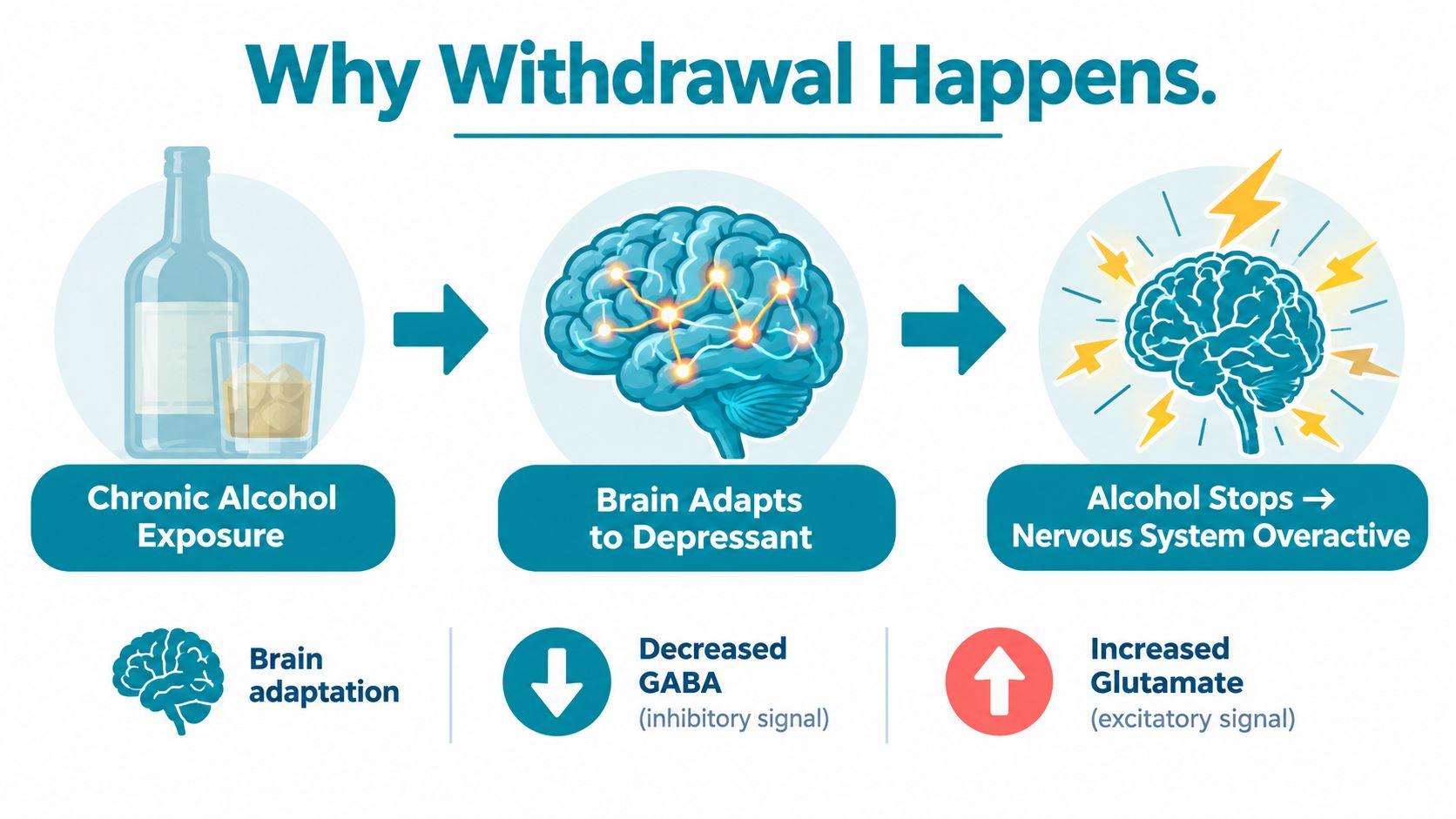
Alcohol changes the balance between calming and stimulating signals in the brain. With repeated heavy exposure, the nervous system adapts to alcohol's presence. If alcohol is removed suddenly, those adaptations can leave the brain and body in an overactive state.
A thermostat offers a useful analogy. Alcohol has a depressant effect, so the brain compensates by turning up stimulating activity and adjusting its sensitivity to calming signals. When alcohol stops, the “thermostat” may remain turned up even though the depressant effect is gone. Tremor, sweating, anxiety, insomnia, palpitations, and high blood pressure can reflect that overactivity.
Tolerance means the body adapts, so a person needs more alcohol to experience the same effect or feels less effect from an amount that once felt stronger. Dependence means the body has adapted enough that reducing or stopping alcohol can produce withdrawal. Dependence and alcohol use disorder can occur together, but a reader shouldn't use symptoms alone to diagnose either condition.
NIAAA includes withdrawal as a diagnostic feature of alcohol use disorder and lists tremors, sweating, increased pulse and blood pressure, insomnia, anxiety, nausea or vomiting, seizures, and delirium tremens among possible withdrawal symptoms in its professional diagnostic resource.
A hangover and withdrawal aren't identical. A hangover may follow a drinking episode without established physiological dependence. Withdrawal follows a significant reduction or cessation after the nervous system has adapted to ongoing alcohol exposure. Anxiety alone can also resemble withdrawal, but anxiety shouldn't be used to dismiss shaking, sweating, a racing heart, altered attention, or perceptual changes.
The course varies with the person's drinking pattern, prior withdrawal episodes, liver function, medical illness, and use of other sedatives. The same reported amount of alcohol doesn't produce the same risk in every person.
For a broader explanation of confidential addiction medicine assessment, a physician can review alcohol use, withdrawal history, medical conditions, and current symptoms without treating the person as a label.
Common Symptoms by Timeline and Severity
A person may wake with tremor and sweating, then develop difficulty concentrating while still describing the problem as anxiety or a poor night's sleep. Alcohol withdrawal is easier to understand as a moving pattern than as a fixed checklist. Early and later features can overlap, and a person may not notice changes in attention or perception.
Early symptoms often begin within 6 to 24 hours after a major reduction or cessation. Trouble sleeping, shakiness, restlessness, nausea, sweating, a racing heart, low mood, and a general sense of illness are common. The autonomic nervous system controls functions such as heart rate, blood pressure, sweating, and digestion. Neuropsychiatric symptoms involve mood, anxiety, attention, perception, and behavior.
A variable timeline, not a promise
The table is a framework, not a personal forecast. Timing varies, and symptom intensity can shift quickly. Mild insomnia can coexist with a rising pulse, while confusion or perceptual changes may be emerging before the person recognizes them.
| Timing window | Typical symptoms | Escalation cues to seek urgent care |
|---|---|---|
| Within 6 to 24 hours | Anxiety, insomnia, shakiness or tremor, restlessness, nausea, sweating, racing heart, low mood, elevated pulse or blood pressure, and a general feeling of being unwell | Symptoms that intensify quickly, marked vital-sign changes, inability to remain safely monitored, or new cognitive or perceptual changes |
| Following the early period | Persistent or worsening autonomic symptoms, headache, fatigue, craving, agitation, sleep disruption, and difficulty concentrating | Hallucinations, severe agitation, disorientation, inability to hydrate, or worsening attention |
| Later over the next days | Severe neuropsychiatric complications may emerge, including hallucinations, seizures, or delirium | Any seizure, hallucination, severe confusion, fever, unstable vital signs, or inability to stay awake |
Hallucinations occur in roughly 2% to 8% of patients, and withdrawal-related seizures affect about 10% of symptomatic individuals, according to the NCBI clinical summary. These population figures cannot predict one person's course.
Some lingering symptoms improve gradually, with sleep and general physical discomfort often changing before concentration and mood fully recover. Persistent confusion, worsening attention, new perceptual experiences, or symptoms that intensify instead of easing warrant reassessment. “Brain fog” is a useful starting description, but clinicians need to clarify when it began, whether it fluctuates, and whether sweating, tremor, or a rapid pulse occur with it.
Depression and anxiety may accompany withdrawal or amplify how it feels. They should not be assumed to explain changes in autonomic function, attention, or perception. Alcohol withdrawal also differs from opioid withdrawal. This overview of opioid withdrawal manifestations describes that separate clinical pattern and should not be used to assess alcohol withdrawal.
Severe Withdrawal Red Flags Including Delirium Tremens and Seizures
A person may begin with sweating, tremor, insomnia, or anxiety and still progress to a dangerous withdrawal state. Early symptoms do not predict a mild course. NIAAA explains that abruptly stopping after prolonged heavy drinking can cause a painful or potentially fatal process, including seizures and other serious complications, in its treatment guidance.
Delirium tremens, or DTs, is the most severe form of alcohol withdrawal. It can involve severe confusion, hallucinations, fever, agitation, and seizures. These symptoms may overlap with milder physical signs, so a person can appear awake and communicative while attention, perception, or judgment is already changing.
DTs occurs in about 3% to 5% of people undergoing alcohol withdrawal and often appears around 72 hours after the last drink, according to a recent peer-reviewed clinical review. The timing varies. Waiting for a particular hour can delay care.
Before modern treatment, mortality reached 50%. Older treated series reported deaths as high as 15% to 20%. With current care, most series report mortality under 5%, and some report rates under 1%. These figures show why prompt medical assessment matters. They do not support watching severe symptoms at home.
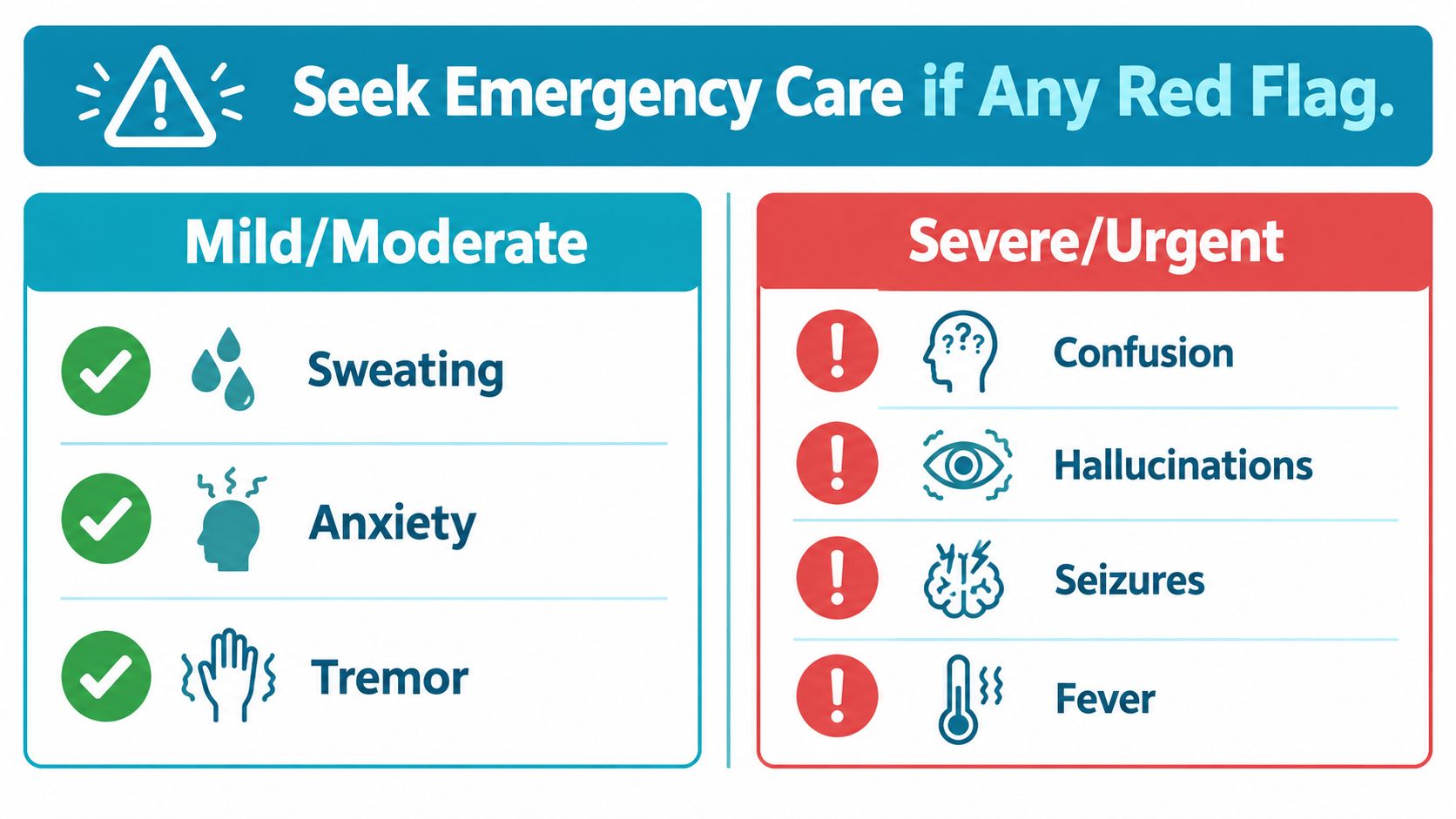
Seek emergency evaluation for:
- Hallucinations: Seeing, hearing, or feeling something others do not perceive.
- Severe confusion: New disorientation, poor attention, or behavior that does not fit the situation.
- Seizure: Any seizure after reducing or stopping alcohol needs urgent assessment.
- Unstable vital signs: Marked changes in pulse or blood pressure, particularly with worsening symptoms.
- Fever or agitation: These may accompany severe withdrawal or DTs.
- Reduced alertness: Inability to stay awake or participate safely in care.
The safest response is escalation. Do not adjust medication at home or use more alcohol to control symptoms. Call emergency services, avoid driving while impaired or confused, and tell responders when the last drink occurred.
How Clinicians Assess Withdrawal and Monitor Safety
Assessment begins with the drinking timeline. A physician asks when the last drink occurred, how consumption changed, how long heavy drinking continued, and whether earlier withdrawal involved a seizure, hallucinations, or delirium tremens. These details help show where the person may be in a changing course, rather than placing symptoms into a fixed checklist.
The review also covers other sedatives, medical conditions, psychiatric history, current medications, and whether someone can remain under observation. These questions are not moral judgments. They help clinicians judge whether symptoms could worsen and whether outpatient monitoring is appropriate. For a deeper look at who conducts this assessment, see the overview of the addiction medicine specialist role.
Questions that uncover vague symptoms
People may describe perceptual or cognitive changes indirectly. “I couldn't sleep” might mean frightening nightmares, agitation, confusion, or seeing movement in the room. “I felt anxious” may occur alongside tremor, sweating, a fast heart rate, or reduced attention. Mild and severe features can overlap, so one calm-sounding description does not settle the level of risk.
Clinicians may ask:
- Have you seen, heard, or felt things others do not?
- Do you know where you are and what day it is?
- Can you maintain attention during a conversation?
- Have you had nightmares, agitation, or unusual fear?
- When was your last drink?
- Have you ever had a withdrawal seizure or delirium?
A clinician checks vital signs and observes orientation, attention, tremor, sweating, speech, behavior, and alertness. A validated scale adds structure to repeated assessments. The American Society of Addiction Medicine clinical practice guideline identifies CIWA-Ar and SAWS as tools for withdrawal assessment.
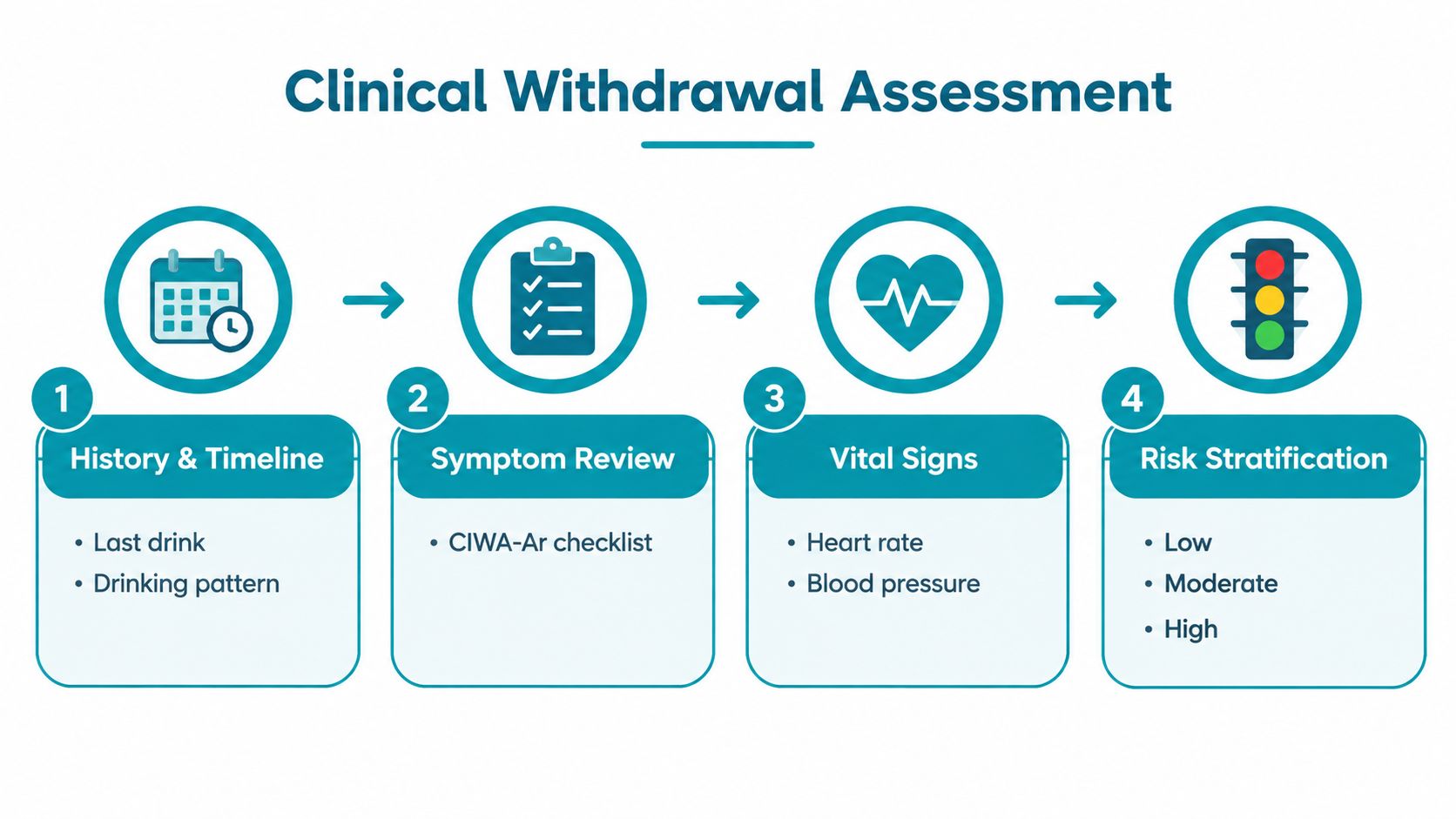
CIWA-Ar means Clinical Institute Withdrawal Assessment for Alcohol, Revised. SAWS means Short Alcohol Withdrawal Scale. Neither scale should determine the level of care alone. Anxiety, pain, communication barriers, medical illness, medication effects, or difficulty describing symptoms can affect scores.
A hypothetical composite example
Hypothetical composite: An adult reports “just anxiety,” while examination shows marked tremor, sweating, a fast heart rate, disorientation, and intermittent visual hallucinations. The point is to combine self-report, observation, vital signs, prior severe withdrawal, other sedatives, medical illness, and available monitoring.
Symptoms can change after one reassuring check. Repeated assessment helps clinicians recognize worsening early and choose a safer level of care.
Risk Factors That Make Withdrawal More Dangerous or Harder to Recognize
Repeated withdrawal can change the next episode. With kindling, the nervous system may become more reactive after earlier withdrawals, so symptoms can begin more abruptly or become harder to control. A person whose previous episode seemed manageable may still face greater risk during a later attempt to stop drinking.
A history of withdrawal seizure or delirium tremens deserves particular attention. Prolonged heavy drinking, acute illness, older age, impaired liver function, and concurrent sedative use can also complicate assessment or treatment. These factors cannot calculate personal risk, but they give clinicians reason to arrange medical evaluation sooner and monitor more closely.
Anxiety or depression may mimic, intensify, or occur alongside withdrawal. Someone may attribute sweating and a racing heart to panic, or explain poor concentration as depression. That interpretation may miss autonomic changes, altered attention, disorientation, or perceptual symptoms. Mild and severe features can also appear together, rather than following a neat checklist.
Symptoms people may describe indirectly
Perceptual changes, poor sleep, and cognitive changes are often underreported. They may feel embarrassing, confusing, or difficult to name. A person might say:
- “My sleep is strange.” Ask about nightmares, wakefulness, agitation, and confusion.
- “I feel watched.” Clarify whether this reflects anxiety, paranoia, or a perceptual disturbance.
- “My mind is foggy.” Check orientation, attention, memory, and ability to follow conversation.
- “I saw something briefly.” Ask whether the experience was visual, auditory, or tactile.
A trusted support person may notice behavior or confusion that the patient does not recognize, when the patient authorizes that input. Clinicians also assess whether the person can hydrate, eat, rest safely, and obtain prompt help if symptoms change. These practical details matter because symptoms may shift between checks.
Alcohol withdrawal remains a substantial clinical burden. Population burden does not predict one person's course, but it helps explain why clinicians take changing symptoms seriously.

When to Seek Emergency Care and Next Steps for Support
Call emergency services or go to an emergency department for hallucinations, severe confusion, disorientation, a seizure, fever, unstable vital signs, or inability to stay awake. Don't drive yourself if you're confused, faint, severely shaky, or otherwise unsafe to travel.
If you seek care, share the last drink time, recent changes in alcohol use, prior withdrawal complications, other sedatives or medications, major medical conditions, and any observed change in behavior. Don't attempt self-detox or change medication at home. Alcohol withdrawal can worsen after an initially mild presentation.
Clinicians judge stabilization using a composite picture, not one symptom. Relevant findings include improving clinician-rated withdrawal severity, stable vital signs, intact orientation and attention, no progression of seizures or hallucinations, ability to hydrate and take nutrition or medication safely, sleep without oversedation, reliable support, and successful follow-up. A worsening trajectory requires escalation.
Detoxification alone isn't treatment for alcohol use disorder. After immediate withdrawal risk is addressed, ongoing addiction medicine may include assessment, evidence-based treatment when clinically appropriate, monitoring, recovery planning, and coordination with outside clinicians or treatment programs. Medication options for alcohol use disorder, including physician discussion of naltrexone, require an individualized medical evaluation and aren't appropriate for everyone.
If someone is unconscious, having a seizure, severely confused, or in immediate danger, call 911. In the United States, call or text 988 for urgent mental health or suicide-related crisis support. Emergency services take priority over an outpatient appointment.
Empire Medical Wellness offers confidential, physician-led outpatient addiction medicine assessment, monitoring, recovery planning, and coordination with outside care when appropriate and authorized. Visit Empire Medical Wellness to learn about private outpatient care and next steps for alcohol-related concerns. This article is educational and isn't personal medical advice.