
Tirzepatide's most common side effects are gastrointestinal: nausea affects 25% at 5 mg, 29% at 10 mg, and 28% at 15 mg, while diarrhea affects 19%, 21%, and 23%, respectively. Vomiting and constipation are also common, making nausea, diarrhea, and vomiting or constipation the symptoms patients most often need to understand.
These rates come from the FDA-approved Zepbound prescribing information, not from an Empire Medical Wellness patient registry. The practical question isn't whether tirzepatide causes side effects. It's whether a symptom is an expected, dose-related reaction that can be monitored with a prescriber, or a warning sign that needs prompt medical evaluation.
Tirzepatide is FDA-approved for chronic weight management under the brand name Zepbound, alongside reduced-calorie eating and increased physical activity when clinically appropriate. Mounjaro is the tirzepatide product approved for type 2 diabetes. Adults considering physician-led obesity care can review how tirzepatide treatment is evaluated and monitored on the tirzepatide treatment page. For broader context about digestive supplements and their own potential risks, readers can also review these common aloe vera safety concerns.
Table of Contents
- What Tirzepatide Side Effects Look Like in Real Use
- Common Gastrointestinal Effects and FDA Trial Rates
- Why Dose Escalation Drives Most Symptoms
- Common Versus Serious Effects at a Glance
- A Hypothetical Look at Managing a Tough Week
- Serious Warning Signs That Need Urgent Care
- What to Bring to Your Next Visit
- Putting It All Together
What Tirzepatide Side Effects Look Like in Real Use
The dominant tirzepatide side effects are gastrointestinal and clearly dose-related. Nausea, diarrhea, and vomiting or constipation are the symptoms most likely to shape the early treatment experience, especially around dose escalation.
The FDA label also lists abdominal pain, dyspepsia, injection-site reactions, fatigue, hypersensitivity reactions, eructation, hair loss, and gastroesophageal reflux disease among adverse reactions reported in at least 5% of treated patients in the relevant trials. These effects vary in intensity. A short period of mild nausea is different from repeated vomiting that prevents adequate fluid intake.
The useful distinction is severity and persistence
Common symptoms may improve as the body adjusts, but persistent or worsening symptoms deserve clinician review. The label states that most nausea, vomiting, and diarrhea occurred during dose escalation and decreased over time. That pattern helps explain why follow-up matters after an increase, rather than treating every symptom as a reason to abandon treatment or assuming every symptom is harmless.
Less common reactions, such as injection-site irritation or reflux, may be uncomfortable without being dangerous. Serious concerns require a different response. The FDA label includes warnings involving severe gastrointestinal reactions, dehydration-related acute kidney injury, hypersensitivity, gallbladder disease, pancreatitis, hypoglycemia with certain glucose-lowering medicines, diabetic retinopathy complications, and thyroid C-cell tumors.
This article translates those categories into plain language. It doesn't diagnose a reader or recommend an individual dose. The safest approach is to document what happened, when it happened, and how much it affected eating, drinking, activity, and other medicines, then discuss that information with the prescribing clinician.
Common Gastrointestinal Effects and FDA Trial Rates
The FDA trial data show a consistent pattern. Gastrointestinal symptoms occurred more often with tirzepatide than placebo, and the rates generally changed by dose. The percentages below come from the FDA prescribing information for adults in weight-loss trials, with the placebo group serving as the comparison.
FDA trial rates by dose
| Adverse event | Placebo | 5 mg | 10 mg | 15 mg |
|---|---|---|---|---|
| Nausea | 8% | 25% | 29% | 28% |
| Diarrhea | 8% | 19% | 21% | 23% |
| Vomiting | 2% | 8% | 11% | 13% |
| Constipation | 5% | 17% | 14% | 11% |
Source: FDA Zepbound prescribing information and summarized label data.
These figures are percentages of trial participants, not a prediction for an individual patient and not an Empire Medical Wellness statistic. They also don't mean that everyone with a reported symptom experienced the same severity, duration, or need for treatment. Clinical trials collect adverse events systematically, while people using medication outside a trial may not report every mild symptom.
Nausea was the most prominent symptom in these data. Diarrhea also followed a dose-related pattern. Vomiting increased across the listed doses, while constipation was reported more often at the lower listed tirzepatide dose than at the higher doses in this table. That variation is one reason a simple “higher dose always means more of every symptom” explanation doesn't fit the label data.
What else may appear
The FDA identifies abdominal pain, dyspepsia, fatigue, reflux, eructation, hair loss, injection-site reactions, and hypersensitivity reactions among commonly reported adverse reactions. Injection-site reactions are usually a separate, localized issue rather than part of the gastrointestinal cluster.
The clinical distinction is not whether a person has ever felt nauseated. It's whether symptoms are tolerable, improving, and compatible with maintaining hydration and nutrition, or whether they're persistent, severe, or interfering with basic intake. The Mounjaro side effects guide provides related product-specific context, while any treatment decision still belongs with the prescribing clinician.
Why Dose Escalation Drives Most Symptoms
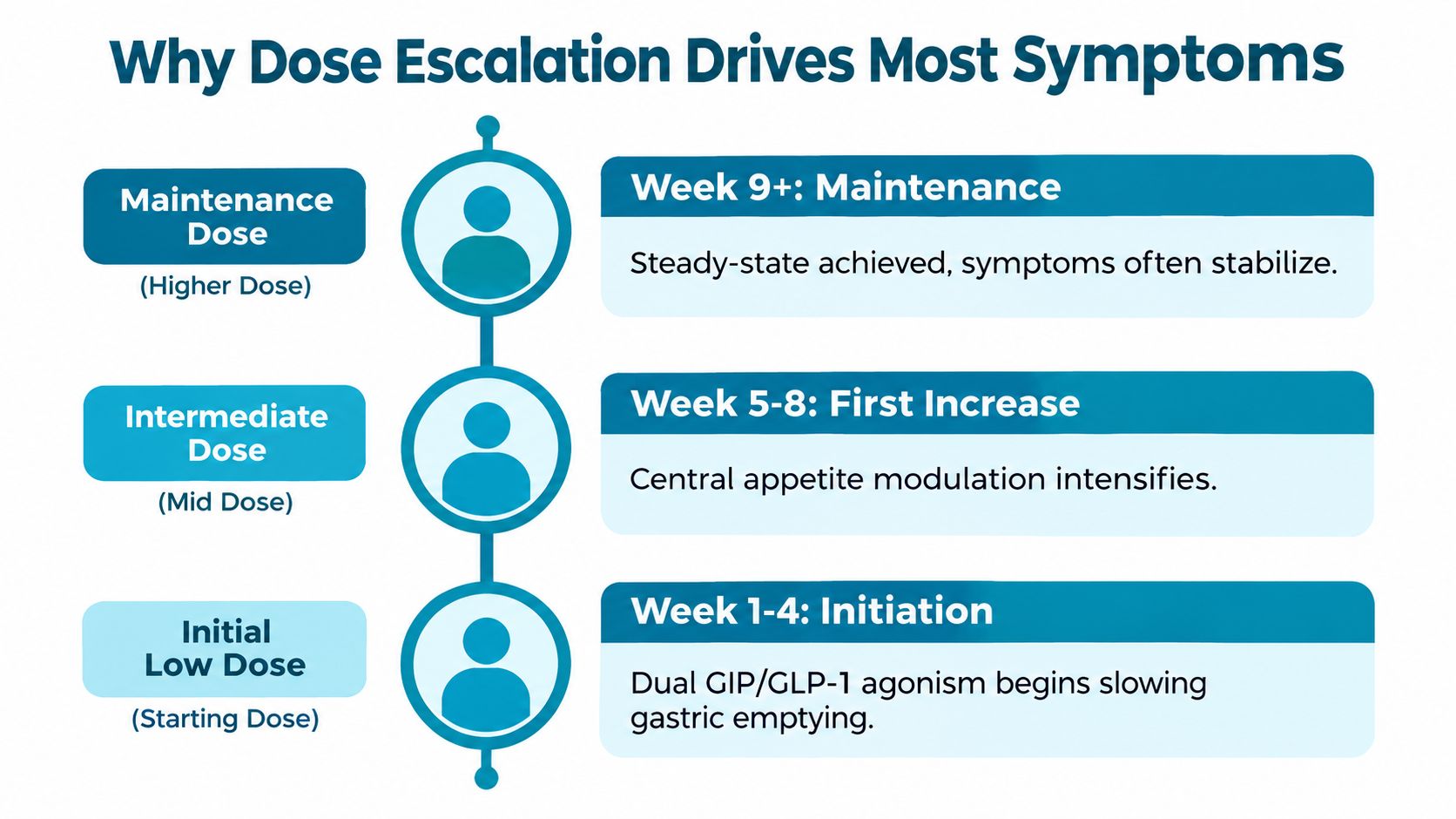
Tirzepatide activates both GIP and GLP-1 receptors. Those effects influence appetite regulation and slow gastric emptying, meaning food may remain in the stomach longer. That mechanism can support reduced appetite, but it can also produce early fullness, nausea, reflux, constipation, or vomiting, particularly while the body is adapting to a higher exposure.
The FDA label describes the clearest timing pattern: most nausea, vomiting, and diarrhea events occurred during dose escalation and decreased over time. Symptoms often become most noticeable after an increase, but the exact onset and duration vary. A patient may notice discomfort soon after an injection, while another may experience symptoms later as reduced intake and slower digestion accumulate.
Medication errors deserve attention
Predictable pharmacology isn't the only explanation for real-world side effects. A 2025 analysis of FDA Adverse Event Reporting System data identified incorrect dose administration as the top reported adverse event, with reports rising from 1,248 in 2022 to 9,800 in 2024. A larger 2026 real-world safety study found that 67.1% of reports with valid onset information occurred within 30 days, with a median onset of 13 days. These findings come from spontaneous safety reports, which can contain reporting limitations and don't establish that every event was caused by tirzepatide. They do show why product strength, injection instructions, and the prescribed schedule need careful review. The real-world pharmacovigilance analysis is useful for understanding this under-addressed safety issue.
A clinician may use slower escalation or remain at a tolerated labeled maintenance dose when symptoms interfere with treatment. That decision depends on the indication, current product, medical history, concurrent medicines, and clinical findings. Patients shouldn't accelerate, skip, repeat, pause, or reverse doses without speaking with the prescriber.
The tirzepatide dosage information can help readers understand why dose schedules require supervision, but it isn't a substitute for instructions from the clinician who prescribed the medication.
Common Versus Serious Effects at a Glance
Common gastrointestinal effects and serious warnings belong in the same conversation, but they shouldn't be treated as equivalent. Nausea, diarrhea, vomiting, constipation, and related symptoms are frequent in the FDA trial data. Serious events are less common, yet they can become time-sensitive when symptoms suggest pancreatitis, gallbladder disease, severe dehydration, a serious allergy, or another significant complication.
| Effect | How often | Tier | Typical response |
|---|---|---|---|
| Nausea | 25% at 5 mg, 29% at 10 mg, 28% at 15 mg, versus 8% placebo | Common, dose-related | Record timing, severity, and effect on intake. Discuss persistent symptoms with the prescriber. |
| Diarrhea | 19%, 21%, and 23% by listed dose, versus 8% placebo | Common, dose-related | Monitor hydration and duration. Worsening or persistent diarrhea needs clinical review. |
| Vomiting | 8%, 11%, and 13% by listed dose, versus 2% placebo | Common, dose-related | Escalate when vomiting is persistent or fluids can't be maintained. |
| Constipation | 17%, 14%, and 11% by listed dose, versus 5% placebo | Common | Track bowel changes and abdominal symptoms. Severe or persistent symptoms warrant review. |
| Dyspepsia, abdominal pain, fatigue, reflux, eructation, hair loss, injection-site reactions | Reported among common adverse reactions in the label | Common or less prominent | Document the symptom and review it at follow-up, sooner if severe. |
| Thyroid C-cell tumor warning | Boxed warning, with human risk not established | Serious warning | People with a personal or family history of medullary thyroid carcinoma or MEN 2 shouldn't use tirzepatide. |
| Pancreatitis | 0.23 patients per 100 years of exposure in one MOUNJARO-treated population versus 0.11 per 100 years in comparators; pancreatitis was 0.1% in tirzepatide randomized trials in a 2025 meta-analysis | Rare but serious | Severe, persistent abdominal pain, especially radiating to the back, requires urgent evaluation. |
| Acute gallbladder disease | 0.6% with tirzepatide versus 0% with placebo in placebo-controlled trials | Uncommon but serious | Right upper abdominal pain, fever, jaundice, or persistent vomiting needs prompt assessment. |
| Severe GI reactions and dehydration-related acute kidney injury | Severe GI reactions rose from 1.7% at 5 mg to 3.1% at 15 mg, versus 1% placebo; discontinuation rose from 3.0% to 6.6%, versus 0.4% placebo | Serious when severe or persistent | Contact a clinician urgently when vomiting or diarrhea prevents fluid intake or causes marked weakness. |
| Hypoglycemia with insulin or sulfonylureas | Risk depends on the combination and clinical context | Serious interaction risk | Shakiness, confusion, sweating, or other low-glucose symptoms require prompt attention. |
| Hypersensitivity or anaphylaxis | Listed FDA warning | Emergency risk | Facial, tongue, or throat swelling, breathing difficulty, or widespread hives requires emergency care. |
| Diabetic retinopathy complications | Relevant particularly to patients with pre-existing diabetic retinopathy | Serious eye concern | New or worsening visual changes should receive prompt medical assessment. |
Sources: FDA Zepbound approval announcement, FDA prescribing information, and 2025 randomized-trial meta-analysis.
This table is a navigation tool, not a personal risk calculator. A symptom's meaning depends on its severity, timing, associated findings, medical history, and concurrent medicines. Adults seeking broader physician-led obesity care can review how GLP-1-based treatment may be discussed in a medical obesity consultation.
A Hypothetical Look at Managing a Tough Week
Hypothetical example, not an Empire patient: Marcus is 47, has a BMI of 34, and is one week into a 7.5 mg dose. On day five after escalation, he contacts his obesity medicine prescriber because nausea has persisted, he has vomited twice, his oral intake has been about half its usual amount for 36 hours, and he feels lightheaded when standing.
The clinician doesn't tell Marcus to tolerate it or automatically abandon treatment. The first step is same-day triage. The prescriber asks about fluid intake, urination, abdominal pain, fever, blood in vomit or stool, glucose-lowering medicines, other possible causes, and symptoms suggesting dehydration or a more serious gastrointestinal problem.
If the symptoms remain significant, the clinician may temporarily pause the next weekly dose while assessing Marcus, arrange laboratory testing if symptoms continue beyond 48 hours, and consider returning to a previously tolerated labeled dose rather than continuing forward. Those are clinician-directed decisions, not a home protocol. The FDA label warns that acute kidney injury has occurred, including in the context of dehydration from nausea, vomiting, or diarrhea, which makes poor intake clinically relevant.
Practical rule: Dose titration can move more slowly, and sometimes backward, when tolerability is poor. The prescriber decides whether that is appropriate after reviewing the full situation.
Marcus would also receive guidance about warning symptoms that require urgent or emergency care, rather than waiting for a routine appointment. A nutrition-focused visit may help organize meal tolerance and hydration information, but it doesn't replace medical evaluation when vomiting, lightheadedness, or abdominal pain is significant. The nutrition care information can be a useful companion to physician-guided obesity treatment.
Readers shouldn't copy this scenario by changing their own schedule. Contact the prescribing clinician before pausing, repeating, increasing, or reducing a tirzepatide dose.
Serious Warning Signs That Need Urgent Care
Those discussing tirzepatide side effects are dealing with gastrointestinal tolerability. The symptoms below signal a different level of concern because they may indicate pancreatitis, gallbladder disease, dehydration-related kidney injury, severe hypoglycemia, anaphylaxis, or a serious eye complication.
Abdominal and hydration red flags
Seek urgent medical assessment for severe or persistent upper abdominal pain, especially pain that radiates to the back, repeated vomiting, or abdominal pain accompanied by fever or jaundice. The FDA label reports 14 adjudicated acute pancreatitis events in 13 MOUNJARO-treated adults, corresponding to 0.23 patients per 100 years of exposure, compared with 0.11 per 100 years in comparators. A separate meta-analysis found no statistically significant overall increase in pancreatitis versus pooled controls, with an estimated relative risk of 1.46 and a confidence interval crossing 1, so the absolute event rate is low while uncertainty remains because the events are rare. The FDA Mounjaro prescribing information provides the primary safety context.
Right upper abdominal pain, fever, yellowing of the skin or eyes, or persistent vomiting can also indicate gallbladder or biliary disease. Acute gallbladder disease occurred in 0.6% of tirzepatide-treated patients and 0% of placebo-treated patients in the cited placebo-controlled trials. Don't attempt to manage these symptoms by changing the next dose.
Vomiting or diarrhea that prevents keeping fluids down for more than 24 hours, very low urine output, fainting, confusion, or severe weakness raises concern for dehydration. The FDA warns that acute kidney injury has occurred and may result from dehydration related to gastrointestinal adverse reactions.
Other urgent concerns
People using insulin or a sulfonylurea may face a clinically important hypoglycemia risk with tirzepatide. Shakiness, sweating, confusion, fainting, or a glucose reading below 70 that doesn't respond to the person's established treatment plan requires prompt medical attention.
Facial, tongue, or throat swelling, trouble breathing, or widespread hives may indicate severe hypersensitivity or anaphylaxis. Call emergency services for breathing difficulty or rapidly progressing swelling. New floaters, a missing area of vision, or sudden worsening of vision also warrants urgent evaluation, especially in someone with diabetic retinopathy.
Tirzepatide carries a boxed warning about thyroid C-cell tumors. It's contraindicated in people with a personal or family history of medullary thyroid carcinoma or multiple endocrine neoplasia syndrome type 2. This history should be reviewed before treatment, not discovered after a concerning symptom appears.
What to Bring to Your Next Visit
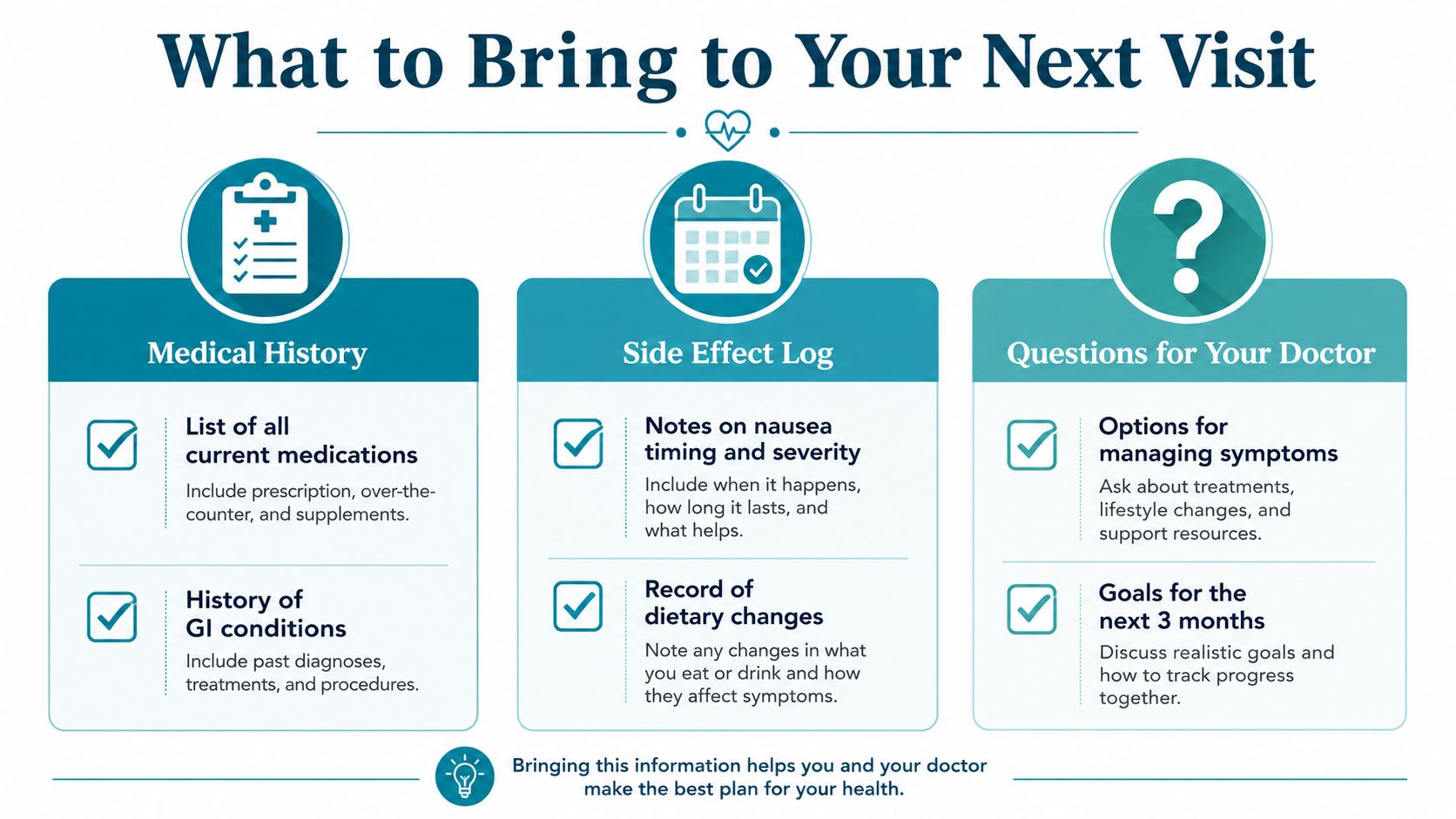
A focused visit works better when the clinician can see the medication timeline and symptom pattern. Bring the product name, indication, strength, current week of therapy, injection day, and a complete list of prescription medicines, over-the-counter products, and supplements.
Medical history to review
Tell the clinician about prior pancreatitis, gallbladder disease, gastroparesis, thyroid nodules, kidney concerns, pregnancy plans, MTC or MEN 2 history, and previous hypersensitivity reactions. Include anesthesia or planned-procedure information, because delayed gastric emptying may affect procedural planning.
Medicines and daily observations
List other GLP-1 medicines, insulin, sulfonylureas, oral contraceptives, NSAIDs, and any medication that could affect glucose, digestion, or kidney risk. Record the injection date, prescribed strength, nausea, vomiting, diarrhea, constipation, abdominal pain, oral intake, hydration, and any missed work or usual activities.
A one-page diary is enough. Use a simple severity scale, note how long each symptom lasted, and record whether you could eat and drink normally. Don't self-adjust the dose based on the diary. Bring it to the clinician, who can decide whether the pattern supports continued escalation, a pause, additional evaluation, or another plan.
Putting It All Together
The central pattern is straightforward. Nausea, diarrhea, vomiting, and constipation are common, dose-related gastrointestinal effects, while pancreatitis, gallbladder disease, severe dehydration-related kidney injury, serious hypersensitivity, hypoglycemia with certain medicines, diabetic retinopathy complications, and the thyroid C-cell tumor warning require more careful screening or urgent evaluation.
Three operating rules help keep the discussion safe. Don't change a dose without prescriber input. Treat persistent vomiting or inability to keep fluids down as urgent, especially with weakness, fainting, or reduced urination. Bring a written symptom log to every follow-up so the clinician can evaluate timing, severity, hydration, and medication context.
Empire Medical Wellness describes physician-led obesity medicine evaluation, medication monitoring, and follow-up through its obesity medicine service, including how treatment decisions may be reviewed over time. This article is educational and isn't personal medical advice.
Empire Medical Wellness offers private-pay, physician-led obesity medicine evaluations for adults considering or using treatment such as tirzepatide, with attention to tolerability, safety warnings, and follow-up planning. Visit Empire Medical Wellness to learn more about the practice and request an evaluation.