
Tirzepatide is initiated at 2.5 mg once weekly for 4 weeks, then increased in 2.5 mg steps no sooner than every 4 weeks, with maintenance doses of 5 mg, 10 mg, or 15 mg weekly and a maximum of 15 mg weekly. The exact dose and pace must be selected and changed by the prescribing clinician.
If you're comparing prescription options, reading an unfamiliar label, or wondering why a dose increase has been delayed, the numbers can seem straightforward while the clinical decisions are not. Tirzepatide is the active ingredient in Mounjaro and Zepbound, but the brands have different FDA-approved indications and monitoring goals. This guide focuses on the labeled dosing framework, the reason escalation is gradual, practical medication-use details, and symptoms that warrant prompt medical attention.
This information is written for adults considering or receiving physician-led obesity care. It doesn't replace an evaluation, prescription instructions, or follow-up with the clinician who knows your medical history.
Table of Contents
- How Tirzepatide Dosing Works
- Mounjaro Versus Zepbound Indications and Dose Ranges
- Why Dose Increases Are Spaced Four Weeks Apart
- Managing Side Effects During Titration
- Medication Use and Safety Checklist
- Discussing Your Dose With a Prescribing Clinician
- Frequently Asked Questions About Tirzepatide Dosing
How Tirzepatide Dosing Works
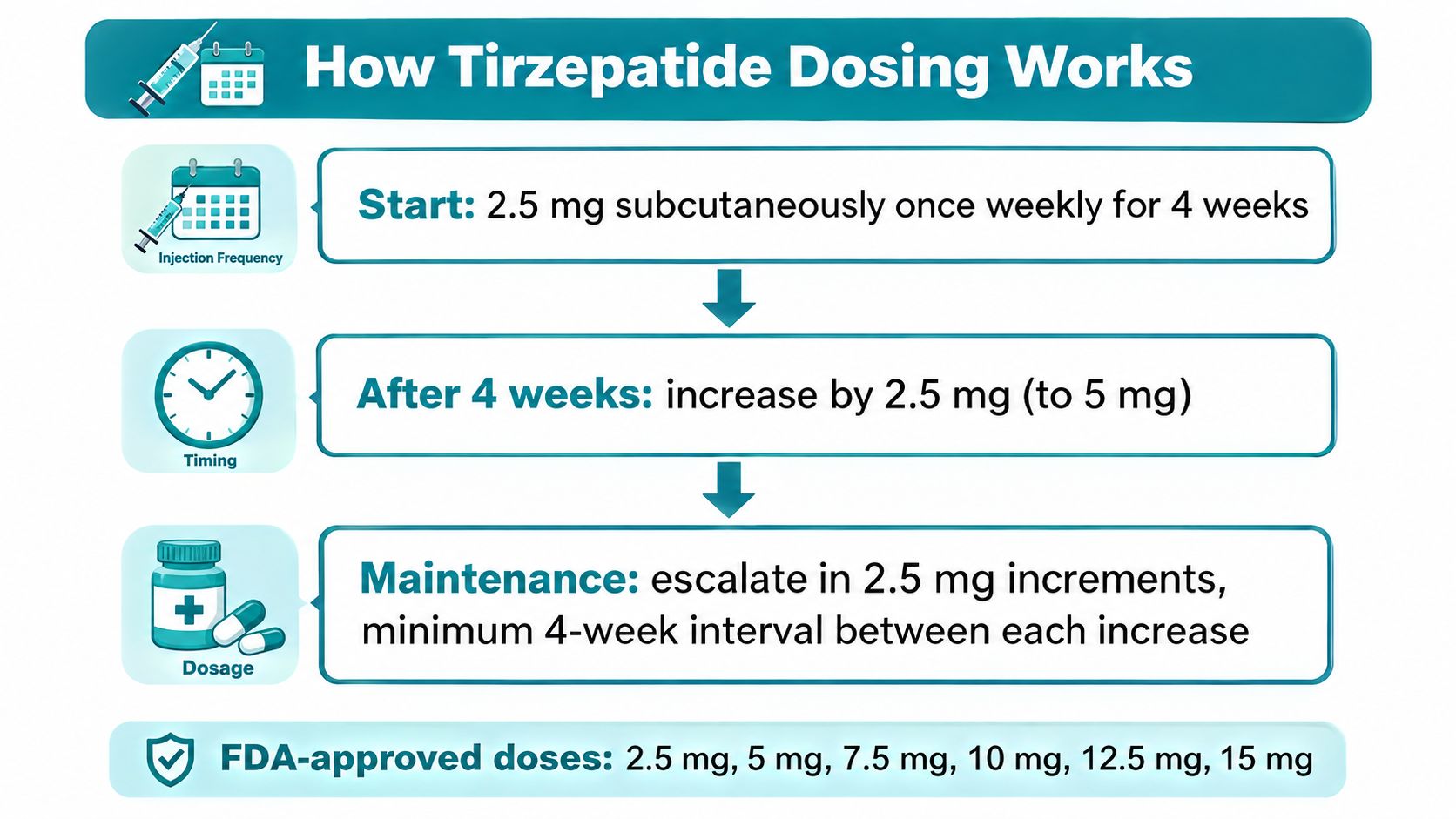
The FDA-labeled schedule begins with 2.5 mg subcutaneously once weekly for 4 weeks. A prescriber may then increase the dose by 2.5 mg, but increases shouldn't occur more often than every 4 weeks. The labeled maintenance choices are 5 mg, 10 mg, or 15 mg once weekly, and 15 mg once weekly is the maximum recommended dose for Zepbound indications. The FDA label lists dosage strengths of 2.5 mg, 5 mg, 7.5 mg, 10 mg, 12.5 mg, and 15 mg, allowing gradual escalation rather than abrupt jumps (current Zepbound FDA prescribing information).
The starter dose has a specific purpose. 2.5 mg is an initiation dose, not a maintenance dose, and it isn't intended to provide the medication's full weight-management or glycemic-control effect. It gives the body time to adjust before a clinician considers a therapeutic maintenance level. Gastrointestinal effects, including nausea, vomiting, and diarrhea, can be dose-related, so a slower pace may be clinically appropriate when tolerability is limited.
A labeled dose reference
| Dose | Role in the labeled schedule | Key point |
|---|---|---|
| 2.5 mg once weekly | Initiation | Used for the initial adjustment phase |
| 5 mg once weekly | Maintenance option | May be selected when clinically appropriate |
| 7.5 mg once weekly | Escalation strength | A step between labeled maintenance choices |
| 10 mg once weekly | Maintenance option | May be selected when clinically appropriate |
| 12.5 mg once weekly | Escalation strength | A step before the maximum dose |
| 15 mg once weekly | Maintenance option and maximum | The highest recommended weekly dose |
The four-week rule is a minimum interval, not a deadline. A clinician may hold a dose longer when symptoms, other medical conditions, concurrent medications, or treatment response make further escalation unhelpful. For general medication education outside tirzepatide, readers may also find this resource on fever relief dosage for children useful, although it concerns a different medication and patient population. For obesity-focused information, see Empire's tirzepatide care page.
Mounjaro Versus Zepbound Indications and Dose Ranges
Mounjaro and Zepbound contain the same active ingredient, tirzepatide, but they aren't interchangeable labels for the same treatment goal. Mounjaro is FDA-approved, along with diet and exercise, to improve glycemic control in adults with type 2 diabetes. Zepbound is FDA-approved for chronic weight management in adults with obesity or adults with overweight plus at least one weight-related condition. Zepbound also has an FDA-approved indication for moderate-to-severe obstructive sleep apnea in adults with obesity (Mounjaro FDA prescribing information).
The shared active ingredient doesn't erase the difference in clinical monitoring. With Mounjaro, the prescribing clinician evaluates diabetes-related treatment response and safety. With Zepbound, the clinician evaluates weight-management response, tolerability, relevant health conditions, and, when applicable, sleep-apnea treatment considerations. The prescription should identify the brand, indication, strength, and device clearly.
Mounjaro versus Zepbound FDA-approved dosing comparison
| Parameter | Mounjaro | Zepbound |
|---|---|---|
| Active ingredient | Tirzepatide | Tirzepatide |
| FDA-approved indication | Adjunct to diet and exercise to improve glycemic control in adults with type 2 diabetes | Chronic weight management in eligible adults, and moderate-to-severe obstructive sleep apnea in adults with obesity |
| Initiation dose | 2.5 mg once weekly | 2.5 mg once weekly |
| Initial duration | 4 weeks before an increase may be considered | 4 weeks before an increase may be considered |
| Titration increment | 2.5 mg, no more often than every 4 weeks | 2.5 mg, no more often than every 4 weeks |
| Maintenance choices | 5 mg, 10 mg, or 15 mg once weekly | 5 mg, 10 mg, or 15 mg once weekly for weight management, and 10 mg or 15 mg once weekly for obstructive sleep apnea |
| Maximum dose | 15 mg once weekly | 15 mg once weekly |
The 2.5 mg strength is used to begin treatment, while the approved maintenance choices depend on the product and indication. A person shouldn't use a Mounjaro prescription to self-direct obesity treatment, or assume that a Zepbound dose answers a diabetes-management question. Only the prescriber should select or change treatment. Readers comparing brand-specific information can review the Zepbound dosage reference while checking the product label supplied with their prescription.
Why Dose Increases Are Spaced Four Weeks Apart
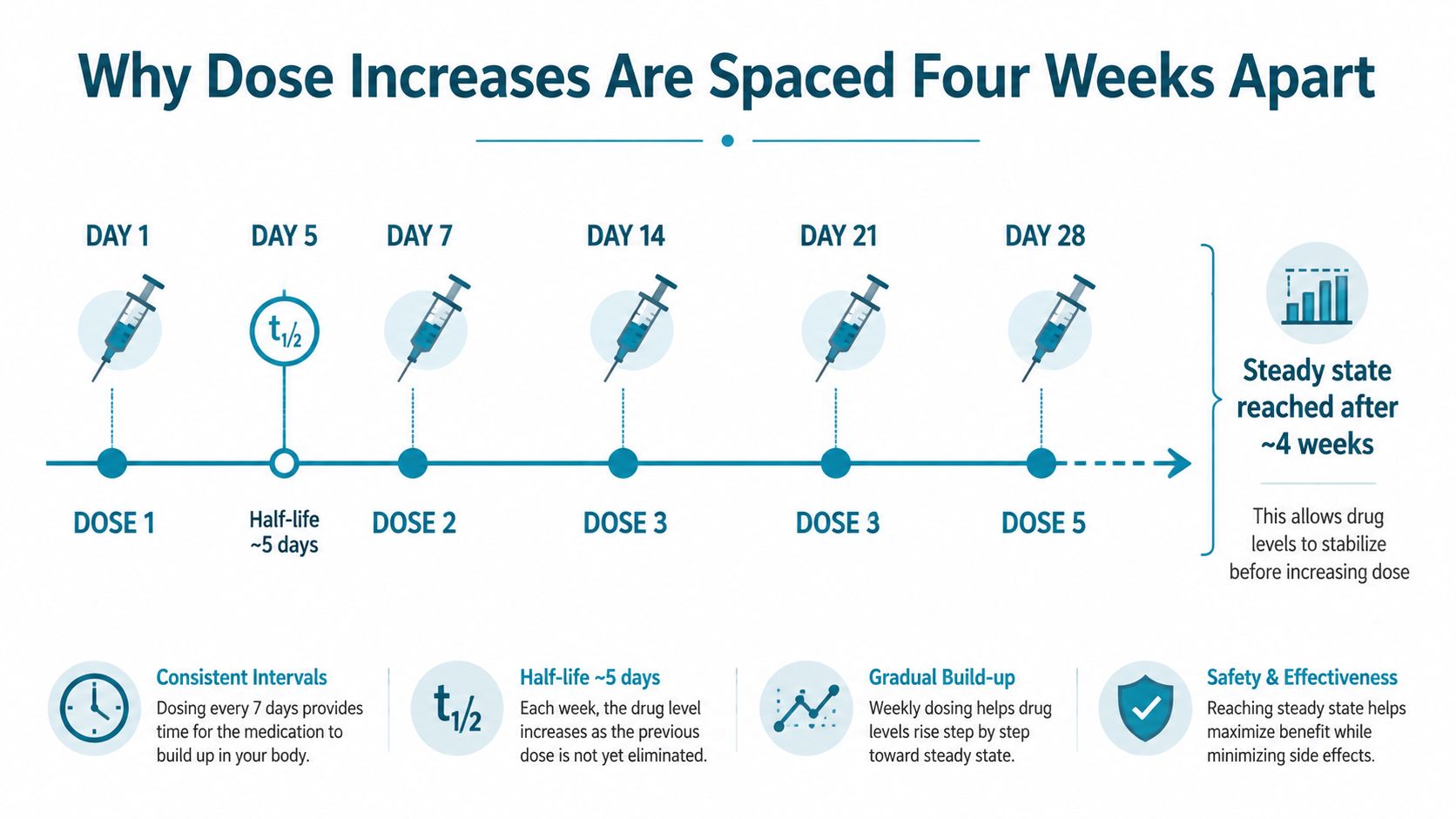
A person may feel ready to increase tirzepatide after a few weekly injections, especially if early effects seem limited. The four-week interval exists because the medicine remains in the body between injections. It follows pharmacology, not an arbitrary calendar rule. Tirzepatide has a terminal elimination half-life of about 5 days, and weekly dosing reaches pharmacokinetic steady state after roughly 4 weeks, according to the FDA clinical pharmacology review.
A half-life is the approximate time required for the body to reduce the amount of a medicine by half. Since tirzepatide persists for several days, each weekly injection overlaps with medication from earlier doses. Waiting at the current strength gives exposure time to settle before the prescriber considers another increase.
What steady state means clinically
Rapid escalation can make symptoms harder to interpret. A clinician may not be able to tell whether nausea, vomiting, or diarrhea reflects the prior dose, the new dose, or medication that is still accumulating. The FDA-approved label therefore uses a stepwise schedule, which takes priority over online charts and informal calendars.
The SURMOUNT-1 dosing framework used maintenance targets of 5 mg, 10 mg, and 15 mg weekly after an initial 2.5 mg lead-in, with dose steps separated by fixed four-week intervals during the 72-week study period. This trial framework illustrates how tirzepatide was studied, not a timetable that every patient should follow automatically. It also does not replace the FDA labeling distinctions between Mounjaro for type 2 diabetes and Zepbound for chronic weight management or obstructive sleep apnea. For product-specific information, review this Mounjaro dosage guide.
Practical rule: A higher dose is useful only when it is appropriate for the indication and remains tolerable.
The initiation dose has a limited purpose: introducing treatment gradually. Maintenance selection depends on the prescription, clinical response, and tolerability. Increasing sooner to seek faster results does not follow the labeled schedule and may increase avoidable adverse effects. The prescribing clinician, rather than the calendar, decides whether the next step is appropriate.
Managing Side Effects During Titration
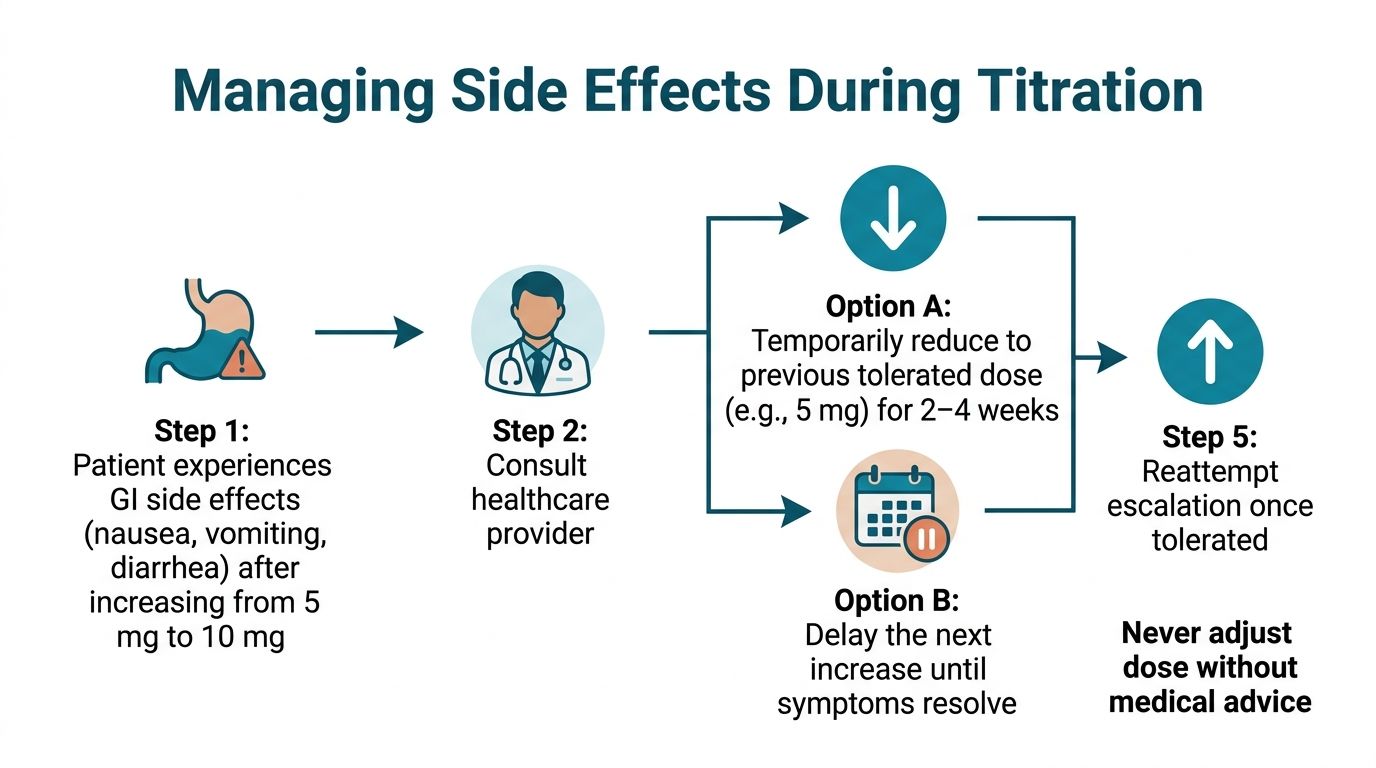
Consider this labeled hypothetical example, not a patient story. An adult tolerates 5 mg but develops nausea, vomiting, or diarrhea after a clinician increases the prescription toward 10 mg. The appropriate response isn't to push through automatically or change the injection independently. The prescriber reassesses symptom severity, hydration, food and fluid intake, other possible causes, concurrent medicines, and the current FDA label.
Depending on that assessment, the clinician may delay a further increase, keep the person at a tolerated labeled maintenance dose, or determine that a previously tolerated dose is more appropriate. For Zepbound, any increase is made in 2.5 mg steps after at least 4 weeks at the current dose. The schedule doesn't require a patient to reach the maximum dose, and the maintenance dose should reflect clinical need and tolerability (Zepbound FDA prescribing information).
A tolerability check before escalation
A simple log can make follow-up more useful. Record the injection day, current prescribed strength, nausea, vomiting, diarrhea, abdominal discomfort, ability to drink, food intake, and any other new medication or supplement. Don't use the log to calculate a new dose. Use it to give the prescriber a clearer timeline.
- Mild and improving symptoms: Report them according to the clinician's plan and ask whether the current schedule remains appropriate.
- Symptoms that interfere with eating or drinking: Contact the prescriber promptly rather than proceeding with an unreviewed escalation.
- Repeated vomiting or diarrhea: Ask for medical guidance because fluid loss can create complications, including kidney-related concerns.
- Severe or persistent abdominal pain: Seek urgent medical evaluation, especially if pain radiates to the back or is accompanied by vomiting.
Many gastrointestinal symptoms occur during initiation or early titration and may improve as the body adjusts, but the experience varies. A symptom shouldn't be dismissed just because it can occur with the medication. Severe abdominal pain may signal pancreatitis or gallbladder disease, while persistent vomiting can contribute to dehydration.
When symptoms are red flags
Call the prescribing clinician promptly for symptoms that are persistent, worsening, or preventing adequate fluid intake. Seek urgent care for severe abdominal pain, facial or throat swelling, trouble breathing, fainting, confusion, or other signs of a serious reaction. If symptoms feel severe or life-threatening, use emergency services rather than waiting for a routine appointment.
The prescribing clinician must direct every dose adjustment. Don't split, combine, skip, or repeat injections to compensate for side effects or to reach a different strength. A Mounjaro side-effects resource can provide additional brand-specific context, but it can't replace medical assessment.
Medication Use and Safety Checklist
Safe use involves more than remembering the milligram number. Before each follow-up, confirm the product name, strength, device, weekly injection day, storage conditions, missed-dose instructions, and any symptoms since the last visit. This is especially useful when prescriptions change, pharmacies dispense a different device, or more than one clinician is involved in care.
Weekly-use checklist
- Confirm the prescription: Check the exact brand, strength, device, and weekly day. Don't measure or transfer medication based on memory or an online conversion chart.
- Use the labeled injection sites: Tirzepatide is injected subcutaneously in the abdomen, thigh, or upper arm. Rotate sites to reduce repeated irritation in one area.
- Keep the schedule consistent: It can be administered at any time of day, with or without food. Use the same weekday unless the prescriber gives different instructions.
- Handle a missed dose correctly: If the missed dose is within 4 days, the FDA label says to administer it. If more than 4 days have passed, skip it and resume the regular schedule. Don't administer two doses close together.
- Store it properly: Follow the product-specific FDA Instructions for Use and pharmacy labeling. Refrigerated storage is generally described as 36°F to 46°F, with permitted room-temperature handling of up to 21 days at up to 86°F for the applicable product instructions, and protection from light (FDA Zepbound prescribing information).
- Bring your log to appointments: Record symptoms, hydration concerns, injection timing, and questions. Don't use it to independently alter treatment.
For broader continuity of care, a structured medication review service may help patients organize questions about multiple prescriptions, but tirzepatide changes still require the prescribing clinician.
Symptoms that deserve prompt attention
Contact the prescriber about ongoing vomiting, significant diarrhea, reduced fluid intake, or symptoms suggesting dehydration. Severe abdominal pain that may radiate to the back can require urgent assessment for pancreatitis. Right-sided abdominal discomfort, fever, jaundice, or other concerning symptoms may require evaluation for gallbladder disease.
People using insulin or a sulfonylurea have a particular need to discuss low-blood-sugar symptoms and monitoring with the treating clinician. Signs can include shakiness, sweating, confusion, unusual weakness, or fainting. A serious allergic reaction, including swelling of the face, lips, tongue, or throat or difficulty breathing, requires emergency care.
Keep the medication box, device instructions, and an up-to-date medication list available for every clinical review.
Discussing Your Dose With a Prescribing Clinician
Tirzepatide dosing isn't a one-size-fits-all ladder. Two adults can receive the same starting prescription and have different experiences with nausea, appetite changes, hydration, other medical conditions, concurrent medicines, and treatment goals. The FDA label supplies the allowable framework, while the prescriber determines whether a specific increase is clinically appropriate.
A useful appointment conversation focuses on patterns rather than a single difficult day. Bring a record of injection dates, symptoms, food and fluid intake, weight trends when relevant, and any changes in prescriptions or supplements. For people using Mounjaro for type 2 diabetes, glucose information and diabetes medicines matter. For people using Zepbound, weight-management response, tolerability, and relevant comorbidities guide the discussion.
Questions worth bringing
- Is the current dose serving its labeled purpose? The 2.5 mg strength is an initiation dose, while maintenance decisions use the labeled options for the indication.
- Is an increase necessary now? A person who is responding adequately and tolerating treatment may not need the maximum dose.
- Would holding the current dose be safer? The minimum four-week interval doesn't require escalation immediately after that interval.
- Could another medicine affect safety? Insulin, sulfonylureas, supplements, and medicines that affect hydration or gastrointestinal function should be reviewed.
The maximum of 15 mg weekly is a ceiling, not a target everyone must reach. A clinician may keep a patient at a lower labeled maintenance dose when the treatment goal is being addressed with acceptable tolerability. Conversely, a clinician may reassess the entire plan if symptoms are persistent or the expected clinical response isn't developing.
Adults seeking physician-guided obesity care can review Empire's weight-management services. Empire Medical Wellness describes its care model as including medical assessment, individualized weight-management planning when appropriate, monitoring, and long-term maintenance planning. Treatment decisions remain specific to the individual evaluation and prescribing relationship.
Frequently Asked Questions About Tirzepatide Dosing
Can a higher-dose pen be split to create a lower dose?
No. A pen is dose-specific and intended for the labeled single use described in the FDA Instructions for Use. Don't attempt to extract, divide, transfer, or measure part of a pen to create another dose. If the prescribed strength seems too high or the device doesn't match the prescription, contact the pharmacy or prescriber before using it.
What happens if more than 4 days have passed since a missed dose?
If more than 4 days have passed, skip the missed dose and resume on the next scheduled day. Don't double-dose or take injections close together to compensate. If multiple doses have been missed, contact the prescriber because the safest restart plan can depend on the treatment history and current product instructions.
Can a prescriber reduce the dose after side effects appear?
Yes. A prescriber may step back to a previously tolerated dose within the approved range or delay further escalation when symptoms make the higher dose unsuitable. The patient shouldn't make that change independently, because the clinician may need to evaluate dehydration, abdominal symptoms, other causes, and interacting medicines first.
Does the injection need to be tied to meals?
No. Tirzepatide can be administered at any time of day, with or without food. Keeping a consistent weekday can make weekly administration easier to remember, but a missed-dose situation should be handled according to the FDA label rather than improvised.
Individualized questions about tirzepatide dosages, brand selection, side effects, or missed injections should go to the prescribing clinician. This article is educational and isn't personal medical advice.
Empire Medical Wellness provides physician-led obesity medicine evaluation, individualized treatment planning when clinically appropriate, and follow-up focused on response and tolerability. Visit Empire Medical Wellness to learn about the practice's physician-guided care for adults considering or using weight-management medication.