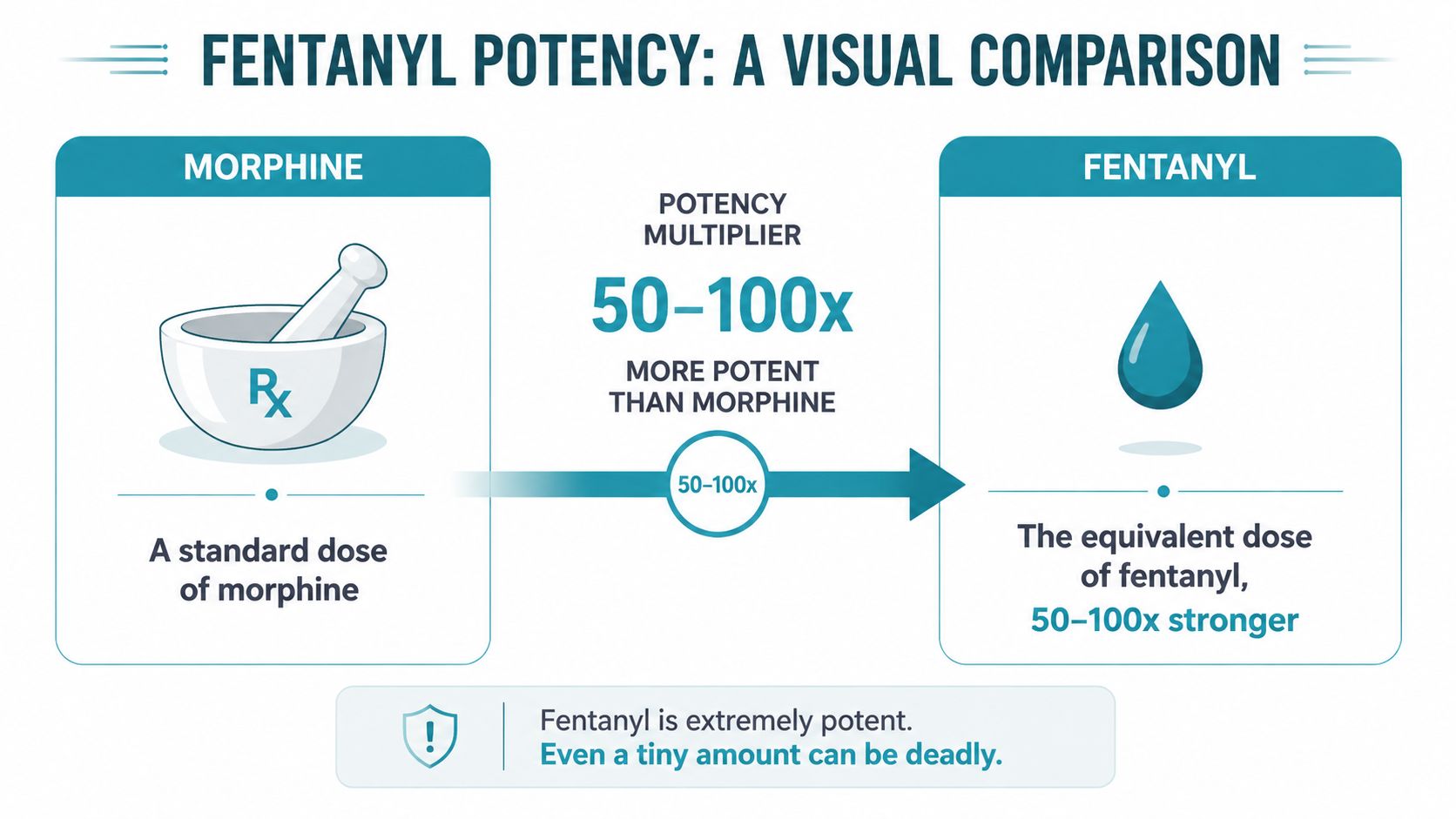
Fentanyl is a synthetic opioid 50 to 100 times more potent than morphine, and most current harms stem from illegally manufactured fentanyl contaminating the drug supply. Its danger comes not only from potency, but also from unpredictable mixtures, rapid respiratory depression, and the fact that a person may not know fentanyl is present.
The scale is difficult to ignore. Synthetic opioid overdose death rates rose from 0.5 per 100,000 people in 2003 to 21.8 per 100,000 in 2021, remained high at 22.7 per 100,000 in 2022, and were 22.2 per 100,000 in 2023, according to the CDC's National Center for Health Statistics. Fentanyl has reshaped opioid risk in the United States, but an overdose remains treatable when someone recognizes the signs, calls emergency services, gives naloxone, and continues monitoring.
This guide focuses on fentanyl safety, overdose response, harm reduction, and outpatient addiction medicine. It doesn't diagnose a substance use disorder or replace emergency care.
Byline: Empire Medical Wellness Editorial Team
Published: August 23, 2026
Updated: August 23, 2026
Table of Contents
- What Fentanyl Is and Why Potency Matters
- How Fentanyl Reshaped Overdose Mortality
- The Changing Illicit Supply and Adulterant Risks
- Recognizing Overdose and Responding with Naloxone
- Harm-Reduction Tools and Safer-Use Practices
- What an Outpatient Opioid Evaluation Looks Like
- A Monitoring Framework for Opioid Use Disorder Care
- Common Questions About Fentanyl Safety and Treatment
What Fentanyl Is and Why Potency Matters
Fentanyl is a fully synthetic opioid, meaning it's manufactured rather than derived directly from the opium poppy. Clinical references describe pharmaceutical fentanyl as about 50 to 100 times more potent than morphine. Its high receptor activity means that very small measurement errors can cause profound central nervous system depression, especially in someone without opioid tolerance. The CDC's fentanyl facts explains that fentanyl is lipophilic, so it can cross into the central nervous system quickly and bind to μ-opioid receptors.
Pharmaceutical and illicit fentanyl aren't the same supply
Pharmaceutical fentanyl is used in carefully controlled medical settings, including surgical anesthesia and treatment of severe pain. It may be delivered through forms such as injections, transdermal patches, or lozenges, depending on the clinical situation and prescribing information. The FDA's fentanyl prescribing information emphasizes that potent opioids require careful patient selection, monitoring, and safe handling.
Illicitly manufactured fentanyl, often abbreviated IMF, is made outside regulated pharmaceutical systems. It may appear in powders or counterfeit tablets designed to resemble other prescription medicines, and it can be mixed with other drugs. The CDC's overview of fentanyl states that most fentanyl-related harms are associated with illegally made fentanyl, while legal fentanyl continues to have legitimate medical uses.
The distinction matters because a prescribed product has known ingredients, labeled strength, and a medical context. An illicit product has none of those protections. A person may believe they're taking a familiar pill or stimulant and unknowingly encounter an opioid capable of suppressing breathing.
For confidential outpatient assessment and evidence-based addiction care when clinically appropriate, adults can review Empire Medical Wellness addiction medicine services. Emergency symptoms always require 911, not a routine appointment.
How Fentanyl Reshaped Overdose Mortality
Fentanyl's public-health significance is visible in the mortality record. One peer-reviewed analysis reported 2,139 unintentional fentanyl overdose deaths in 2012 and 70,813 in 2022, a 31-fold increase over that decade. The analysis is available through the National Library of Medicine.
CDC reporting also found that fentanyl-involved overdose death rates increased 279%, from 5.7 per 100,000 in 2016 to 21.6 per 100,000 in 2021. The highest rates in that 2021 analysis occurred among adults ages 35 to 44 and 25 to 34, as described in the CDC National Center for Health Statistics report.
Selected mortality markers
| Year | Estimated or reported deaths | Share of overdose deaths | What the data show |
|---|---|---|---|
| 2003 | Synthetic opioid rate of 0.5 per 100,000 | Not provided in the cited CDC framework | Synthetic opioids were a far smaller mortality driver |
| 2012 | 2,139 unintentional fentanyl deaths | Not provided | A historical baseline before the steep rise |
| 2021 | Synthetic opioid rate of 21.8 per 100,000 | Not provided in this row | Fentanyl had become a central overdose driver |
| 2022 | Fentanyl-related deaths reported at about 73,838 | Not provided in this row | The highest number then recorded in the cited analysis |
| 2023 | Synthetic opioid rate of 22.2 per 100,000 | About 69% of all overdose deaths involved synthetic opioids | Mortality remained exceptionally high despite edging down from 2022 |
The numbers don't mean every community experienced the same pattern. Illicit supply changes occur at different times and can involve different combinations of opioids, stimulants, sedatives, and other substances. A national decline can therefore coexist with serious local risk.
More recent reporting points in the same direction, but it shouldn't be interpreted as an all-clear. A 2026 report on provisional overdose data described roughly 69,973 overdose deaths in 2025, a 14% decline from 2024, while also noting uneven state patterns and continuing tens of thousands of fentanyl-involved deaths. Mortality is a lagging measure. It tells us what happened, not necessarily what changed in the supply yesterday or what risk a person faces today.
The Changing Illicit Supply and Adulterant Risks
A fentanyl-positive toxicology result doesn't necessarily mean fentanyl was the only substance involved. The illicit supply can contain mixtures, and the combination may change the clinical picture, the speed of deterioration, and the apparent response to naloxone.
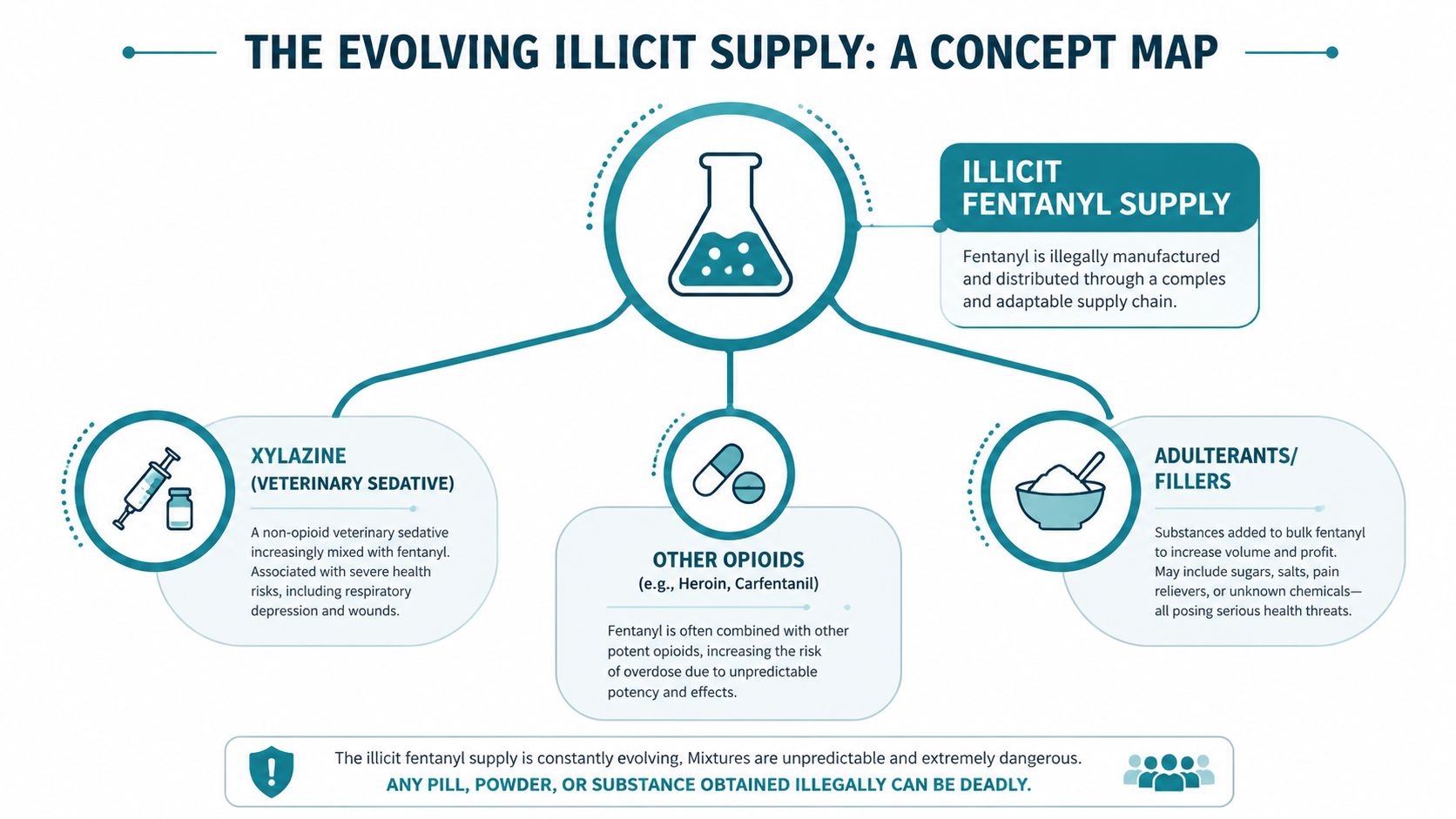
The DEA's 2025 National Drug Threat Assessment describes declining fentanyl purity and changing adulterant patterns. It reported that xylazine appeared in 36% of fentanyl powder samples in 2024. A regional report cited in the same verified data found xylazine positivity in fentanyl samples fell from 97% in the first quarter of 2024 to 28% in the third quarter of 2025, while medetomidine increased.
Why mixtures complicate overdose response
Xylazine is a veterinary sedative that can cause marked sedation and other harmful effects. Naloxone reverses opioid effects, but it doesn't reverse non-opioid sedation caused by xylazine. Medetomidine, another sedating alpha-2 agonist, has also emerged in changing illicit mixtures. A person may therefore remain unresponsive even after naloxone has addressed the opioid component.
That apparent lack of response is not a reason to stop helping. Call 911, give naloxone when opioid overdose is suspected, support breathing as trained, and remain with the person until emergency responders arrive. Continued unresponsiveness can reflect severe opioid toxicity, another sedative, or both.
Practical rule: Naloxone may not restore consciousness when a mixture contains non-opioid sedatives. Keep treating the situation as an emergency.
Other substances can contribute to poly-substance toxicity, including benzodiazepine-like compounds and other opioids. The risk isn't just the presence of one named adulterant. It's the uncertainty about concentration, distribution, interactions, and the person's health.
That uncertainty makes layered protection more useful than relying on a single test or assumption. Drug checking, avoiding solitary use, keeping naloxone accessible, and knowing the signs of respiratory depression each address a different failure point.
Recognizing Overdose and Responding with Naloxone
Treat suspected fentanyl overdose as a medical emergency. The clearest warning signs include:
- Unresponsiveness: The person doesn't wake to their name or a firm shoulder tap.
- Abnormal breathing: Breathing is slow, shallow, irregular, or absent.
- Pupil changes: Pupils may be very small, although this sign isn't present in every overdose.
- Color change: Lips or fingertips may look blue, gray, or unusually pale.
- Body changes: The person may make choking, gurgling, or snoring sounds and may become limp.
Fentanyl can cause rapid respiratory depression. Some severe opioid overdoses can also involve chest-wall rigidity, which may make ventilation difficult. Naloxone can reverse opioid receptor effects, but it won't reverse sedation from xylazine, medetomidine, alcohol, or benzodiazepines.
The emergency sequence
- Call 911 immediately. Put the phone on speaker if possible and tell the dispatcher the person may have overdosed. Give the location and follow dispatcher instructions.
- Give naloxone if it's available. Use the product according to its label. Intranasal naloxone is placed in the nostril, while injectable products must be used according to their specific instructions.
- Support breathing. If the person isn't breathing normally and you're trained to do so, provide rescue breaths. Follow dispatcher guidance. Avoid delaying emergency care while searching for certainty about what was taken.
- Stay with the person. If they're breathing but remain drowsy or unresponsive, place them in the recovery position if it can be done safely. Keep watching their breathing.
A person may wake and then become sedated again because naloxone can wear off while opioid effects continue. That's why emergency evaluation remains necessary even when the person appears better. If there's no response, continue emergency measures and follow 911 instructions. Repeated naloxone administration may be needed, but a bystander should follow the product label and dispatcher guidance rather than improvise dosing.
For a concise discussion of what happens after emergency stabilization, this overview of fentanyl overdose treatment options may help readers prepare questions. It isn't a substitute for 911 or emergency medical evaluation.
Naloxone access and training are also part of outpatient safety planning. Empire Medical Wellness naloxone guidance can help adults understand reversal medication and discuss access with a clinician.
Harm-Reduction Tools and Safer-Use Practices
Harm reduction doesn't endorse drug use. It recognizes that people may face risks before they're ready or able to stop, and it offers practical ways to reduce death and injury while connecting them with care.
No single tool detects every danger. Fentanyl test strips can identify fentanyl in a sample under appropriate testing conditions, but they don't measure concentration or guarantee that the tested portion represents the entire supply. A negative result therefore isn't proof that a substance is safe.
Three layers of protection
| Tool or practice | What it can help with | Limits to understand |
|---|---|---|
| Fentanyl test strips | Can flag fentanyl presence in a tested sample | Doesn't establish strength, uniform distribution, or the presence of every adulterant |
| Advanced drug checking | Services using methods such as mass spectrometry or FTIR can identify a broader range of compounds | Availability varies, and results still represent the submitted sample |
| Social and emergency safeguards | Naloxone, avoiding use alone, and avoiding combinations with alcohol or sedatives can reduce the chance of an unattended fatal overdose | These measures don't remove the toxicity of an unpredictable supply |
Testing for fentanyl also doesn't necessarily identify xylazine or medetomidine. A person who relies on one strip may miss a second substance that changes sedation or breathing. Layering tools is more protective than treating a test result as a safety certificate.
Safety planning works best when it anticipates uncertainty. Keep naloxone nearby, tell someone what to do in an emergency, and treat abnormal breathing as an emergency even when the substance is unknown.
Avoiding combinations is particularly relevant because opioids, alcohol, benzodiazepines, and other sedatives can all impair breathing or consciousness. If someone is using despite these risks, never-using-alone services or a trusted person who knows how to call 911 and administer naloxone can reduce isolation. Local syringe-service programs and public-health departments may also provide naloxone, testing supplies, education, and referrals.
The safest option is not to use an unregulated drug. If stopping has become difficult, a clinician can assess opioid use disorder, overdose risk, withdrawal, medical conditions, and treatment preferences without reducing the person to a label.
What an Outpatient Opioid Evaluation Looks Like
The following is a labeled hypothetical example, not an Empire patient story or clinical outcome. It shows how an outpatient evaluation might proceed without assuming that a single symptom, toxicology result, or medication name determines the diagnosis.
Immediate safety comes first
A clinician would begin by asking about recent opioid or other substance use, prior overdose, current alertness, access to naloxone, breathing concerns, and immediate safety. If someone appears to be overdosing, outpatient evaluation is the wrong setting. The person needs 911 and emergency care.
Once immediate danger has been addressed, the assessment can become more detailed. It may include a substance and medication history, screening for opioid use disorder, review of withdrawal and craving, urine drug testing when clinically appropriate, and evaluation for pain, pregnancy, infectious disease risk, sleep problems, and mental-health concerns.
A test result is evidence, not a diagnosis. Clinicians interpret it alongside the person's history, goals, symptoms, prescribed medicines, and safety context.
Shared medication decisions
For opioid use disorder, a clinician may discuss buprenorphine, methadone, or extended-release naltrexone. These medications work differently and aren't interchangeable.
- Buprenorphine is a partial opioid agonist. It can reduce withdrawal and cravings, but starting it at the wrong point in relation to ongoing opioid use can cause precipitated withdrawal.
- Methadone is a full opioid agonist provided through regulated treatment systems. It can reduce withdrawal and cravings, while requiring careful attention to interactions, sedation, and other safety factors.
- Extended-release naltrexone is an opioid antagonist. It blocks opioid effects, but a person must be free of opioids before treatment begins, and loss of tolerance can increase overdose risk if opioid use resumes.
The choice depends on clinical assessment and patient preference. Adults seeking a physician-led evaluation can review Empire's addiction medicine specialist information, while remembering that the practice doesn't provide emergency, inpatient, or residential detoxification care.
Follow-up may include symptom review, medication monitoring, naloxone planning, psychosocial support referrals, and coordination with outside clinicians when authorized. Telemedicine can support continuity when the patient is physically located in a state where the practice's workflow permits care, but it doesn't replace emergency services.
A Monitoring Framework for Opioid Use Disorder Care
A useful monitoring plan turns broad goals such as “stay safe” or “reduce cravings” into observable measures. It should be agreed upon with a qualified clinician and adjusted for the person's health, treatment, housing, work, transportation, and support context.
| Measure | Baseline | Reassessment interval | Safety threshold or escalation point | Missing-data rule |
|---|---|---|---|---|
| Overdose risk | Recent opioid use, prior overdose, sedative use, naloxone access | At each clinical contact | Any abnormal breathing, unresponsiveness, or suspected overdose requires emergency action | Treat unknown information as unresolved risk, not as reassurance |
| Craving and withdrawal | Patient-described intensity and timing | Early follow-up, then according to clinical need | Worsening symptoms, return to uncontrolled use, or inability to take medication safely warrants prompt contact | Ask again rather than infer from appearance |
| Medication use | Current prescribed and non-prescribed substances | Each medication review | Missed medication, unexpected sedation, or concerning interaction requires clinician review | Reconcile all medicines and document uncertainty |
| Function and sleep | Work, relationships, sleep, and daily activities | Reassess with treatment response | Deterioration, confusion, or new mental-health concern may require escalation | Record the patient's context and barriers |
| Recovery and support | Existing counseling, peer support, family support, and care partners | Periodically and after major changes | Loss of support or inability to access care should prompt safety-plan revision | Document what wasn't assessed and why |
These categories align with the safety-centered approach described in SAMHSA TIP 63, NIDA opioid treatment resources, FDA medication labeling, and current federal opioid treatment standards under 42 CFR Part 8.
A hypothetical monitoring record might show a person reporting moderate cravings at baseline, improved sleep after treatment begins, and a later return to frequent unregulated opioid use. Those values are illustrative only. The clinically meaningful point is the decision: renewed use plus reduced naloxone access should trigger a prompt safety review, not a judgment or automatic discharge.
For a plain-language discussion of symptoms that can occur when opioid use changes, see opioid withdrawal manifestations. Don't attempt to manage severe withdrawal or medication changes without medical guidance.
Common Questions About Fentanyl Safety and Treatment
Can fentanyl exposure happen through casual contact?
Routine skin contact with an unknown surface isn't the same as ingesting, inhaling, or injecting fentanyl. The emergency concern is exposure that produces opioid symptoms, especially unresponsiveness or abnormal breathing. Don't delay calling 911 while trying to identify the substance.
Does naloxone work if xylazine or medetomidine is present?
Naloxone can reverse opioid effects, but it doesn't reverse sedation from non-opioid substances. Give naloxone when opioid overdose is suspected, call 911, support breathing as trained, and continue monitoring. A partial response doesn't mean help is futile.
Is physical dependence the same as addiction?
No. Physical dependence means the body has adapted to a substance, so stopping or reducing it can produce withdrawal. Addiction, commonly discussed clinically as a substance use disorder, involves a pattern of impaired control, continued use despite harm, and other diagnostic features. A clinician considers the full history rather than one symptom.
Are fentanyl test strips enough?
No. They can flag fentanyl in a tested sample, but they don't determine concentration or detect every adulterant. They work best as one part of a broader safety plan that includes naloxone and emergency preparedness.
What happens at a first outpatient appointment?
Expect questions about substance use, medications, overdose history, withdrawal, cravings, health conditions, mental health, and treatment goals. The clinician may discuss medication options, monitoring, support, and coordination with other care. Adults searching for fentanyl detox help should distinguish outpatient addiction care from emergency or medically supervised withdrawal services.
Medication treatment isn't automatically appropriate for every person, and no single option fits every situation. Suboxone treatment information can help readers prepare questions, but a clinician must determine whether buprenorphine is suitable and how it should be started safely.
If someone is unresponsive or breathing abnormally, call 911 and administer naloxone if available. This article is educational and isn't personal medical advice.
Empire Medical Wellness offers confidential, physician-led outpatient addiction medicine evaluations, evidence-based treatment when clinically appropriate, monitoring, recovery planning, and coordination with outside clinicians or programs when authorized. Visit Empire Medical Wellness to learn about the practice and decide whether a private outpatient consultation fits your needs.