
If you're dealing with opioid withdrawal manifestations right now, the short answer is this, the syndrome is usually a predictable rebound after opioid levels fall, and it tends to feel like a severe flu with sweating, restlessness, stomach upset, insomnia, and body aches. The exact timing depends on the opioid involved, and the symptoms can be uncomfortable enough that they deserve medical assessment, not guesswork.
Table of Contents
- What Opioid Withdrawal Manifestations Are and Who This Article Is For
- Why Withdrawal Happens, the Hyperadrenergic Rebound
- The Core Symptom Clusters You Should Recognize
- How Opioid Half-Life Shapes the Withdrawal Timeline
- How Clinicians Measure Withdrawal Severity
- When Withdrawal Becomes Medically Concerning
- Evidence-Based Outpatient Care Pathways
- Key Takeaways and When to Reach Out for Confidential Care
What Opioid Withdrawal Manifestations Are and Who This Article Is For
Opioid withdrawal manifestations are the physical, autonomic, and emotional signs that can appear when a person who has developed physiologic dependence on an opioid suddenly reduces or stops it. They answer the questions people usually have first, what it feels like, how long it lasts, what is dangerous, and when it's time to get medical help. If you're trying to make sense of what your body is doing, the pattern is recognizable and studied, not random.
This topic matters for adults using prescribed opioids, people using non-prescribed opioids, family members trying to help, and clinicians or students who want a structured clinical reference. The symptoms are not a moral issue. They're the body's response to a sudden change in a drug that has been suppressing pain, slowing gut activity, and altering stress signaling.
A useful way to read the rest of this is to think in layers. First, there's the mechanism, the hyperadrenergic rebound that explains why withdrawal feels so intense. Then there are the symptom clusters, the timeline by opioid type, the way clinicians measure severity, the situations where withdrawal becomes medically concerning, and the outpatient care pathways that are commonly used in physician-led addiction medicine, including confidential addiction medicine evaluation.
Practical rule: withdrawal symptoms are often distressing, but the pattern itself is usually recognizable and time-limited. The right question is not “am I weak enough to endure this?” It's “what level of care fits the symptoms I'm having?”
Why Withdrawal Happens, the Hyperadrenergic Rebound
Chronic opioid use does more than blunt pain. It also quiets the brain's stress circuitry, especially the locus coeruleus and the noradrenaline pathways it helps regulate. Over time, that dampening contributes to sedation, pain relief, and slower gut motility.
When the opioid is reduced or stopped, the suppressed system rebounds. The result is a hyperadrenergic state, meaning the body's alarm signaling rises too high for a period of time. That shift explains why withdrawal often includes sweating, tachycardia, hypertension, piloerection, diarrhea, yawning, lacrimation, and mydriasis.
The body is reacting to lost restraint. Heart rate can rise, the skin can feel clammy, the pupils can widen, and the gut can become active again in ways that feel uncomfortable and hard to control. Those symptoms cluster because the same stress rebound is reaching several organ systems at once.
Understanding the broader context of opioid withdrawal and recovery helps make sense of why the experience can feel so diffuse. The point is not that each symptom has a separate cause. The same rebound can show up in the eyes, skin, bowel, and sleep cycle at the same time.
This mechanism also helps explain why clinicians do not rely on a vague impression alone. Withdrawal has a recognizable pattern, so standardized assessment tools are used to judge severity and guide care. That makes the syndrome easier to identify across settings, whether the opioid was short acting or long acting, and whether the person is being managed in clinic or through outpatient addiction care.
The Core Symptom Clusters You Should Recognize
Withdrawal usually shows up in clusters, not as one isolated symptom. The cluster can look different from person to person, but the same broad categories appear again and again in DSM-5 and ASAM descriptions of the syndrome, along with clinical reviews of common manifestations.
Autonomic signs
These are the “body alarm” symptoms. They include piloerection, lacrimation, rhinorrhea, yawning, diaphoresis, mydriasis, tachycardia, and mild hypertension. People often notice that their eyes water, their nose runs, they can't stop yawning, or they feel sweaty and keyed up even when they're not exerting themselves.
Gastrointestinal symptoms
The gut is often one of the most obvious places withdrawal shows up. Common findings include nausea, vomiting, abdominal cramping, diarrhea, and reduced appetite. These symptoms matter because they're uncomfortable, but they also affect hydration and nutrition.
Musculoskeletal and sensory symptoms
Many adults describe myalgia, arthralgia, muscle aches, hot and cold flashes, and a heightened sense that their body hurts everywhere. The pain can feel diffuse rather than localized. Some people also notice tremor or twitching.
Neuropsychiatric symptoms
Withdrawal often changes mood and thinking. Dysphoria, anxiety, irritability, insomnia, restlessness, difficulty concentrating, and craving are all common. That emotional layer is easy to underestimate, but it can be one of the reasons people struggle to get through withdrawal without support.
The symptom pattern is usually mixed. A person may have sweating and yawning first, then stomach symptoms, then sleep disruption and anxiety. Another person may feel the emotional symptoms early. The order is less important than the fact that the clusters overlap.
Common manifestations at a glance
- Autonomic: sweating, gooseflesh, tearing, runny nose, dilated pupils, yawning.
- Gut-related: nausea, vomiting, cramps, diarrhea, loss of appetite.
- Body pain: muscle aches, joint aches, hot and cold flashes, tremor.
- Mood and sleep: anxiety, irritability, dysphoria, restlessness, insomnia, cravings.
That mix is why withdrawal can feel so consuming. It touches multiple systems at once, and the next section explains why the timing differs so much between short-acting and long-acting opioids.
How Opioid Half-Life Shapes the Withdrawal Timeline
A person who stops an opioid may feel fine at first, then notice the body shifting into overdrive. That shift is tied to half-life, the amount of time the drug stays active enough to keep opioid signaling going. Once that signaling drops below what the brain has adapted to, withdrawal begins. Short-acting opioids usually bring an earlier onset and a sharper peak. Long-acting opioids start later and tend to linger.
| Withdrawal Timeline by Opioid Type | Examples | Symptom onset | Peak intensity | Typical duration |
|---|---|---|---|---|
| Short-acting opioids | Heroin, hydrocodone, oxycodone, morphine | Often within 8 to 12 hours after the last dose, and some reviews describe onset within 12 hours (NCBI clinical review, ASAM guideline summary) | Around 36 to 72 hours, with some guideline summaries noting 48 to 72 hours | About 4 to 10 days, depending on severity and opioid involved (ACLP guide) |
| Long-acting opioids | Methadone, extended-release formulations | Often 12 to 48 hours after the last use, and can be later with some long-acting agents | Later and more prolonged than short-acting opioids, commonly several days into the course | Can last 10 to 20 days or longer in some guideline descriptions |
The table is a timing map, not a promise. The same symptoms can appear in different orders, but the clock usually follows the drug's half-life. A short-acting opioid leaves the system faster, so the brain's rebound shows up sooner. A long-acting opioid fades more slowly, so the hyperadrenergic surge can unfold later and stretch out.
Buprenorphine is a special case because it is a partial agonist with a long half-life and tight receptor binding. That usually means a delayed, milder, and more prolonged withdrawal course compared with short-acting full agonists. Starting it too early can trigger precipitated withdrawal, which is a different mechanism from ordinary withdrawal.
For readers who want a plain-language companion to clinical guidance, addiction detox and recovery information can help make the timing easier to picture. The clinical point remains the same. Short-acting opioids tend to hit fast and peak fast. Long-acting opioids tend to arrive later and last longer.
That timing difference matters in outpatient planning. A person withdrawing from one opioid may need a different observation window, medication approach, or check-in schedule than someone stopping another. If you are comparing opioid withdrawal with alcohol withdrawal care, the syndromes are separate, even though both can feel like the body has lost its internal brake system.
How Clinicians Measure Withdrawal Severity
Clinicians often use the Clinical Opiate Withdrawal Scale, or COWS, to make the assessment more objective. It is an 11-item clinician-administered tool that looks at pulse, sweating, restlessness, pupil size, bone or joint aches, runny nose or tearing, gastrointestinal upset, tremor, yawning, anxiety or irritability, and gooseflesh.
The point of the scale is not to label someone. It's to stage severity and guide the next clinical step. A patient-rated companion scale, the Subjective Opiate Withdrawal Scale, can add useful context, but the COWS gives the clinician a structured way to look for autonomic signs that are easier to miss in a self-assessment.
How the score is used
In everyday terms, the score helps answer whether withdrawal is mild, moderate, or more severe enough to consider medication treatment, observation, or escalation. Objective signs matter because people can under-recognize their own symptoms when they're anxious, exhausted, or trying to push through discomfort.
COWS also has limits. It doesn't predict outcome, and it wasn't designed as a home self-scoring tool. Clinicians interpret it alongside history, vital signs, and the broader medical picture rather than using it alone.
Clinical point: a structured withdrawal exam is more reliable than relying on how “bad” the experience feels in the moment.
That distinction matters because two people can describe similar distress and still need different levels of support. One may be stable for outpatient treatment, while another may need closer supervision because of dehydration risk, pregnancy, or another medical issue.
When Withdrawal Becomes Medically Concerning
A common misconception is that opioid withdrawal is either always dangerous or always harmless. Neither is quite right. Uncomplicated withdrawal is rarely life-threatening in adults, but that doesn't mean it should be ignored. Certain situations need medical supervision because the stress of withdrawal can destabilize the rest of the body.
Situations that deserve urgent attention
- Persistent vomiting or diarrhea, especially if fluids won't stay down, because dehydration and electrolyte loss can become clinically important.
- Pregnancy, because withdrawal requires specialized management and shouldn't be handled casually at home.
- Concurrent alcohol, benzodiazepine, or other sedative withdrawal, since overlapping syndromes can raise the risk of seizures or delirium.
- Active suicidal thoughts or self-harm, because the mood symptoms of withdrawal can become unsafe.
- Serious medical illness, such as coronary disease, uncontrolled diabetes, or another unstable condition.
- Inability to maintain oral intake or safe housing, which makes outpatient management much harder.
A separate concern is that body stress can worsen pain, blood pressure issues, or mental health symptoms even if the withdrawal itself isn't directly life-threatening. In that sense, the risk often comes from what withdrawal does to the person's broader health, not from the syndrome in isolation.
If symptoms are severe, unusual, or accompanied by confusion, chest pain, or inability to hydrate, the right response is not to wait it out. Seek same-day evaluation, urgent care, or emergency care depending on how ill the person looks. For people asking about safety planning and overdose prevention, naloxone education is often part of the broader discussion.
Evidence-Based Outpatient Care Pathways
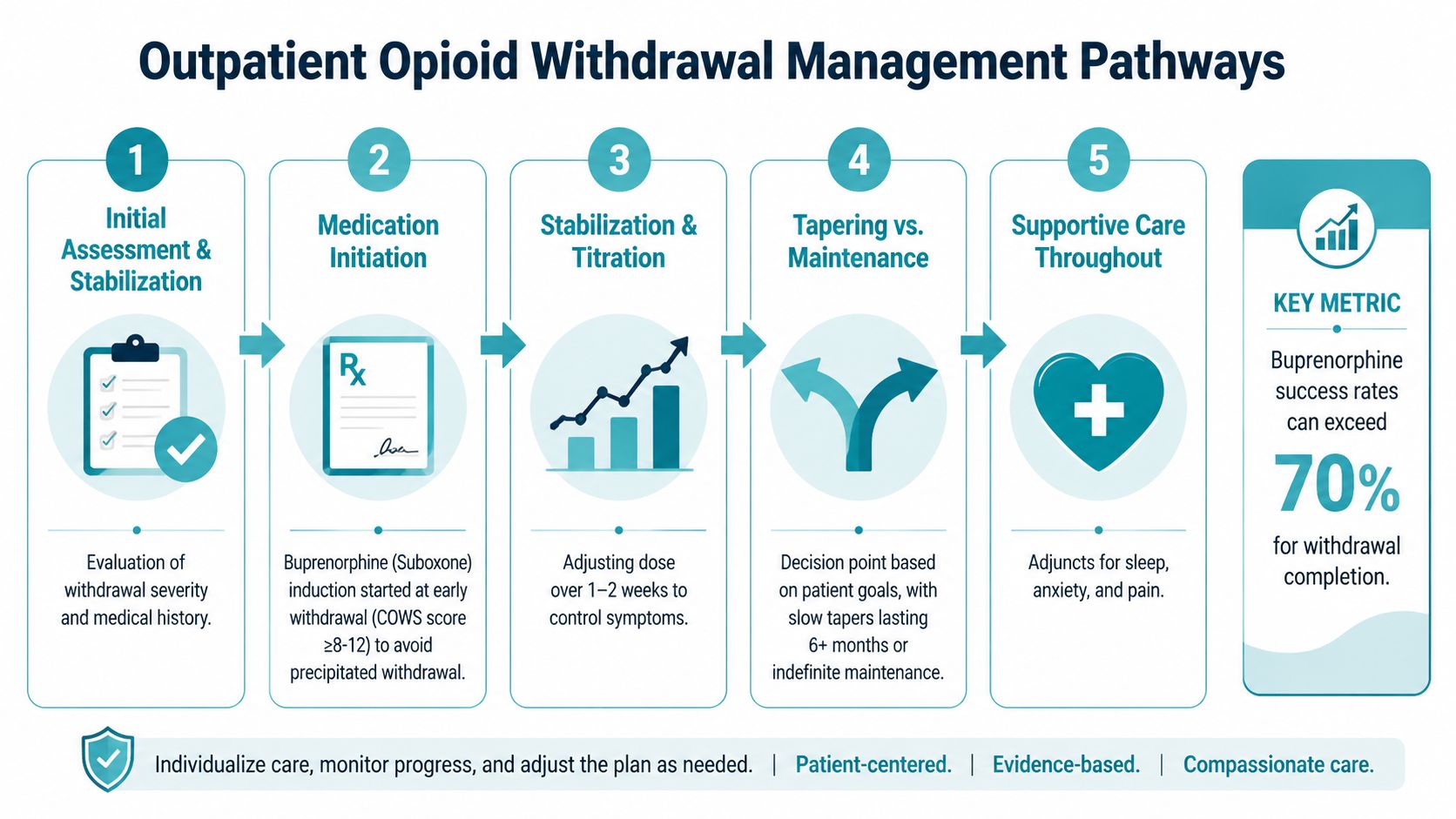
A person who can still drink, rest, and check in with the clinician often can be managed as an outpatient, especially when symptoms are mild to moderate and the home setting is stable. Physician-led care starts with the last opioid dose, route of use, other substances, pregnancy status, cardiac history, and psychiatric status. A baseline urine toxicology test often sits alongside a COWS assessment and a clear follow-up plan.
Common medication pathways
Medication choice follows the stage of withdrawal. Buprenorphine is usually started once early withdrawal signs are present, because starting too soon can trigger precipitated withdrawal, and buprenorphine (Suboxone) treatment is one outpatient option clinicians may use. Methadone is used in regulated settings and may fit people who need a more supervised pathway. Naltrexone is for relapse prevention after withdrawal has fully resolved, not during active withdrawal.
Symptom-targeted medicines can steady the rest of the picture. Clonidine can calm adrenergic symptoms. Loperamide can help diarrhea. Ondansetron is often used for nausea. NSAIDs can ease muscle aches. Sleep disturbance is often addressed with agents such as trazodone or hydroxyzine, depending on the clinical situation.
For readers who want to see how structured care is organized, evidence-based opioid treatment can be a useful reference point for outpatient pathways.
Key Takeaways and When to Reach Out for Confidential Care
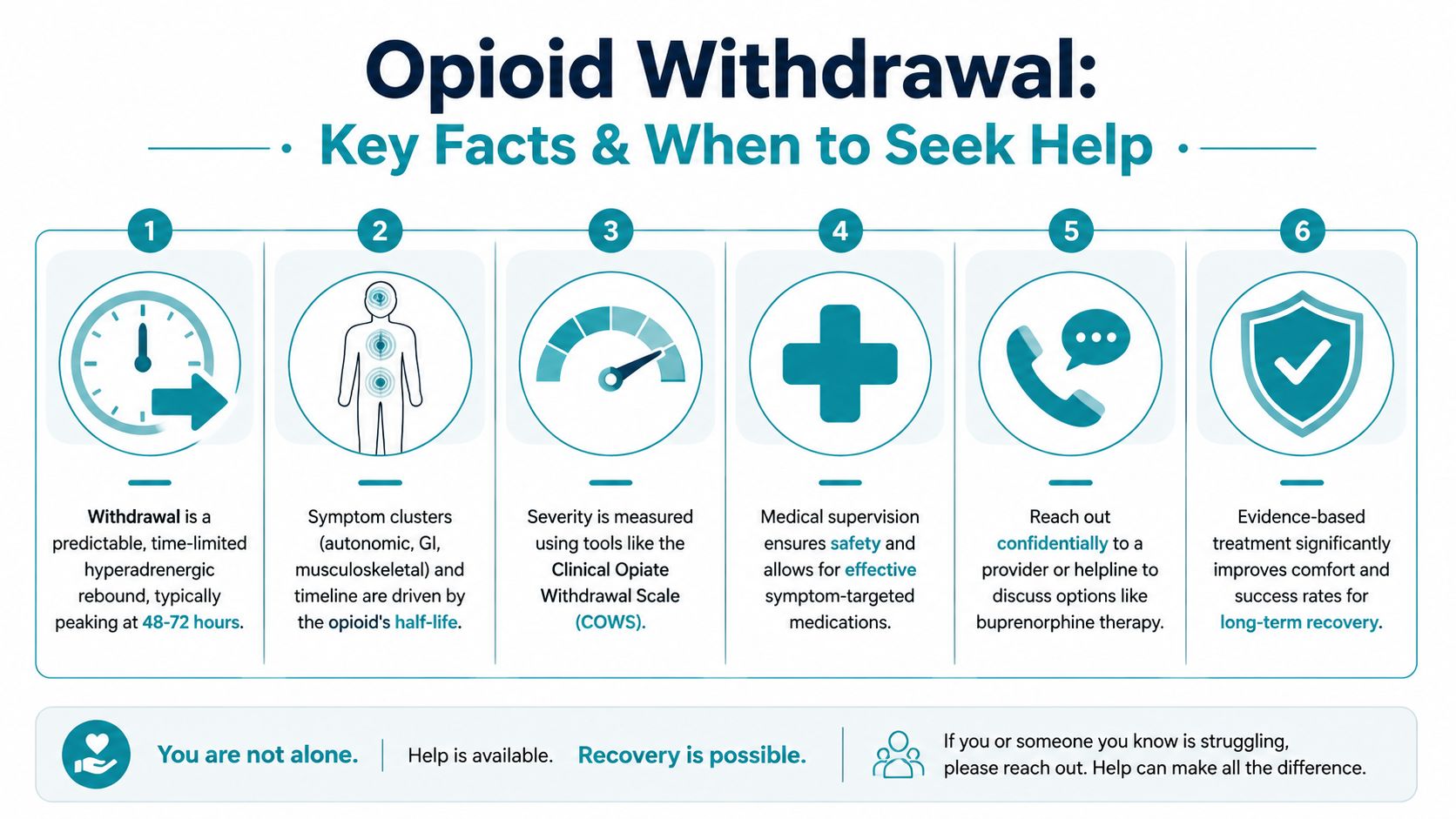
Opioid withdrawal manifestations are a predictable, time-limited hyperadrenergic rebound after opioid levels fall. The symptom clusters and timeline depend heavily on the opioid's half-life, which is why short-acting and long-acting drugs don't behave the same way. Severity is best measured with validated tools like COWS, not self-judgment.
Medical supervision is appropriate for many adults, especially when symptoms affect hydration, sleep, mood, pregnancy, or co-use with alcohol or benzodiazepines. If there's repeated vomiting, inability to keep fluids down, marked suicidal thinking, pregnancy, or overlapping sedative withdrawal, the safer move is same-day medical evaluation.
A confidential outpatient assessment can help clarify what level of care fits the situation and what medication or monitoring pathway makes sense. If you're weighing your next step, you can visit Empire Medical Wellness to review physician-led addiction medicine care in a private, judgment-free setting.
FAQ
Can opioid withdrawal happen after prescribed use? Yes. It can occur after prescribed opioid use if the body has adapted to the medication and the dose is reduced or stopped.
Does a single missed dose always count as withdrawal? Not always. It depends on the opioid, the dose, how long you've been taking it, and whether physiologic dependence has developed.
How soon can buprenorphine be started after the last dose? Timing depends on the opioid involved and the presence of early withdrawal signs. Clinicians usually wait for withdrawal to begin so they can reduce the risk of precipitated withdrawal.
Empire Medical Wellness offers confidential outpatient addiction medicine assessment, medication management when clinically appropriate, and structured follow-up for adults navigating opioid withdrawal and recovery. If you want a careful, physician-led conversation about symptoms, timing, and next steps, visit Empire Medical Wellness to learn more.
This article is educational and not personal medical advice. If you have repeated vomiting, can't keep fluids down, have severe confusion, chest pain, suicidal thoughts, or are withdrawing while pregnant or from alcohol or benzodiazepines too, seek urgent medical care now.