
A calorie deficit means eating fewer calories than your body uses. Start by estimating your needs with the NIDDK Body Weight Planner or a validated equation, then subtract a modest, clinician-appropriate deficit and judge the result by trends over weeks, not by a single app number.
Why can two people enter the same calorie deficit in an app and see very different results? The answer is that a calorie counter provides an estimate, while your body's response is the information that helps determine whether the estimate is useful.
For adults researching physician-led obesity care, the practical question isn't just, “What number should I eat?” It's whether the number supports a tolerable energy deficit while preserving protein, fiber, micronutrients, strength, and lean mass. Diet pattern, activity, sleep, medications, medical conditions, hunger, and adherence can all affect how a plan works in real life.
Table of Contents
- What a Calorie Counter Deficit Means and How It Works
- How to Estimate Maintenance Calories Before Choosing a Deficit
- Choosing a Safe and Sustainable Deficit Range
- Using Calorie Tracking Tools Accurately Without Overrelying on App Numbers
- Monitoring Progress Troubleshooting Plateaus and Knowing When to Seek Care
- Safe Next Steps and When Physician Led Obesity Care Helps
What a Calorie Counter Deficit Means and How It Works
Could the deficit shown in a calorie counter be useful without being an exact prescription? Yes, if you treat it as a starting estimate and compare it with your weekly weight trend, hunger, strength, and health markers.
A calorie deficit occurs when food and beverages provide less energy than your body uses. Your body covers part of the gap by drawing on stored energy. The gap changes among individuals because daily energy use includes resting needs, digestion, ordinary movement, and planned exercise.
The NIDDK Body Weight Planner models how changes in food intake and activity may influence weight over time. Its output helps with planning. It does not prescribe one fixed intake for every adult.
App totals can also miss part of the picture. Inaccurate database entries, large portions, restaurant oils, dressings, sweetened drinks, cooking tastes, and overestimated exercise calories may make recorded intake differ from actual intake.
Why the deficit should be treated as a range
Clinical guidance has used energy deficits as an initial framework. NIH-linked guidance describes a daily deficit of 500 to 1,000 kcal, historically associated with typical weight loss of about 1 to 2 lb per week for up to 6 months. It also describes reduced-calorie plans commonly using about 1,200 to 1,500 kcal per day for women and 1,500 to 1,800 kcal per day for men, adjusted to the individual. Review the NIH-linked obesity treatment guidance for context.
These figures are reference points, not universal targets. A number that appears precise in an app still needs validation in real life.
Use a simple weekly worksheet: record the planned intake, average weight, hunger, strength, energy, and relevant clinical markers. Compare weekly patterns rather than reacting to one day of scale change. The useful target is the one that supports adequate nutrition, manageable hunger, daily function, and physical capacity.
A smaller deficit may work better than an aggressive target that repeatedly causes fatigue, reduced strength, or abandonment. For adults considering physician-led obesity medicine care, calorie tracking can sit within a broader review of weight history, medications, health factors, progress, and maintenance planning.
How to Estimate Maintenance Calories Before Choosing a Deficit
Before subtracting calories, estimate the amount that may maintain your current weight. This estimate is often called maintenance calories or total daily energy expenditure. It's a starting point, not a measurement of your metabolism in a laboratory.
The NIDDK Body Weight Planner uses personal inputs and planned changes in food and activity to model expected weight change over time. A validated equation can provide another starting estimate. Neither approach can fully capture every factor affecting energy use, including changes in activity, body weight, appetite, medication effects, and medical conditions.
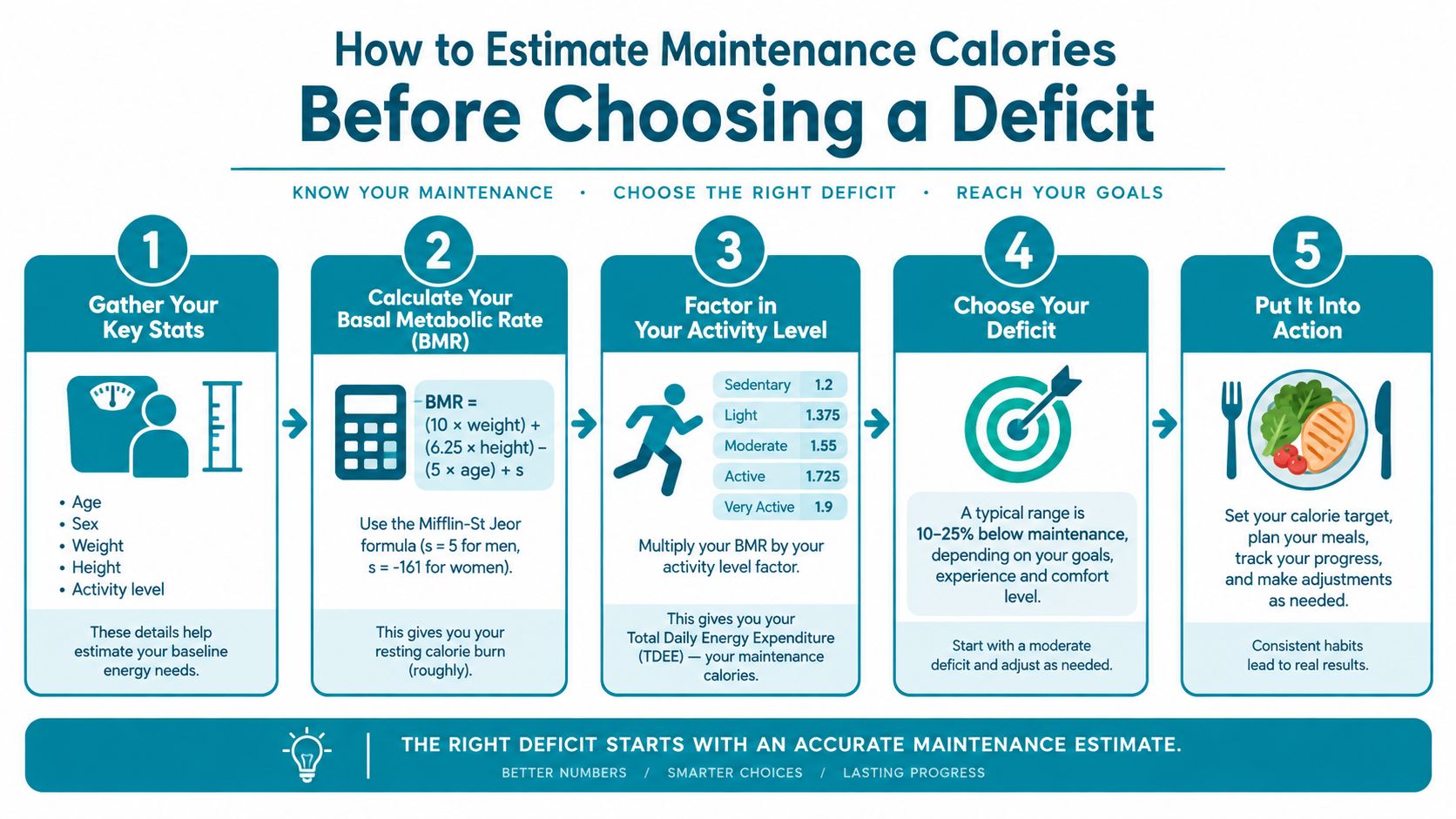
A practical estimation sequence
Enter accurate information. Use current body weight, height, age, sex, and a realistic description of usual activity. An activity setting that reflects occasional exercise but mostly sedentary days can produce a different estimate from one that reflects regular movement.
Record a baseline. For a short period, log food, beverages, portions, and activity without trying to create a large deficit. Also observe weight consistently under similar conditions. The purpose is to compare the estimated intake with the direction of the weight trend, not to judge your eating.
Look at the pattern. A single weigh-in can be affected by fluid balance, digestive contents, sodium intake, and other ordinary factors. A repeated trend gives more useful information about whether the estimated maintenance level is close to reality.
Choose a modest adjustment with clinical context. Once needs are estimated, a clinician can help determine whether a deficit is appropriate and how it should account for health conditions, medications, activity, hunger, and nutritional adequacy.
The calorie deficit formula can help explain the arithmetic, but arithmetic alone can't determine whether a target is safe or sustainable for you.
Why estimates need validation
Maintenance needs change as body size, activity, and eating patterns change. The same intake may create a different energy balance later, particularly if body weight declines or unplanned movement decreases. That's why a calorie counter should be treated like a dashboard. It displays an estimate that must be checked against real-world trends.
Seek clinician input before making substantial changes if you have a condition that affects nutrition or metabolism, take medications that may influence weight or appetite, have a history of disordered eating, or are considering a very low-calorie approach. An app can't review your medical history or recognize when a target conflicts with your care.
Choosing a Safe and Sustainable Deficit Range
What makes a calorie deficit reasonable for you: the number on the calculator, or what happens to your body after you use it? Guidelines describe a 500 to 750 kcal per day deficit as a common starting framework for adult weight loss. The 2013 AHA/ACC/TOS guideline gives example intake ranges of 1,200 to 1,500 kcal per day for women and 1,500 to 1,800 kcal per day for men, with adjustments for body size and activity. These figures describe populations, not personal prescriptions.
The classic 3,500-kcal rule treats a cumulative deficit of roughly 3,500 kcal as approximately 1 lb of weight loss. A 500-kcal daily shortfall over a week reaches about that cumulative amount, although the rule simplifies a changing biological system and cannot predict every person's result. A European obesity guidance review discusses an individualized practical target of about a 600 kcal per day deficit, associated with roughly 0.5 kg per week in its example. The European obesity guidance review explains the limitations and context of these estimates.
Deficit range and safety considerations at a glance
| Approach | What to monitor |
|---|---|
| Moderate guideline-based deficit | Weekly weight trend, hunger, strength, meal quality, and ability to maintain the plan |
| Historical larger deficit | Use greater supervision, especially as restriction becomes more aggressive. The NIH-linked guidance describes this approach for a limited period, not as a universal target. NIH-linked guidance |
| Very low intake or aggressive restriction | Review nutrient adequacy, hunger, adherence, and lean-mass preservation. A 2024 review found that, with intake restricted to 900 kcal per day or less, mass other than fat represented approximately 25.5% of weight loss in people with type 2 diabetes and 27.5% in people without it. Systematic review and meta-analysis |
| Low-energy diet | Use only within a multicomponent obesity-management program with long-term support. NICE describes 800 to 1,200 kcal per day approaches in that structured context, rather than as a long-term strategy. NICE obesity guidance |
A calculator provides a starting estimate, like a route on a map. Your weekly trend tests whether that route fits real life. Record the planned intake, hunger, strength, and weight trend for each week. If weight changes faster than intended, hunger becomes difficult to manage, strength falls, or daily function suffers, reduce the size of the deficit or seek clinical guidance. If weight remains stable across repeated weeks, review the estimate and tracking pattern before making another large change.
The lower boundary needs care. General weight-management guidance advises against eating less than 1,200 calories per day, while NICE reserves low-energy approaches for structured programs with long-term support. Persistent meal skipping, disabling hunger, or declining function calls for reassessment, not automatic further restriction.
Healthy balanced eating, keto, and intermittent fasting are structures, not guarantees. Compare them by nutrient adequacy, hunger, strength, adherence, and medical fit. A calorie deficit calculation resource can clarify the arithmetic, but your weekly trend and clinical markers must validate the target.
Using Calorie Tracking Tools Accurately Without Overrelying on App Numbers
A calorie counter becomes more useful when you use it to learn patterns rather than to pursue perfect daily precision. Record food and beverages as completely as practical, including cooking oils, sauces, alcohol, sweetened drinks, snacks, and small tastes. Choose entries that match the actual product and serving size, and check whether the database lists cooked or uncooked weight.
Exercise calories deserve caution. An app's activity estimate may not reflect your actual energy expenditure, so automatically “eating back” the full amount can erase the intended deficit. Physical activity still supports health, function, and lean-mass preservation, but its app-generated calorie value shouldn't be treated as a bank account.
Build meals around nutritional quality
The Dietary Guidelines for Americans and American Heart Association dietary guidance support an eating pattern built from nutrient-dense foods. In practical terms, that can mean vegetables, fruit, minimally processed carbohydrates, protein foods, legumes, and unsaturated fats, adapted to preferences and medical needs.
Use the app to inspect whether meals contain enough protein and fiber, not only whether the calorie total fits. Persistent hunger, declining strength, poor recovery, or difficulty adhering can signal that the structure needs adjustment even when the displayed number looks correct.
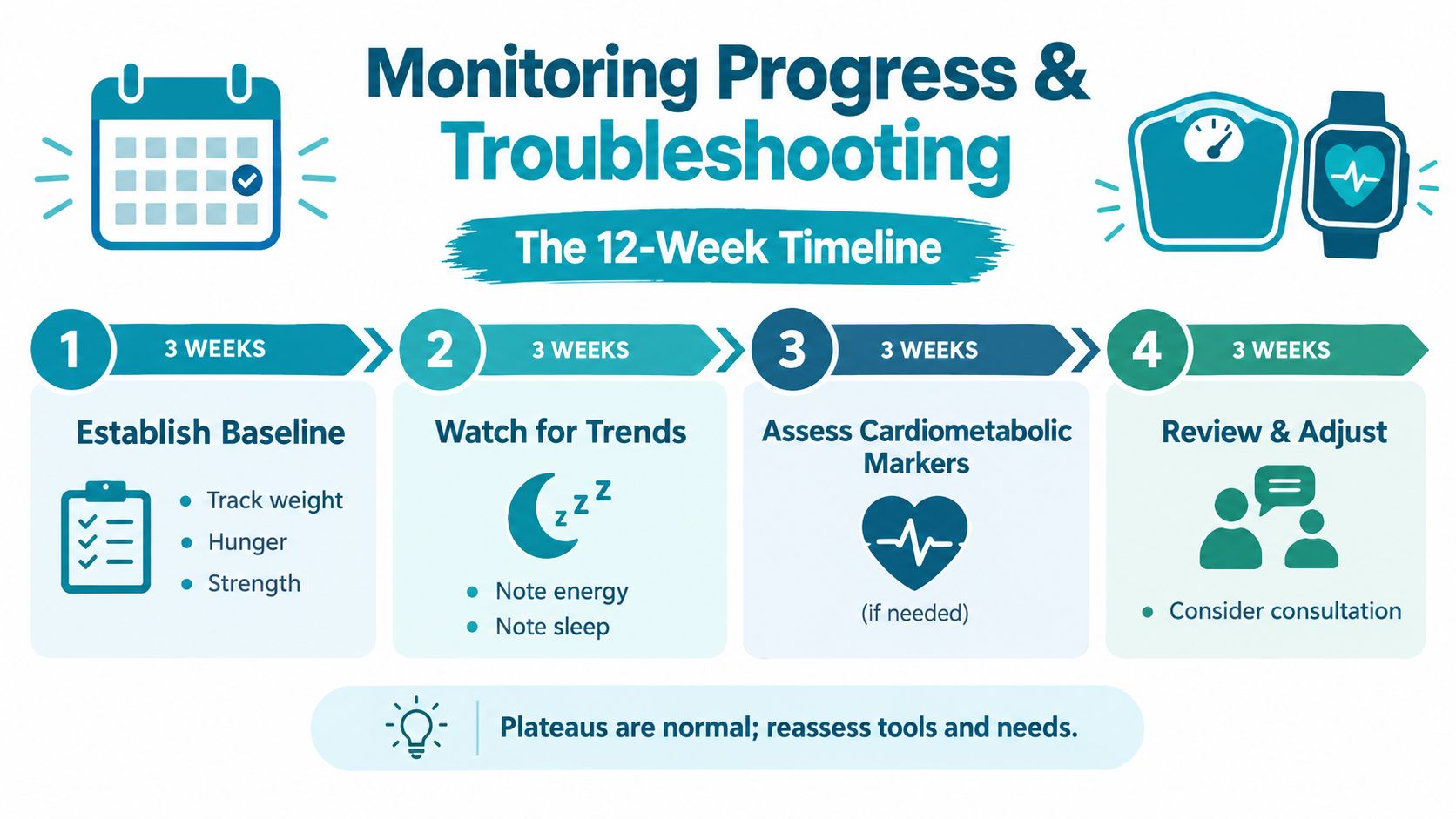
Weekly trend worksheet
| Measure | What to record | What it may help you evaluate |
|---|---|---|
| Calories | Daily intake and weekly pattern | Whether the planned deficit is being followed consistently |
| Protein | Protein-containing foods across meals | Whether meals support fullness and lean-mass preservation |
| Fiber | Vegetables, fruit, legumes, and whole or minimally processed carbohydrates | Whether the pattern provides filling, nutrient-dense foods |
| Hunger | Manageable, frequent, intense, or disruptive | Whether the deficit is tolerable |
| Strength | Usual training performance and functional capacity | Whether restriction may be affecting lean tissue or recovery |
| Adherence | What was easy, difficult, or repeatedly missed | Whether the plan fits ordinary life |
| Contraindications and concerns | Medical conditions, medication changes, symptoms, or eating-pattern risks | Whether clinician review is needed |
This worksheet isn't a diagnostic tool. It's a way to bring organized information to a clinician or to identify that the app's number isn't translating into a workable routine. Nutrition care through Empire Medical Wellness can be considered within the practice's verified obesity-care services, without assuming that a calorie counter can replace medical evaluation.
Monitoring Progress Troubleshooting Plateaus and Knowing When to Seek Care
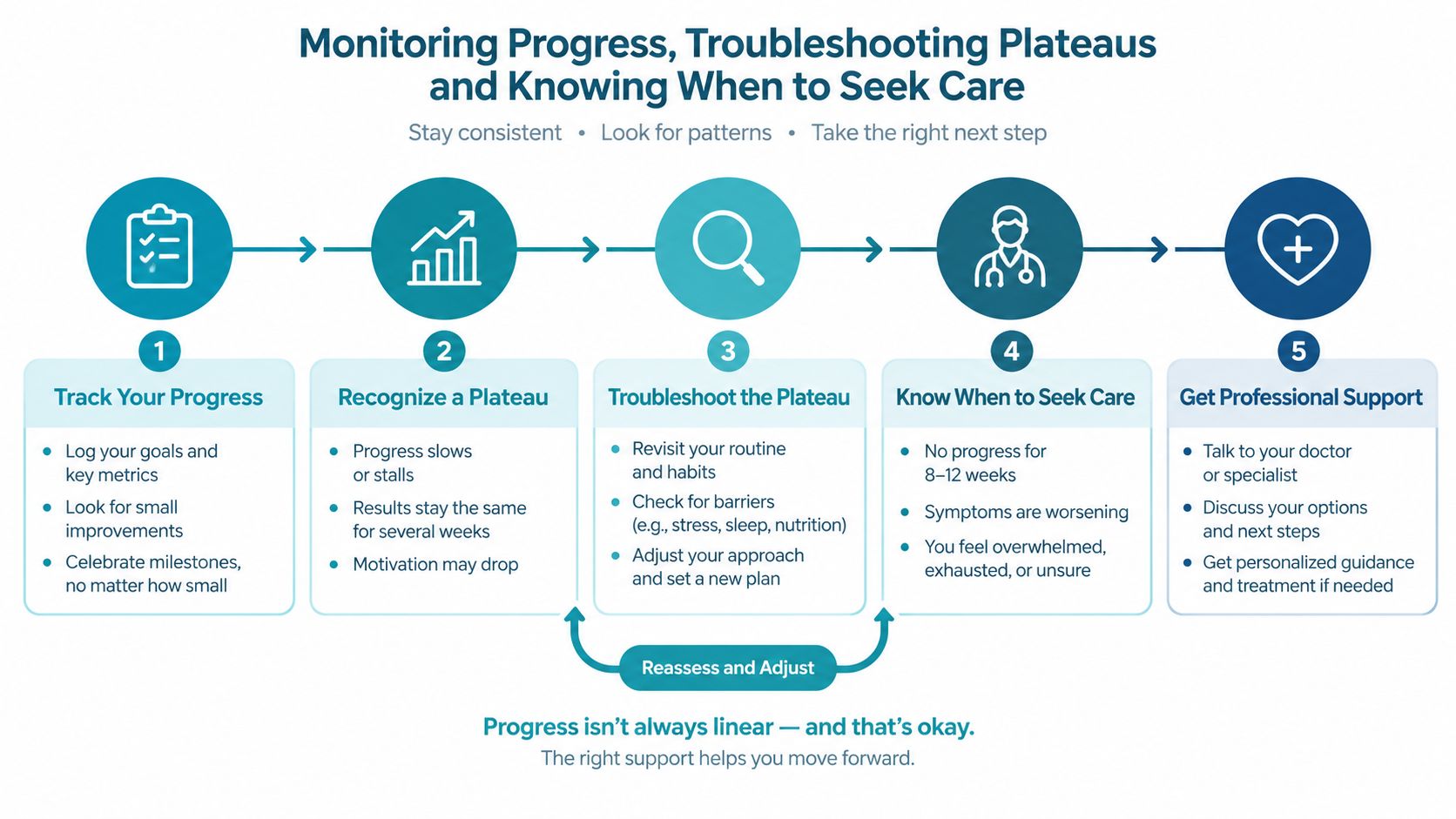
A plateau doesn't automatically mean that you lack willpower or that the plan has failed. As weight changes, energy needs and appetite can change too. The VA obesity guideline describes adaptive changes in appetite and energy expenditure and emphasizes that small sustained changes don't produce unlimited linear loss. A deficit can become smaller as the body adapts, so maintenance planning and reassessment matter. VA obesity clinical practice guideline
Start with the data, not punishment. Review portions, beverages, restaurant meals, oils, activity estimates, sleep, hunger, and strength. If the trend has slowed, the next step may be clarifying the estimate, improving meal structure, changing activity, or discussing medical factors with a qualified clinician. It isn't automatically a reason to cut calories further.
A composite example, clearly labeled
Hypothetical composite example: An adult repeatedly abandons aggressive diets because hunger and fatigue make the plan difficult to sustain. Rather than pursuing a more extreme calorie-counter deficit, the person works with a clinician on a smaller deficit, meals that emphasize protein and fiber, resistance training appropriate to their health, and a weekly review of calories, hunger, strength, and adherence.
This example doesn't predict a particular result and isn't a patient story from Empire Medical Wellness. It illustrates a decision principle: when a plan repeatedly fails because it's intolerable, making the deficit smaller and the monitoring more thoughtful may be more rational than escalating restriction.
When routine follow-up is appropriate
Consider routine clinician follow-up when a plateau persists despite careful review, when hunger is becoming disruptive, when strength is declining, or when a medication change or medical condition may affect weight, appetite, or energy. Physician-led monitoring is also relevant when someone is considering or using an FDA-approved anti-obesity medication, because nutrition, activity, response, tolerability, and long-term maintenance still require clinical context.
Seek urgent medical attention for severe or rapidly worsening symptoms such as fainting, chest pain, severe shortness of breath, confusion, or inability to keep fluids down. Those symptoms aren't routine calorie-tracking concerns.
Safe Next Steps and When Physician Led Obesity Care Helps
A safe calorie-counter deficit has three features. It's based on an estimate rather than an arbitrary number, it produces a tolerable pattern of eating, and it's evaluated through trends and health indicators rather than one day's app total.
Use this checklist before making the plan more restrictive:
- Validate the estimate: Compare the NIDDK Body Weight Planner or a validated equation with real-world intake and weight trends.
- Protect food quality: Include protein, fiber, micronutrient-rich foods, and unsaturated fats within a pattern you can follow.
- Watch function: Track hunger, energy, sleep, strength, activity, and adherence.
- Reassess plateaus: Review logging accuracy and changing needs before reducing intake further.
- Get clinical input: Ask a physician to review medical conditions, medications, symptoms, and whether a low-energy approach is appropriate.
Healthy balanced, keto, and intermittent-fasting patterns can each serve as a structure for some adults, but none guarantees weight loss. Medicines, sleep, activity, medical conditions, and adherence can change the outcome. Low-energy diets of 800 to 1,200 kcal per day should be used only as part of a multicomponent strategy with long-term support, as described by NICE, rather than as a self-directed long-term plan.
Adults who have tried repeated diets, experience persistent plateaus, or want careful monitoring alongside anti-obesity medication may benefit from physician-led obesity care. Empire's weight-management service includes medical and metabolic assessment, review of relevant health factors, individualized planning, monitoring, and maintenance planning when clinically appropriate. The practice doesn't assume that a calorie counter can explain every factor affecting weight.
Published: September 15, 2026
Updated: September 15, 2026
Byline: Empire Medical Wellness Editorial Team
Sources
- NIDDK Body Weight Planner
- NIH-linked obesity treatment guidance
- AHA/ACC/TOS guideline
- NICE obesity management guidance
- 2024 systematic review and meta-analysis
This article is educational and isn't personal medical advice.
Empire Medical Wellness provides physician-led obesity medicine for adults seeking individualized evaluation, weight-management planning, monitoring, and long-term maintenance support. If you want to review how your calorie-counter data, hunger, strength, medications, and health factors fit together, visit Empire Medical Wellness to learn more about the practice and available care.