
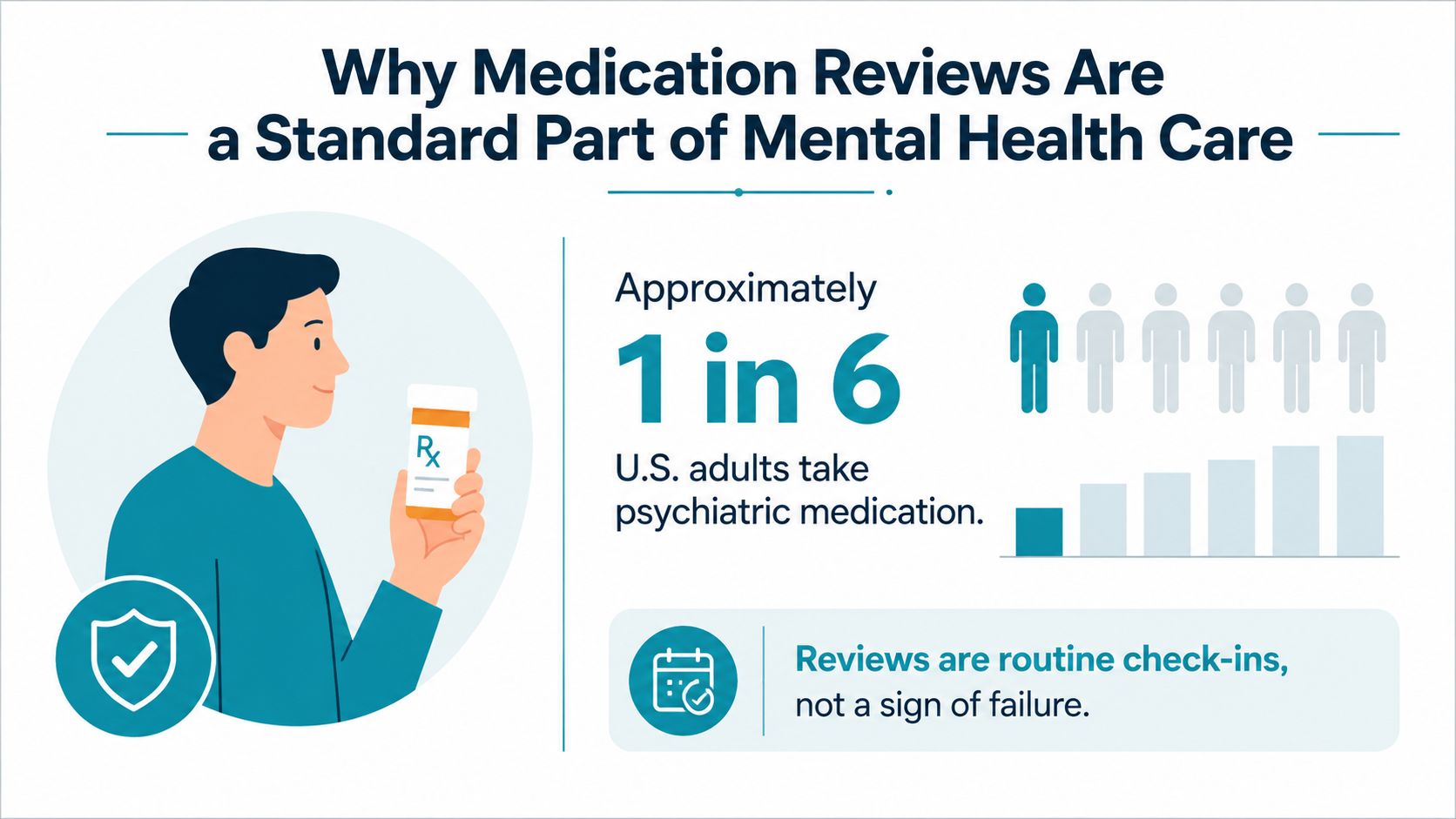
A mental health medication review is not a sign that treatment has failed. It's a routine safety check, and in the U.S. it matters for a lot of adults, since the CDC reported that 19.3% of adults took medication for their mental health in the past 12 months in 2024 CDC data brief. When medication use is this common, the question is whether the current regimen still fits the person in front of the clinician, not whether the person “needs” a review.
A thoughtful review asks simple, important questions. Is the medication still helping, are side effects getting in the way, are there interactions or missed doses, and does the original diagnosis still look right? For adults seeking physician-led care, that's the point of the visit, careful reassessment rather than an automatic refill.
Table of Contents
- Why Medication Reviews Are a Standard Part of Mental Health Care
- The Structured Process Behind a Thorough Medication Review
- How Clinicians Assess Whether Your Medication Is Still Working
- How to Prepare for Your Medication Review Appointment
- What Happens After the Review and How Follow-Up Works
- Common Questions About Mental Health Medication Reviews
Why Medication Reviews Are a Standard Part of Mental Health Care
The CDC's data make the point clearly. In 2024, 19.3% of U.S. adults took medication for their mental health in the past 12 months, 14.0% received counseling or therapy, and one in five adults had used prescription medication for feelings of depression, anxiety, or other mental-health concerns CDC data brief. That means medication management is not a niche service. It belongs in ordinary adult outpatient care.
A mental health medication review is a structured visit to decide whether each medicine still has a clear purpose, a meaningful benefit, and acceptable risks. The clinician is not just asking, “Do you want a refill?” The visit checks effectiveness, tolerability, adherence, and safety, especially when life circumstances, other medicines, or symptoms have changed over time.
Practical rule: if a medication is meant to help symptoms over time, it should also be checked over time.
The population data show why this matters. The CDC reported that in 2020, 16.5% of adults had taken prescription medication for mental health, up from 15.8% in 2019, and 20.3% had received any mental-health treatment CDC data brief. More recently, the CDC reported that 11.4% of adults took prescription medication for depression in 2023, with women at 15.3% and men at 7.4% CDC depression data brief. Those figures do not tell one person what to do, but they show that medication use is common enough that routine review is a basic safety practice.
A physician-led visit is meant to be calm and methodical. A closer look at the Empire Medical Wellness practice overview shows the outpatient model in general terms. The core idea is simple. A prescription should keep earning its place in the plan, rather than stay there by default.
The Structured Process Behind a Thorough Medication Review
A good review follows a sequence. It starts with medication reconciliation, which means making sure the clinician has the full list of prescriptions, over-the-counter products, supplements, timing, and actual use. From there, the visit asks whether each item still matches a current need, and whether the plan should continue, change, or stop.
The STRIP framework is one useful way to understand that structure. It uses five steps, medication assessment, pharmacotherapy review, treatment plan, shared decision-making, and follow-up monitoring, with published examples including a follow-up around six months STRIP framework article. In community mental health settings, one model used trained pharmacists to conduct 30 to 45 minute interviews before preparing optimization reports for a multidisciplinary panel STRIP framework article. That tells you something important. A real review takes time because the information has to be gathered carefully.
What clinicians are actually checking
The review is not just about names of medicines. It's about the relationship between the medicine and the person's current symptoms, function, and side effects. Clinicians ask whether the original reason for the prescription still applies, whether the expected benefit is present, and whether adverse effects are eroding that benefit.
A medication can be appropriate on paper and still be the wrong fit in real life.
The process also looks for interactions. New prescriptions, supplements, and even changing routines can alter how a psychiatric medicine feels or works. That's why a thorough review usually ends with a shared treatment plan, which may include a dose change, a switch, a taper, or no change at all. The point is not to force a change. The point is to make the current plan deliberate.
For a view of how a physician-led outpatient service organizes care around this kind of assessment, the services page is a useful starting point. A review done well should make the reasoning visible. You should leave knowing what is being treated, what is being monitored, and why the next step makes sense.
The short video below gives a plain-language overview of medication review thinking in mental health care.
How Clinicians Assess Whether Your Medication Is Still Working
A patient might say, “I'm not miserable, so why revisit anything?” That's a fair question. Clinicians don't look only for a crisis. They look for drift, the subtle kind that can show up as less motivation, flatter mood, poorer sleep, more anxiety, or side effects that used to be tolerable but now feel disruptive.
A few realistic patterns
A person may report that panic episodes are less intense than before, but daily fatigue has made work harder. Another person may say the medicine still helps mood, yet sexual side effects or daytime grogginess have become the main issue. In both cases, the review is about weighing benefit against harm, not assuming the answer is automatically to continue or stop.
The literature also supports this kind of active reassessment. A systematic review and meta-analysis found that focused medication review was associated with optimization of psychotropic prescribing focused medication review review. That doesn't mean every visit changes the regimen. It means the structured conversation itself can improve prescribing quality.
When the diagnosis still needs clarification
Sometimes the question isn't whether a medicine works, but whether the symptom pattern has been understood correctly. A rapid review of low-threshold psychiatric prescribing found that these settings may start medication when the diagnosis is still unclear, and that for most medications there are no prescribing guidelines, and little to no research in that context rapid review. That gap matters because depression, anxiety, trauma, bipolar spectrum symptoms, and substance use can overlap.
A careful review tries to separate those possibilities instead of forcing one explanation too early. It also asks whether a symptom reflects undertreatment, overtreatment, a timing problem, or a formulation issue. If sleep is the main problem, for example, the issue may not be the drug class itself. It may be when the medicine is taken or how long it lasts in the body.
The best reviews keep that reasoning explicit. They don't treat symptom checklists as the whole story. They connect those symptoms to daily functioning, side effects, and the original treatment goal.
How to Prepare for Your Medication Review Appointment
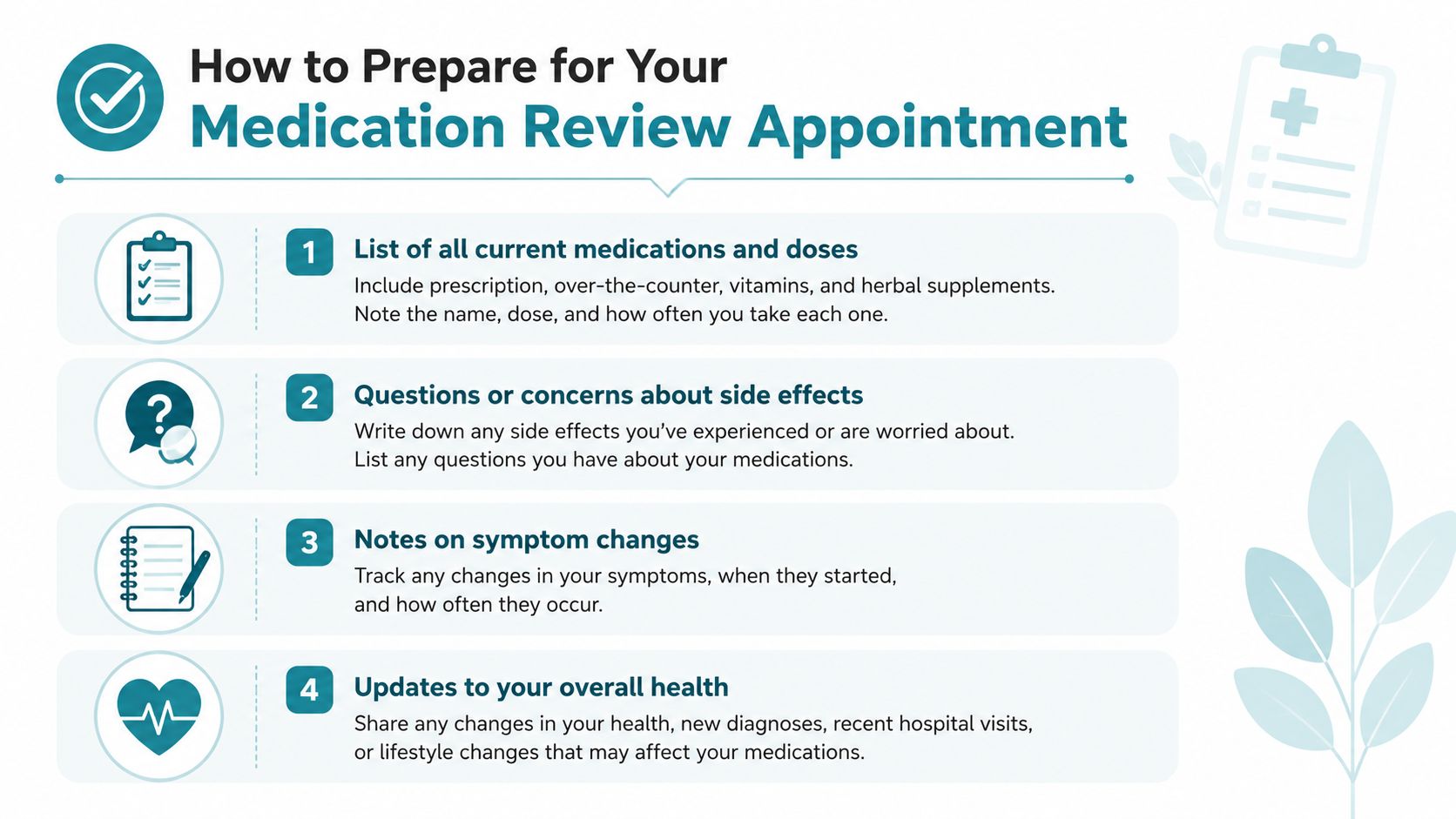
Preparation makes the visit more useful. Bring a complete list of every prescription, over-the-counter medicine, vitamin, herbal product, and supplement, along with doses, timing, and how often you take each one. That matters because a medication review depends on reconciliation, and reconciliation only works if the list is accurate.
What to gather before you come in
- Current medications and doses: Include psychiatric medicines, sleep aids, pain medicines, allergy medicines, and supplements. Small details matter, especially if you take something only some days.
- Side effects and daily impact: Write down what you notice and whether it changes work, driving, sleep, appetite, or relationships.
- Symptom changes: Note what has improved, what hasn't, and when the change started.
- Other clinicians and recent testing: Bring names of other prescribers and any recent lab results, if you have them.
If cost, access, or refill logistics are part of the problem, say so plainly. A review is a reasonable place to discuss missed doses, trouble getting to the pharmacy, or concerns about dependency. Those are clinical issues, not character flaws.
When patients prepare this way, the conversation gets sharper. The clinician can spend less time reconstructing the basics and more time on the hard part, deciding what the current regimen is doing. If you're arranging a visit, you can use the appointment request page to get the process started.
Helpful frame: bring facts, not guesses. “I miss doses twice a week” is more useful than “I'm probably not great at taking it.”
What Happens After the Review and How Follow-Up Works
A medication review does not end with a simple yes or no. The clinician may recommend staying with the current plan, adjusting the dose, changing medicines, tapering gradually, or dealing with a side effect or access problem before making a larger change. Each of those choices is tied to a monitoring plan, because the next step depends on what happens after the change.
That slower pace is intentional. Expert guidance supports deprescribing or dose reduction when it is planned, gradual, and reversible, especially when a medicine has been helping or when safety needs close watching focused medication review review. The STRIP model builds follow-up and monitoring into the review itself STRIP framework article. In plain terms, the visit is not a final judgment. It starts the next round of clinical reasoning, much like checking the results after adjusting a treatment plan before deciding whether to keep going.
Follow-up is where the reasoning gets tested
A follow-up visit asks a practical question: did the chosen plan improve symptoms, lower side effects, or address the problem that brought you in? If the answer is yes, the regimen may stay in place. If the answer is no, the clinician looks again at the pattern of symptoms, the timing of changes, and whether the medicine is still the right fit.
Coordination can matter here as well. When authorized and clinically useful, physician-led care may communicate with a therapist or another treating clinician so symptom changes, side effects, and functional goals are interpreted together. That kind of coordination helps when the diagnosis is still being clarified or when more than one clinician is involved in care. It keeps the review anchored to the same clinical picture rather than to isolated fragments of information.
The practice's fees and how it works page explains the outpatient model in practical terms. The larger point is straightforward. A well-run medication review works as a loop, assess, plan, monitor, then reassess. That loop is what makes medication management safer and more personalized over time.
Common Questions About Mental Health Medication Reviews
Do I need a review if I feel fine?
Yes, possibly. Feeling fine can mean the medicine is helping, but it can also mean side effects have become easy to overlook or that a medication is being continued without a fresh reason. A review is meant to confirm that the current plan still makes sense.
How often should a medication review happen?
There isn't one schedule that fits everyone. Frequency depends on diagnosis, symptom stability, side effects, other medicines, and whether any changes were made recently. The key is that follow-up should be intentional, not accidental.
Can a review help if cost or access is the main problem?
Yes. Access barriers, missed doses, and refill problems are part of medication safety. A review can help sort out whether the main issue is affordability, timing, side effects, or coordination with another clinician.
What if the diagnosis is still being clarified?
That's a common reason to review medication carefully. When symptoms overlap, the clinician has to weigh the pattern of symptoms, prior responses, and the risk of misclassification before changing treatment. A thoughtful review is especially useful in that setting.
For more educational material on related topics, the Empire Medical Wellness blog can help you think through what to ask at a visit.
If you're looking for physician-led outpatient care that includes diagnostic clarification, medication review, and ongoing medication management in adult mental health, visit Empire Medical Wellness to learn more about the practice and how appointments work. This article is educational and not personal medical advice. If you're in immediate danger or thinking about harming yourself, call emergency services or go to the nearest emergency department right away.
Sources
- CDC, Mental health treatment and prescription medication use, 2024
- CDC, Mental health treatment and prescription medication use, 2020 and 2019
- CDC, Prescription medication for depression among adults, 2023
- STRIP framework and medication review process
- Focused medication review and psychotropic prescribing optimization
- Low-threshold psychiatric prescribing rapid review