
Could the medication that was supposed to steady your mood be the reason you're awake at 3 a.m.?
For some people, yes. Psychotropic medications can change sleep, and the change can move in either direction: toward insomnia, meaning trouble falling asleep, staying asleep, or waking too early, or toward somnolence, meaning sleepiness during the hours you want to be alert. Some people get both, at different points in the day or at different points in treatment.
What follows is a guide to noticing those changes precisely, understanding what the trial evidence does and doesn't say, and describing what you observe to the clinician who prescribes. It never involves adjusting a medicine on your own.
Table of Contents
- Why Psychotropic Medications Can Cause Insomnia or Sleepiness
- Sleep Effects by Medication Class and Agent
- How Antidepressants Change Sleep Architecture
- Sedation, Daytime Function and Sleep Quality
- Telling Medication Effects From Illness or Other Causes
- Off-Label Sleep Uses, Approved Options and Evidence
- Share Your Sleep Log With Your Prescriber
Why Psychotropic Medications Can Cause Insomnia or Sleepiness
Psychotropic medications act on neurotransmitter systems that also help regulate wakefulness and sleep. That overlap explains why a drug prescribed for depression, anxiety, bipolar disorder, or psychosis can push sleep in either direction, sometimes in the same person at different times of day.
Think of it as a dimmer switch rather than a light switch. A medication may quiet the symptom it was prescribed for while turning up something else, such as daytime drowsiness or a longer wait before sleep arrives. The setting varies by drug, dose, time of day taken, and how long someone has been on it. Sleep complaints are common enough to appear plainly in trial data.

The harder question is whether a sleep change comes from the medication, the condition being treated, or something else entirely. A review of antipsychotic and antidepressant sleep effects found insomnia, somnolence, and sedation to be the most common sleep-related adverse effects, with meaningful differences among drugs. In its network analysis, ziprasidone was associated with increased insomnia risk, while haloperidol, lurasidone, and ziprasidone were associated with somnolence. Antidepressants can run both ways as well: SSRIs may increase sleep-onset latency and nighttime awakenings while suppressing REM sleep.
Three patterns cover most of what people report:
- Insomnia: a longer wait to fall asleep, repeated awakenings, or waking hours before the alarm and being unable to return to sleep.
- Excessive sleepiness or sedation: drowsiness that persists into the working day, grogginess that lifts slowly, or nodding off during quiet tasks.
- Changes in dreaming: unusually vivid, intense, or disturbing dreams, which can appear when a medication starts or stops.
Dream changes deserve their own note. Discontinuation can contribute to vivid or disturbing dreams through REM rebound, which is one reason stopping a drug abruptly is a clinical decision rather than a personal one. If other prescriptions, supplements, or sleep aids are part of your routine, this guide to psychiatric drug interactions explains why timing and combinations matter.
The most useful first step is a written record of sleep kept before the next visit with the prescriber. Memory flattens a bad week into "sleep is worse." A dated record shows when it changed.
Sleep Effects by Medication Class and Agent
Start with the table. It's the fastest way to see whether the change you noticed matches what trials reported for your medication or class. The figures come from a review of antidepressant and antipsychotic sleep effects drawn from placebo-controlled trials.
| Medication or class | Sleep effect | Reported rate in trials |
|---|---|---|
| SSRIs (selective serotonin reuptake inhibitors) | Insomnia | About 7%–22% (placebo 4%–11%) |
| SSRIs (selective serotonin reuptake inhibitors) | Somnolence | About 4%–24% (placebo 4%–11%) |
| Chlorpromazine and thioridazine (older antipsychotics) | Somnolence | About 33%–57% |
| Haloperidol (older antipsychotic) | Somnolence | About 23% |
| Aripiprazole | Insomnia | About 24% |
| Risperidone or olanzapine | Insomnia | About 17%–18% |
| Quetiapine or ziprasidone | Insomnia | About 9% |
The ranges are wide because the underlying studies differ in drug, dose, patient population, and design. What they establish is that sleep disruption is a measurable, treatment-emergent problem rather than an isolated complaint.
Read the table in three steps.
- Find your row. Note whether the reported effect is insomnia or somnolence, since those point in opposite directions.
- Compare with the placebo column where one exists. For SSRIs, insomnia appeared in about 7% to 22% of treated patients versus 4% to 11% on placebo, and somnolence in 4% to 24% versus 4% to 11%. Placebo rates show how much sleep trouble appears anyway, in people taking no active drug.
- Treat the number as a group pattern, not a forecast. A trial rate doesn't predict what will happen to one person.
A medication can carry a high rate of one effect and still be the right choice, because the prescriber weighs that risk against the condition being treated. A drug that helps sleep may be wrong for someone whose depression needs an activating option, and the reverse is equally true.
Here's how the table becomes useful outside a clinic. Say a person on an SSRI notices it now takes an hour to fall asleep, a change that began two weeks ago. They can find the SSRI insomnia row, note the change date, and bring both to the visit. That turns "my sleep is off" into a specific, dated observation. If anxiety is the condition under treatment, anxiety medication covers options and monitoring in more depth.
Match the class to the sleep change you noticed. Bring the match to the visit. Don't act on it by changing the medication yourself.
How Antidepressants Change Sleep Architecture
Have you noticed a change in sleep after starting an antidepressant or changing its dose? Sleep architecture describes how quickly sleep begins, how it moves through lighter and deeper stages and REM sleep, and how well it continues until morning. Sleep latency is the time it takes to fall asleep. Sleep continuity describes how well sleep stays unbroken once it starts.
Many antidepressants affect serotonin or noradrenaline reuptake. These medicines are associated with longer REM latency, less REM sleep, and, for some people, more fragmented sleep continuity, according to a review of antidepressant effects on sleep architecture. Activating agents such as fluoxetine and venlafaxine may disrupt sleep, particularly early in treatment.
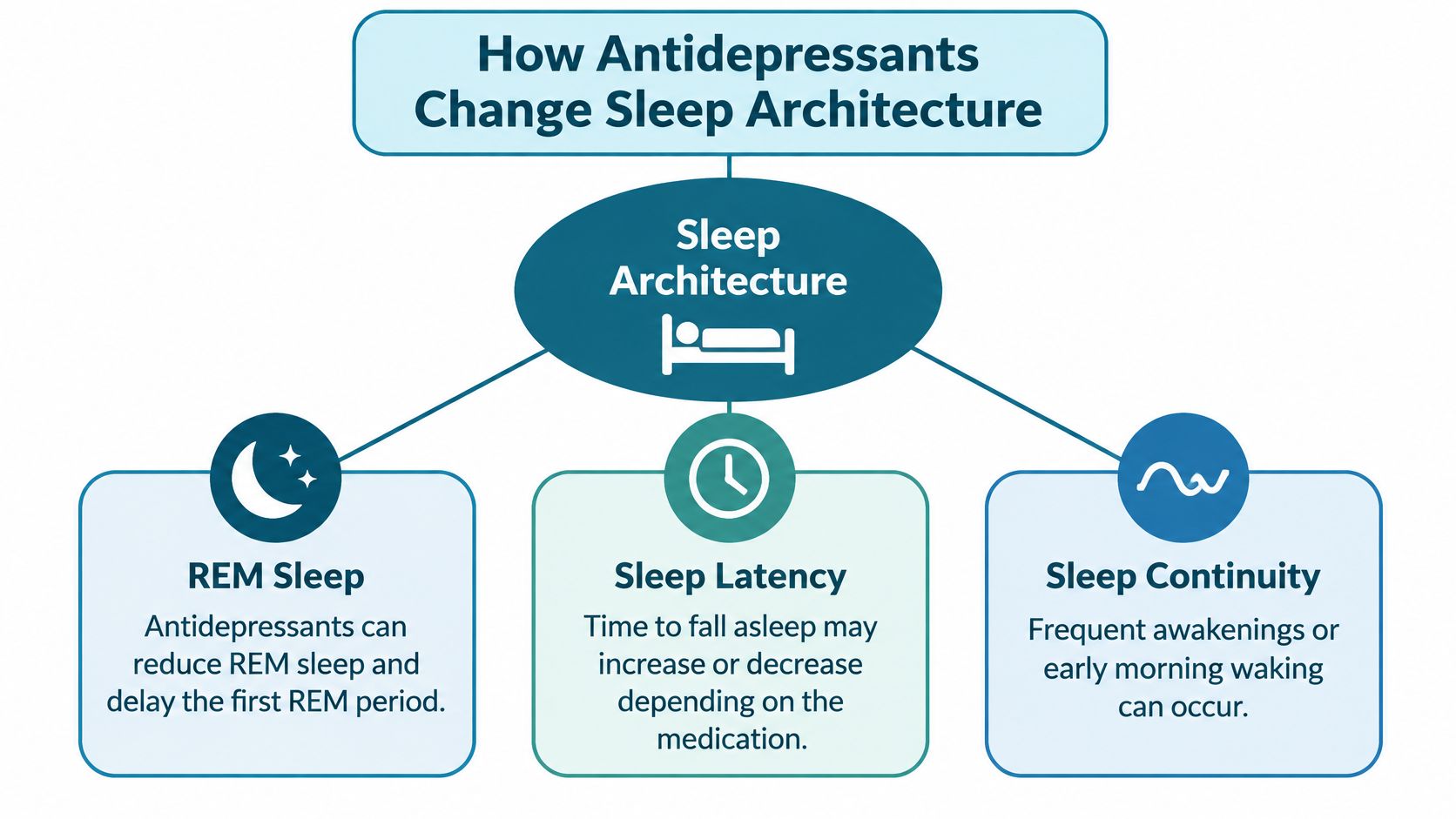
Changes may first become noticeable in the weeks after starting treatment or changing a dose, but there is no fixed timetable. Effects differ by medication, dose, and person, and the available evidence cannot predict when an individual's sleep will settle. A dated note of when treatment changed and what happened to sleep can make the pattern clearer to discuss with a prescriber.
What an Odds Ratio Tells You
A 2023 dose-effect network meta-analysis of 21 antidepressants, reviewed in the Frontiers in Psychiatry article, put numbers on these patterns. Thirteen antidepressants had higher odds of somnolence than placebo, with fluvoxamine ranking highest at an odds ratio of 6.32 (95% CI 3.56 to 11.21). Eleven increased insomnia risk, with reboxetine ranking highest at an odds ratio of 3.47 (95% CI 2.77 to 4.36).
An odds ratio compares the odds of an outcome in one group with the odds in another. An odds ratio of 6.32 means the odds of somnolence were more than six times those with placebo. It does not mean six in ten people became sleepy. The confidence interval, 3.56 to 11.21, gives a range of plausible values; a wider interval indicates greater uncertainty.
A sedating antidepressant may shorten sleep latency and increase sleep efficiency, yet leave someone sleepy the next morning. Note the dates of treatment changes alongside changes in sleep, and record specific effects such as difficulty falling asleep or waking during the night. These observations can help separate a medication-related pattern from sleep changes that may also accompany the condition being treated. They do not establish the cause on their own.
For an explanation of treatment selection and monitoring, see the overview of antidepressant care. Bring dated observations and specific questions to the prescriber, and discuss concerns before making any change to medication.
Sedation, Daytime Function and Sleep Quality
Falling asleep faster is not the same as sleeping well. A medication can shorten the wait for sleep and still leave someone groggy, unsteady, or mentally slower the next morning. The question worth asking isn't only whether sleep arrived. It's whether the day that followed was better.

Recent evidence shows adverse effects aren't limited to insomnia. A 2025 network meta-analysis in Frontiers in Psychiatry covering 102 randomized trials and 35,700 participants found higher adverse-event risks with several insomnia medications, particularly somnolence, dizziness, headache, taste disturbance, and nausea. That analysis examined insomnia drugs rather than psychiatric medicines broadly, so it informs the question without settling it for any individual.
A sedating effect and restorative sleep are different outcomes, and that gap matters most in specific situations: driving, caregiving, sustained concentration at work, and older adulthood, where dizziness and unsteadiness raise the stakes of a fall. It also matters because antidepressants and antipsychotics aren't interchangeable treatments for insomnia. European sleep guidance recommends very careful use of both for that purpose, given contraindications and adverse effects.
A short functional check helps readers describe what they're noticing in terms a clinician can act on:
- Morning alertness: how long after waking does clear thinking return, and has that time grown longer since a medication change?
- Concentration and reaction time: any near misses while driving, or tasks that now take noticeably longer?
- Balance: unsteadiness, a stumble, or a near fall on stairs or at night?
- Breathing at night: has a partner noticed loud snoring, gasping, or pauses in breathing?
- Sustained quality: does sleep feel restorative, or does the night pass in a haze?
These observations go to the prescriber, who decides what they mean for the treatment plan. A pattern of next-day impairment is information worth reporting, not something to solve by skipping a dose or splitting pills. The answer is a conversation with the clinician who knows the full regimen.
Telling Medication Effects From Illness or Other Causes
Worsening sleep has more than one possible author. The condition being treated can disrupt sleep on its own. A medication can cause it. Stopping or missing doses can cause it. An unrecognized sleep disorder can sit underneath all of it.
The 2025 VA/DoD insomnia guideline pocket card requires clinicians considering insomnia medication to evaluate daytime sleepiness, respiratory impairment, cognitive impairment, other sleep disorders such as sleep apnea, substance-use history, and medication interactions. That list isn't paperwork. Each item changes what a safe next step looks like.
The safety logic runs like this: a sedating medicine can worsen daytime impairment or breathing-related risk even while it helps someone fall asleep. The same guideline warns that some prescription sleep medicines can cause serious problems, including falls, sleepwalking, or dependence. Those risks carry more weight when another central nervous system depressant is already in use, or when a sleep disorder hasn't been diagnosed.
Reading the Clues Table
The table below organizes common observations. It's a prompt sheet for a clinical conversation, not a diagnosis.
| Clue | May point toward medication | May point toward another cause |
|---|---|---|
| Timing | Changes began after a medication was started, stopped or changed | Sleep was already disrupted before treatment or changes track symptom flares |
| Daytime alertness | Morning grogginess that eases as the day goes on | Sleepiness with loud snoring, witnessed breathing pauses or unrefreshing sleep, which warrants a sleep apnea review |
| Sleep pattern | Sleep onset or awakenings changed soon after a dose change | Sleep changes that follow worry, low mood or other symptoms of the illness |
| Other substances | Changes after alcohol, sleep aids or other sedating products were added | Changes linked to caffeine, shift work or irregular schedules |
| Legs and dreams | Restlessness or vivid dreams after starting or stopping a medication | Restless leg symptoms or dream changes present before any medication change |
A single clue can point both ways. Grogginess in the morning could be residual sedation from a bedtime dose, or it could be the unrefreshing sleep of an undiagnosed breathing disorder. Only a clinician can weigh the clues together, which is why the observations are worth collecting rather than interpreting alone. Body timing plays a role too, and circadian rhythm explains how schedule and light exposure shape sleep timing.
At Empire Medical Wellness, mental health care begins with a thorough review of symptoms, medical history, current functioning, previous treatment, and current and past medications. Sleep, substance use, and lifestyle are considered when they affect diagnosis or treatment response.
If you suspect an adverse effect, don't stop or alter prescribed psychiatric medication on your own. Stopping can itself change sleep, sometimes with rebound vivid or disturbing dreams. That observation belongs to the prescribing clinician, who decides whether the pattern reflects the drug, the illness, or a change in dose or timing.
Off-Label Sleep Uses, Approved Options and Evidence
Approval is specific. A drug can be FDA-approved for depression and carry no insomnia approval at all, even when it makes people sleepy. The VA academic detailing guide on insomnia medications makes this distinction directly: some antidepressants and other psychiatric medicines are used off-label for sleep because their sedating effects reduce alertness, and sedation is not the same as restoring normal sleep.
The same guide describes low-dose mirtazapine as sedating primarily through blockade of histamine-1 receptors, and notes that low-dose trazodone acts at alpha-1, histamine-1, and serotonin receptors. It also states that evidence for trazodone in insomnia is limited, with very few randomized controlled trials evaluating its safety and efficacy for that use. Low-dose doxepin is different in kind: it is FDA-approved for insomnia at 3–6 mg, primarily for sleep-maintenance problems.
What the Guideline Suggests
The 2025 VA/DoD guideline provider summary recommends cognitive behavioral therapy for insomnia, commonly called CBT-I, as first-line treatment for chronic insomnia and suggests it over medication. CBT-I is a structured behavioral treatment addressing sleep habits and thoughts, not a sedating drug by another name.
When medication is offered, the guideline suggests a limited set of options: low-dose doxepin, dual orexin receptor antagonists such as lemborexant, daridorexant, and suvorexant, and selected nonbenzodiazepine agents such as eszopiclone, zaleplon, and zolpidem. It does not suggest antipsychotics, benzodiazepines, diphenhydramine, or trazodone for chronic insomnia disorder.
Evidence strength varies even among suggested options. The full 2025 VA/DoD insomnia guideline reports that support for doxepin came from one systematic review containing four randomized controlled trials, rated very low in strength. It also notes that clinicians may hesitate to use tricyclic antidepressants in people with cardiac disease or those susceptible to anticholinergic effects, which can include dry mouth, constipation, blurred vision, urinary retention, or confusion.
| Use or option | Regulatory status | Evidence or guideline note |
|---|---|---|
| Low-dose doxepin for sleep maintenance | FDA-approved for insomnia at 3–6 mg | Evidence from one systematic review of four randomized trials, rated very low strength by VA/DoD |
| Low-dose mirtazapine for sleep | Off-label sleep use | Sedating effect described in the VA medication guide; not an approved insomnia indication |
| Low-dose trazodone for sleep | Off-label sleep use | VA medication guide notes very few randomized trials for insomnia |
| Dual orexin receptor antagonists (lemborexant, daridorexant, suvorexant) | FDA-approved for insomnia | Suggested for chronic insomnia in the 2025 VA/DoD guideline |
| Cognitive behavioral therapy for insomnia (CBT-I) | Non-drug treatment | First-line recommendation in the 2025 VA/DoD guideline |
| Antipsychotics, benzodiazepines, diphenhydramine or trazodone for chronic insomnia | Not suggested for chronic insomnia | Not suggested by the 2025 VA/DoD guideline for that use; approved psychiatric uses are separate |
Not being suggested for chronic insomnia is not the same as being inappropriate. These drugs have approved psychiatric and medical indications, and a guideline statement about one use says nothing about another. The guideline's patient materials describe sleep medicines as generally intended for short-term use. How long a particular medicine is expected to stay in the plan is a fair question for the prescriber, and the answer depends on the indication rather than on habit.
Share Your Sleep Log With Your Prescriber
Bring a dated record, not a conclusion about the medicine. Keep the log below for about two weeks. Fill each item at the same time every day, then take it to the visit.
| Item to record | What to note |
|---|---|
| Bedtime and wake time | Actual times, including weekends |
| Time to fall asleep | Estimate in minutes |
| Number of awakenings | Count and approximate duration |
| Morning alertness | Rated on a simple scale or in words |
| Naps | Time and length |
| Dream changes | Vivid, disturbing or new dreams |
| Medications and timing | Name, timing and any change during the week |
| Stopped or changed medicines | Date and who advised the change |
| Supplements, alcohol and caffeine | Amount and timing |
| Daytime safety concerns | Driving, falls or near misses |
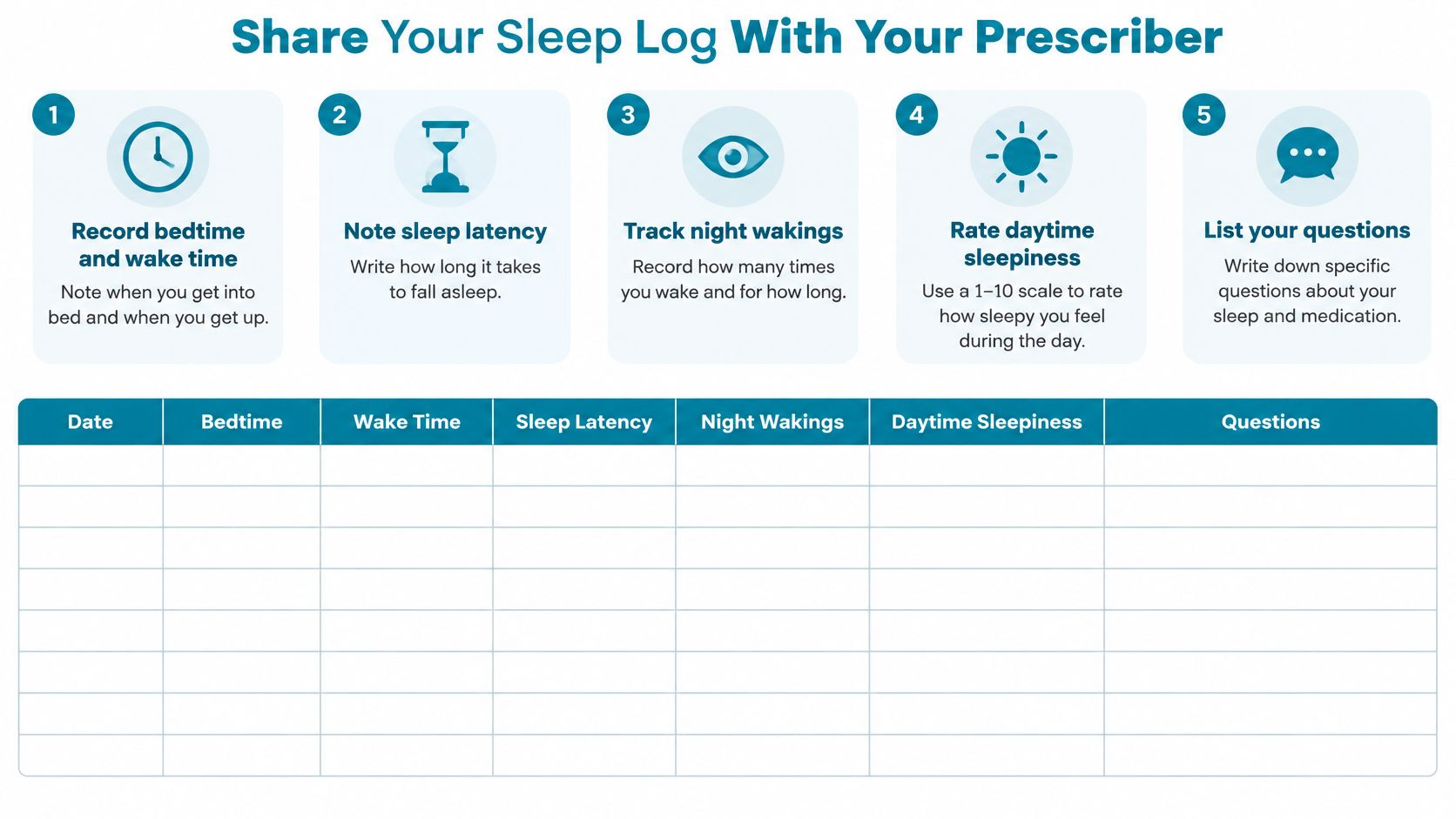
The log works like a weather notebook for nights. Tuesday's late bedtime, Wednesday's new dream, and Thursday's groggy morning each get a date. A symptom that began the week a dose changed looks different on paper from one that has come and gone for months. Caffeine at 4 p.m., a new supplement, alcohol, or a stopped medicine can leave a similar footprint. The dates are what let you and the prescriber tell those stories apart. You are reporting observations. You are not proposing a change to the regimen.
For a first visit, bring an updated medication list, including supplements and any side effects you've noticed. A psychiatric medication management worksheet can hold that list next to the questions below. A review of the medication plan discusses whether current treatment is helping, the side effects you're experiencing, and concerns about the plan. When medication is appropriate, follow-up assesses response and tolerability and determines whether treatment needs adjustment. That decision stays with the prescriber who has the full history.
Five Questions Worth Writing Down
- Which sleep change started after which medication change? Name the drug, the date, and the symptom, in that order.
- Does this look like better sleep or like sedation? Describe mornings, not just nights.
- Which other causes have been checked? Ask specifically about sleep apnea, restless legs, substance use, and interactions with everything else on the list.
- What monitoring is planned, and when will it be reviewed? A named checkpoint makes a subtle pattern harder to miss.
- Which changes should prompt an earlier call? Ask for the specific warning signs relevant to your regimen.
Routine Review or Urgent Call
Most sleep changes fit a routine review. Persistent or bothersome changes, a pattern that appeared after a dose change, or next-day impairment affecting driving or work all justify scheduling a conversation. The mental health medication management and medication review pages describe how those visits are structured.
Some situations do not wait. Call 911 or seek emergency care for fainting, severe breathing difficulty, or unresponsiveness. Call or text 988 for thoughts of suicide or self-harm. Then arrange routine follow-up through the scheduling page once the urgent concern has been addressed.
This article is educational and does not replace personal medical advice. Decisions about starting, stopping, or changing any medication belong with the prescriber who knows your history.
By Empire Medical Wellness Editorial Team. Published October 8, 2026. Updated October 8, 2026. Sources linked above include the 2025 VA/DoD insomnia guideline and its provider summary, the VA academic detailing guide on insomnia medications, a review of antidepressant and antipsychotic sleep effects, a review of antidepressant effects on sleep architecture, and a 2025 network meta-analysis of insomnia medications in Frontiers in Psychiatry.
Sleep changes after a medication start or dose adjustment deserve a structured conversation rather than a guess. Empire Medical Wellness provides physician-led mental health evaluation and medication management, including a review of whether treatment is helping, any side effects, and concerns about the plan. If a change has been present since a start or a dose adjustment, bring the two-week log and let the dated notes carry the visit. Learn more about the practice and how appointments work at Empire Medical Wellness.