
Can an interaction checker recognize a risk if a sleep aid or herbal supplement never makes it onto the medication list? It cannot. A psychiatric drug interaction happens when a medicine, supplement, or substance changes another treatment's concentration or effects, and a checker can only compare the entries it is given. Preparing a complete list, then asking a pharmacist or prescriber to interpret it alongside medical history and monitoring results, is more useful than treating a checker as a safety certificate.
This guide to psychiatric drug interactions focuses on preparing for that conversation: building the list, turning it into specific questions, and understanding what no tool can guarantee.
Empire Medical Wellness Editorial Team
Table of Contents
- How Psychiatric Drug Interactions Happen
- Build a Complete Medication and Supplement List
- Interaction Examples Across Common Psychiatric Medicines
- What Interaction Checkers Cannot Tell You
- Questions to Bring to Your Pharmacist or Prescriber
- Red Flags Versus Routine Follow-Up
- Bring Your List to a Physician-Led Medication Review
How Psychiatric Drug Interactions Happen
A psychiatric drug interaction can change how another medicine is absorbed, broken down, or acts in the body. The resulting effect may be stronger, weaker, or different from what the prescriber intended.
Pharmacokinetic interactions change the amount of medicine reaching or remaining in the body. Liver enzymes, including CYP2D6 and CYP2C19, help process many psychiatric medicines. An inhibitor slows an enzyme's activity, much like a blocked traffic lane slows the movement of cars.
The FDA fluoxetine prescribing information explains that fluoxetine inhibits CYP2D6 and can make someone with normal enzyme activity functionally resemble a person who processes CYP2D6 substrates slowly. A substrate is a medicine that an enzyme processes. Exposure to certain tricyclic antidepressants, antipsychotics, and other substrates can therefore increase, with possible concentration-related adverse effects.
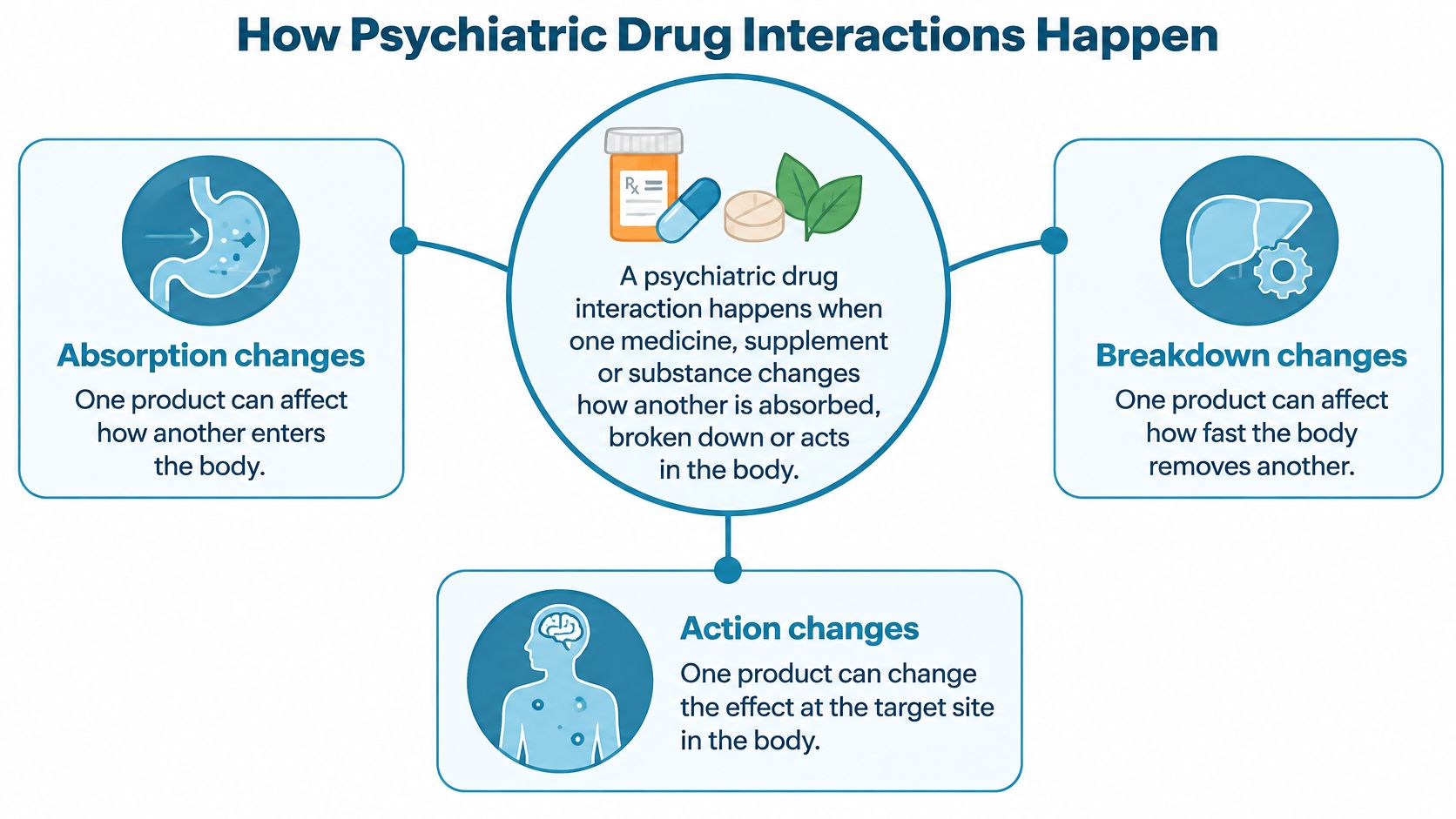
Changes in drug action
Pharmacodynamic interactions involve overlapping effects on the body, even without a change in drug concentration. Medicines may act on the same signaling system or affect the same organ.
Two clinically important concerns are serotonin syndrome, a potentially life-threatening reaction involving excessive serotonin activity, and QT prolongation, a change in the heart's electrical recovery cycle. Fluoxetine labeling includes warnings about both serotonergic combinations and medicines known to prolong QT.
Kidney or liver function, age, and other medicines can affect how a clinician interprets an interaction. Several sedating products also warrant review as a complete regimen rather than as isolated pairs.
Practical distinction: An interaction warning identifies a risk for clinical evaluation. It isn't a prediction that harm will occur.
For adults considering anxiety medication, the relevant review includes treatments prescribed for other conditions, not just medicines intended for anxiety.
Build a Complete Medication and Supplement List
Medication and supplement worksheet
This worksheet can be copied into a phone note or printed. Each category should include everything taken during the past few weeks, including occasional products and recently discontinued medicines.
| Item | What to write | Why it matters |
|---|---|---|
| Psychiatric medicines | Name, strength as labeled, how often taken, prescriber | Shows the full psychiatric regimen being reviewed |
| Other prescriptions | Name, prescriber, reason if known | Clinicians outside mental health may add interacting drugs |
| Over-the-counter medicines | Pain, cough, cold, allergy, and sleep products by name | Some contain sedating or serotonergic ingredients |
| Vitamins, herbs, and supplements | Product name and active ingredient from the label | St. John's wort is a documented serotonergic concern with lithium |
| Alcohol and other substances | Type, amount, and how often, reported honestly | Central nervous system depressants can add to sedation and breathing effects |
| Start, stop, and change dates | Date each item began, stopped, or changed | Helps match side effects to a timeline |
| Side effects noticed | Symptom, when it began, what made it better or worse | Gives the prescriber a clear timeline |
| Pharmacy and records | Pharmacy name, phone, relevant lab results if available | Helps the pharmacist check dispensing history and the clinician assess monitoring |
Record actual use, not just label instructions
For prescriptions, the list should distinguish the labeled instructions from actual use. If a medicine is taken only when needed, the pharmacist needs to know how often that happens. Strength, quantity taken, and timing are separate details, so each deserves its own entry.
Other prescriptions belong on the same list, including medicines from primary care, urgent care, pain, and sleep clinicians. Brand names alone may be insufficient for combination products. Packaging or photographs of ingredient panels can resolve uncertainty about an over-the-counter medicine or supplement.
The FDA lithium labeling records advise informing the physician and pharmacist about every prescription medicine, over-the-counter medicine, and herbal product. Lithium has a narrow safety margin, meaning relatively small changes in exposure can become clinically significant.
Add the details that records may miss
Alcohol and other substance use should be recorded without judgment, using type, amount, and frequency rather than vague descriptions. Approximate dates are useful when exact dates aren't available. Symptoms should be described plainly, such as increased sleepiness after a particular change, rather than labeled as a confirmed interaction.
Questions about over-the-counter products for anxiety should include the exact product and ingredients. A product marketed for relaxation still belongs on the list.
A complete list reduces guessing. A missing warning doesn't establish that a combination is safe.
Before a first visit, Empire Medical Wellness asks patients to bring an updated medication list, including supplements and noticed side effects, pharmacy information, relevant laboratory results or records, and contact details for other treating clinicians.
The list should accompany every appointment and be updated after any change. It supplies essential information, but interpretation still requires dose, timing, organ function, and clinical context.
Interaction Examples Across Common Psychiatric Medicines
Examples of clinically important psychiatric interactions
These examples identify issues for clinician review. They aren't instructions to avoid, combine, or modify medicines independently.
| Medicine | Interacting medicine or factor | Main concern | What to flag |
|---|---|---|---|
| Lithium | SSRIs, SNRIs, MAOIs, triptans, tramadol, St. John's wort | Serotonin syndrome | Any new serotonergic medicine or supplement |
| Lithium | Methadone | Serotonergic and QT effects | Need for prescriber-led risk assessment and monitoring |
| Citalopram | CYP2C19 inhibitors or other QT-prolonging drugs | Additional QT prolongation | Heart history and ECG discussion |
| Fluoxetine | CYP2D6 substrates, including some tricyclics and antipsychotics | Higher exposure, sedation, or arrhythmia | Dose, timing, or substitution questions for the prescriber |
Lithium and serotonergic combinations
The FDA lithium prescribing information identifies potentially life-threatening serotonin syndrome with serotonergic combinations, particularly when lithium is initiated or combined with another serotonergic medicine. Named interacting products include selective serotonin reuptake inhibitors (SSRIs), serotonin-norepinephrine reuptake inhibitors (SNRIs), monoamine oxidase inhibitors (MAOIs), triptans, tramadol, buspirone, and St. John's wort.
This makes ingredient-level reporting valuable. A supplement marketed for mood and a prescription from another clinician may be relevant to the same risk assessment. Remembering only the psychiatric prescriptions leaves an incomplete picture.
An NIH-hosted interaction reference also identifies serotonergic and QT concerns with lithium and methadone, supporting clinical monitoring and ECG consideration when feasible. Methadone illustrates why treatment prescribed outside mental health care must appear on the same list.

Citalopram and cardiac context
The FDA citalopram prescribing information warns that other QT-prolonging medicines can produce additional QT prolongation. CYP2C19 inhibitors can also increase citalopram exposure and the risk of ventricular arrhythmias, abnormal rhythms arising in the heart's lower chambers.
The fluoxetine row illustrates a different review question: whether another medicine's concentration could increase. A discussion of antidepressant treatment therefore needs the full medication history, not just the antidepressant's name.
These examples draw on prescribing information and a clinical reference, not a trial establishing the safety of every listed combination. They don't provide an individual probability of harm. Some warnings require avoidance; others require a prescriber-led assessment of alternatives, monitoring, and treatment benefits.
What Interaction Checkers Cannot Tell You
A pair-by-pair checker can flag a documented interaction. It generally can't establish how the entire regimen will affect a particular adult's alertness, coordination, blood pressure, breathing, or heart rhythm.
Polypharmacy means taking multiple medicines. The practical concern isn't the number of products, but overlapping effects and the patient's ability to process them. Older adults, people taking pain or sleep medicines, and people using alcohol or other central nervous system depressants need particular attention to cumulative effects.
Look beyond the severity label
Several warnings labeled moderate may deserve more attention together than any individual warning suggests. Sedation, impaired coordination, falls, respiratory depression, and anticholinergic burden are examples of outcomes that a clinician assesses across the whole regimen. Anticholinergic burden refers to the combined effects of medicines that block acetylcholine, a signaling chemical involved in functions including memory, bowel activity, and urination.
A checker may also lack information about:
- Actual exposure: How often an as-needed medicine is taken and whether products overlap.
- Patient factors: Kidney or liver impairment, dehydration, cardiac history, and recent laboratory results.
- Missing products: Supplements, alcohol, and medicines obtained elsewhere.
- Clinical purpose: Why a combination was selected and what monitoring already exists.
Evidence about every possible multi-drug combination is less complete than documentation of specific interacting pairs. A severity category therefore shouldn't be treated as a personalized forecast.
Useful next step: A flagged result should become a specific question for the pharmacist or prescriber, not an independent treatment decision.
Likewise, an empty results screen can't certify a regimen as safe. The appropriate endpoint is an interpreted medication review with an agreed monitoring and communication plan.
Questions to Bring to Your Pharmacist or Prescriber
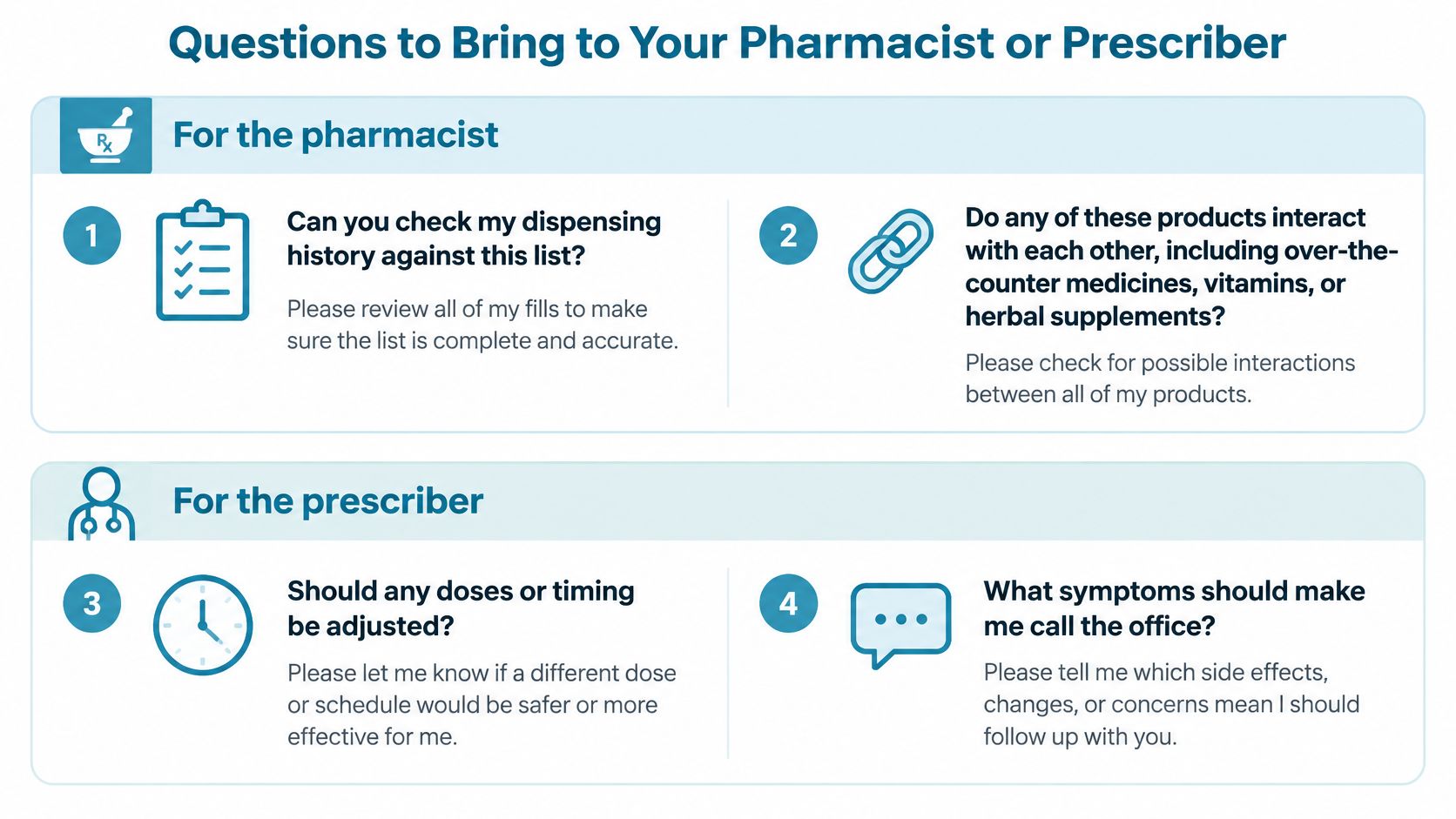
A question list works like a sorting tool. Some concerns can be answered from pharmacy dispensing records, while others require the clinician who knows the diagnosis, the dose history, and the treatment goal. Separating the two before the appointment keeps a short visit focused. A structured format such as the psychiatric medication-management worksheet gives the completed list and the questions one shared place to live.
For the pharmacist
- Dispensing history: Can the pharmacist compare dispensing records against the completed list and flag anything missing?
- Product combinations: Do any listed products interact, including over-the-counter items or supplements being considered?
- Overlapping effects: Are any ingredients likely to affect sleep, alertness, heart rhythm, or serotonin activity?
A dispensing record shows what was filled at that pharmacy, not what is taken each day or what was filled somewhere else. The patient's account closes that gap. Unidentified products can be brought in their original packaging rather than described from memory.
For the prescriber
- Treatment review: Which items need review before any product is continued, changed, or added?
- Monitoring: Does any combination call for an ECG, a blood-level check, or other monitoring, and what follow-up schedule is appropriate?
- Warning symptoms: Which symptoms would warrant a same-day call, and which would warrant emergency care?
- Coordination: Should a therapist, primary care clinician, or another treating clinician be included, with permission?
- Genetic testing: Is pharmacogenomic testing relevant to the medicines being reviewed?
Pharmacogenomic testing examines how inherited differences in drug-processing enzymes may affect medication levels or tolerability. A review available through PubMed Central identifies CYP2D6 and CYP2C19 results as particularly actionable for selected antidepressants, while evidence for predicting treatment response through other genetic markers remains inconsistent.
Two limits matter here. A normal enzyme result does not cancel the effect of a separate medicine that inhibits that enzyme, and a test does not replace assessment of organ function, age, symptoms, or the medication list itself. Genetic reference data may also be less informative for some ancestry groups, so asking what a result can and cannot show is a reasonable question.
Before starting, stopping, or adjusting any product, the patient should get guidance from the appropriate clinician or pharmacist. These questions support a shared discussion; they do not replace clinical judgment or authorize a medication change.
Red Flags Versus Routine Follow-Up
Urgency guide for medication-related concerns
| Situation | Urgency | Action |
|---|---|---|
| New confusion or agitation with fast heartbeat, fever, muscle stiffness or twitching, or heavy sweating | Emergency | Call 911 or the local emergency number now |
| Fainting, chest pain, palpitations with severe symptoms, seizure, or severe dizziness | Emergency | Call 911 or the local emergency number now |
| Thoughts of harming oneself or others | Immediate safety assessment | Call 911 for immediate danger; call or text the 988 Suicide and Crisis Lifeline for crisis support |
| Worrying symptom not listed above | Same day | Contact the prescriber or pharmacist the same day |
| Another clinician changes a medicine | Same day | Notify the psychiatric prescriber before any further independent change |
| Bothersome but non-severe side effect | Routine | Contact the prescriber during office hours |
| Question about an over-the-counter product or supplement | Routine, before use | Ask the pharmacist before starting and review with the prescriber |
These red flags don't diagnose an interaction. Symptoms can have other causes, and emergency assessment shouldn't be delayed while searching an online checker. Severe breathing difficulty or inability to awaken also requires emergency help.
When cardiac monitoring deserves discussion
The FDA cardiac-safety document describes how QT-related risk can increase when medicines have overlapping effects or one medicine inhibits another's metabolism. Relevant factors include low potassium or magnesium, a slow heart rate, structural heart disease, liver impairment, prior QT prolongation, and a family history of sudden cardiac death.
These details belong in the clinical history even when the patient feels well. They can help the prescriber decide whether an electrocardiogram, also called an ECG, or additional monitoring is appropriate.
Any dosing decision involving citalopram or escitalopram belongs to the prescriber and falls outside this article. Patients shouldn't stop or change psychiatric treatment independently. For non-emergency concerns, the prescriber can assess symptoms, timing, and the complete regimen before recommending next steps.
Bring Your List to a Physician-Led Medication Review
The completed list becomes the working document of the visit. Bring it with your pharmacy's details, relevant laboratory results or records, and contact information for other clinicians involved in your care. Mark uncertain entries as uncertain. A question mark on the page tells the reviewer more than a confident guess.
A checker flags pairs of medicines. It cannot weigh your heart rhythm, your potassium or magnesium levels, or the reason each medicine was prescribed. That weighing happens in the review. Expect to cover whether treatment is helping, which side effects are bothersome, and your concerns about the plan, and come away knowing who manages each medicine, who orders monitoring, and whom to contact after a change.
What a visit can establish
A first mental health appointment at Empire Medical Wellness runs 50 minutes, covering symptoms, medical and treatment history, current medications, daily functioning, and goals. Medication management includes selecting an appropriate option, reviewing risks and interactions, explaining use, and monitoring response over time. Recommendations are individualized, and a visit does not guarantee a particular medication.
Adults can explore a focused mental health medication review or ongoing mental health medication management. Information about fees and how visits work and appointment scheduling can help with practical preparation.
Sources: FDA prescribing information for fluoxetine, lithium, and citalopram; FDA cardiac-safety information; an NIH-hosted interaction reference; and a pharmacogenomics review, linked alongside the relevant discussions.
This article is educational, not personal medical advice. Psychiatric medicines shouldn't be stopped or changed without clinician guidance, and emergency symptoms require emergency care rather than a routine appointment.
Empire Medical Wellness offers physician-led mental health medication review and ongoing medication management, including discussion of side effects and potential interactions. Adults preparing for a review can visit Empire Medical Wellness to learn about care and bring a completed medication and supplement list to the conversation.