
BMI is weight in kilograms divided by height in meters squared. For adults, the standard categories are underweight below 18.5, healthy weight from 18.5 to less than 25, overweight from 25 to less than 30, and obesity at 30 or higher.
That answer is mathematically simple, but the popular advice to “just check your BMI” leaves out the part that matters most. BMI is a screening measurement, not a diagnosis, fitness score, or final judgment about your health. A physician interprets it alongside waist size, blood pressure, laboratory results, medicines, body composition, medical history, and day-to-day function.
This distinction matters in obesity medicine. The same BMI can reflect different combinations of muscle, fat, bone, and fluid in different adults. The number can open a useful clinical conversation, but it can't finish one.
Table of Contents
- What BMI Actually Measures
- How to Calculate BMI and Read the Adult Categories
- Two Adults With the Same BMI Can Carry Very Different Risk
- Where BMI Falls Short and Why Clinicians Look Beyond It
- Adding Waist, Ratios, and Body Composition to the Picture
- When a Deeper Physician-Led Evaluation Makes Sense
- Using BMI as a Starting Point in Personalized Care
What BMI Actually Measures
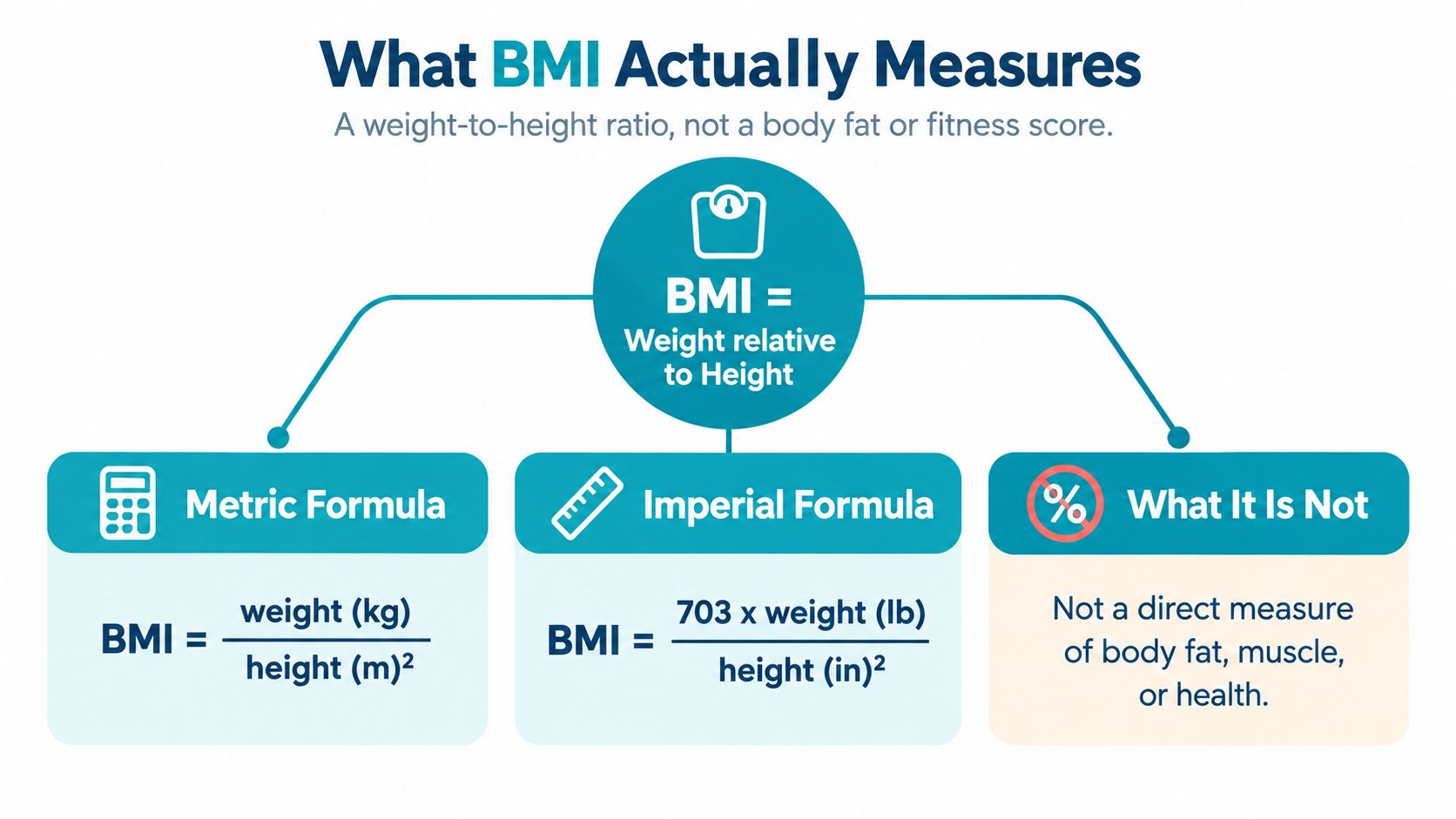
BMI, or body mass index, is a screening tool, not a verdict about an individual. It is a standardized ratio that compares weight with height. That makes it useful for sorting broad patterns, but it does not directly measure body-fat percentage, fitness, metabolic health, or fat stored around internal organs.
The unit-safe formulas
For metric measurements, calculate:
BMI = weight in kilograms ÷ height in meters squared
“Height in meters squared” means multiplying the height by itself before dividing. A height of 1.75 meters becomes 1.75 × 1.75. Square the height, not the weight, and convert units before calculating.
For U.S. customary measurements, use:
BMI = 703 × weight in pounds ÷ height in inches squared
The conversion factor 703 aligns the imperial calculation with the metric formula. A calculator can limit arithmetic mistakes, but the result remains screening information rather than a diagnosis. The CDC adult BMI categories show how clinicians classify adult results.
Why clinicians still use it
BMI is quick, inexpensive, repeatable, and standardized. Those features let researchers and public-health teams compare weight patterns across large populations and over time. The World Health Organization reports that 2.5 billion adults aged 18 and older were overweight in 2022, including more than 890 million adults living with obesity. Its report also states that about 43% of adults worldwide were overweight in 2022, compared with 25% in 1990, while adult obesity more than doubled during that period. (WHO obesity and overweight fact sheet)
For one person, BMI is the opening measurement in a clinician's sequence. First, verify the units. Then calculate the number once and place it in a category. After that, the clinician considers waist size, blood pressure, laboratory results, medicines, body composition, medical history, and daily function.
A BMI chart for adults can show the category. It cannot explain what produced the result or determine its meaning without the rest of the clinical picture.
How to Calculate BMI and Read the Adult Categories
BMI is easy to calculate, but its category is not a personal verdict. It is a screening range, similar to a sorting label that helps a clinician decide what information to review next.
Consider a hypothetical adult who weighs 200 pounds and is 5 feet 8 inches tall. Convert the height first. Five feet equals 60 inches, and 60 plus 8 equals 68 inches.
Using the imperial formula:
BMI = 703 × 200 ÷ 68²
The result is 30.4, which falls in the obesity category under the CDC adult framework. The CDC uses this same example in its public BMI guidance. (CDC adult BMI guidance)
That result does not show whether the person has an obesity-related complication. It places the measurement in a screening range that may prompt a fuller discussion, depending on medical history, body composition, waist size, blood pressure, laboratory findings, medicines, and daily function.
Adult category reference
| Category | Standard BMI | Asia-Pacific BMI |
|---|---|---|
| Underweight | Below 18.5 | Varies by guideline |
| Healthy weight | 18.5 to less than 25 | Varies by guideline |
| Overweight | 25 to less than 30 | Some guidelines use a lower threshold, around 23 |
| Obesity, class 1 | 30 to less than 35 | Varies by guideline |
| Obesity, class 2 | 35 to less than 40 | Varies by guideline |
| Obesity, class 3 | 40 or higher | Varies by guideline |
The standard adult ranges follow CDC guidance. NIDDK identifies BMI 40 or higher as severe obesity, a subgroup used in adult obesity-care discussions. (NIDDK overweight and obesity statistics)
The Asia-Pacific column requires careful interpretation. Some clinicians use a lower overweight threshold, around 23, for adults from higher-risk Asian populations. Guidelines differ, and ancestry alone does not determine how an individual result should be understood. Waist distribution and other risk markers can change the clinical picture.
Practical rule: Confirm the units, calculate BMI once, record the category, then ask what the number leaves out.
Adult cutoffs do not apply to children or teenagers. For ages 5 to 19 years, the WHO describes a major global rise in obesity, from 2% to 8% over the period covered in its fact sheet. Pediatric assessment uses age- and sex-specific growth references instead of adult thresholds. (WHO obesity and overweight fact sheet)
For an arithmetic check, the Empire BMI calculator can calculate the ratio. Use its output as a starting point for discussion, not as a diagnosis or a guarantee that the result is safe.
Two Adults With the Same BMI Can Carry Very Different Risk
The same BMI can describe very different health situations. BMI is a population screening measure, not a personal verdict. It can place a result in a category, but it cannot show waist distribution, blood pressure, glucose regulation, cholesterol patterns, medical history, or physical function by itself.
A clinician's sequence is straightforward: verify the units, calculate the ratio once, record its category, then add the measurements and clinical context that the ratio leaves out.
The following is a clearly labeled hypothetical composite, not an Empire patient story and not a report of a clinical outcome.
Person A and Person B have the same BMI. Person A has a larger waist circumference, increased blood pressure, borderline glucose results, and low HDL cholesterol, a type of cholesterol considered in cardiometabolic assessment. Person B has an athletic frame, a smaller waist, normal blood pressure, unremarkable laboratory findings, and strong day-to-day function.
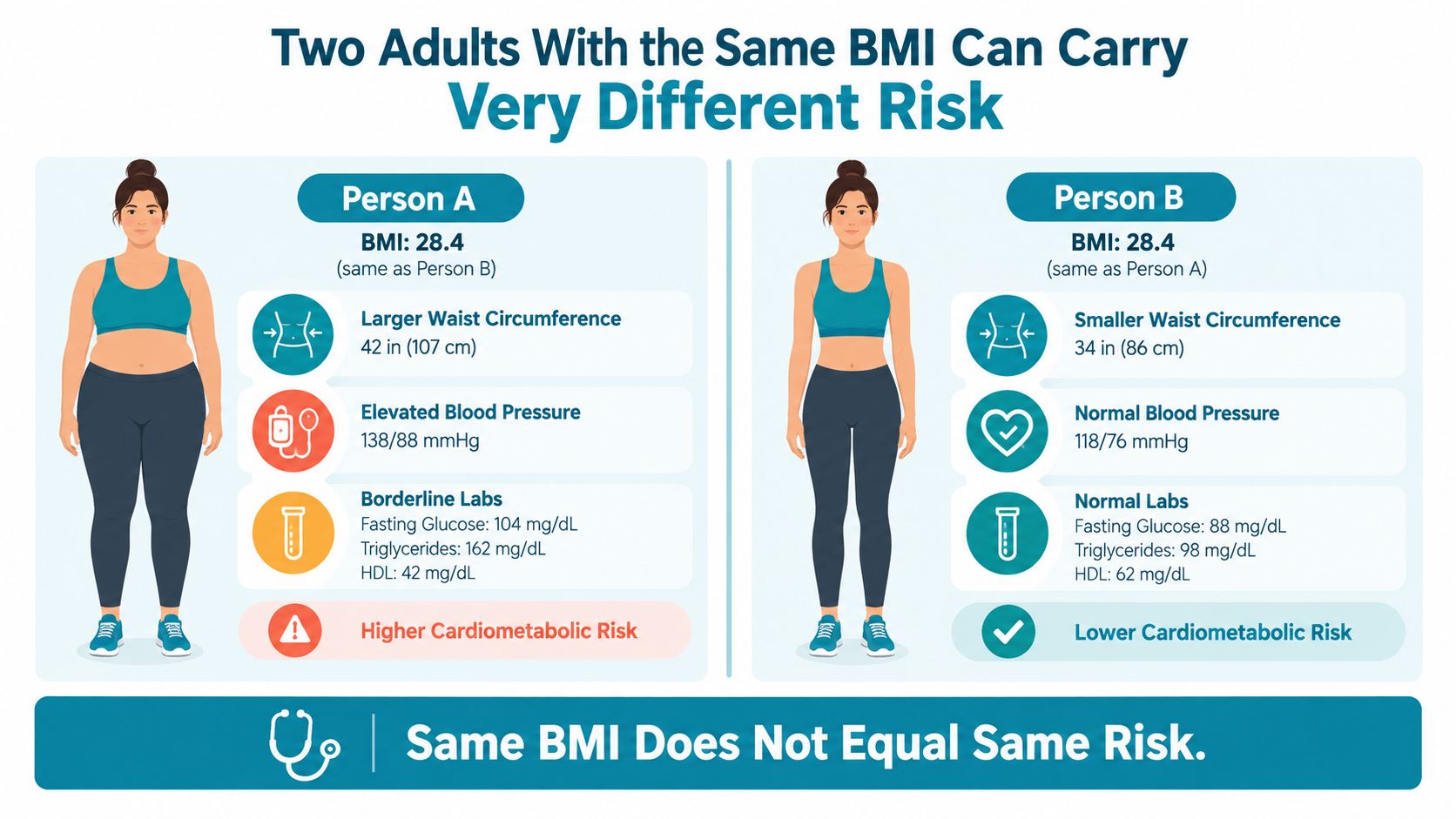
What gets added to the screening number
A clinician might review:
- Waist circumference: This helps estimate central adiposity, meaning fat concentrated around the abdomen.
- Blood pressure: Readings can change the overall cardiometabolic assessment.
- Fasting glucose or A1C: These tests provide information about blood-sugar regulation. A1C reflects average blood glucose over a period of time.
- Lipid panel: Cholesterol and triglyceride results add information that BMI cannot provide.
- Function: Strength, mobility, endurance, pain, sleep, and the ability to perform routine activities can affect clinical priorities.
These profiles could lead to different follow-up questions and care priorities despite the matching BMI. Clinical guidance notes that BMI does not identify every adiposity-related complication and that waist circumference can add information by reflecting central adiposity more directly. (Clinical guidance on BMI limitations)
An overview of metabolic syndrome and its related markers explains why abdominal measurements, blood pressure, glucose, and lipids are considered together. BMI is a doorway, not a diagnosis.
Population research also should not be treated as a precise forecast for one person. A meta-analysis covering 239 prospective studies found that all-cause mortality was minimal in the BMI range of 20.0 to 25.0 kg/m² and increased approximately log-linearly above 25 kg/m². It reported different hazard ratios across regions, including 1.39 in Europe, 1.29 in North America, 1.39 in East Asia, and 1.31 in Australia and New Zealand for each 5 kg/m² increase above 25. These are population-level associations, not an individual prediction. (IARC summary of the 239-study meta-analysis)
A short video offers another visual explanation of how clinicians use BMI alongside broader health information:
Where BMI Falls Short and Why Clinicians Look Beyond It
BMI is a screening signal, not a personal verdict. It compresses height and weight into one number, much like using a map scale to estimate an area without seeing every street. That shortcut helps clinicians identify who may need a closer look, but it cannot show what the weight represents.
The limitations become clearer when the same BMI is examined through different clinical questions:
- Muscularity: A resistance-trained adult may have a higher result because of lean mass. BMI can place that person in an overweight or obesity category without separating muscle from fat.
- Age: Aging can involve less muscle and changes in height. BMI cannot show whether a higher result reflects fat, muscle loss, or both.
- Sex: Men and women may have different amounts and distributions of body fat at the same BMI. Standard adult categories do not capture every difference in body composition.
- Ethnicity: Health risk may emerge at different BMI values across populations. Some guidance uses lower thresholds for Asian adults because BMI may not represent risk consistently across groups.
- Pregnancy: BMI does not assess pregnancy-related weight change. Pregnancy requires prenatal assessment and its own clinical framework.
- Visceral adiposity: This term means fat stored around internal organs. BMI cannot locate that fat, although central measurements may provide additional information.
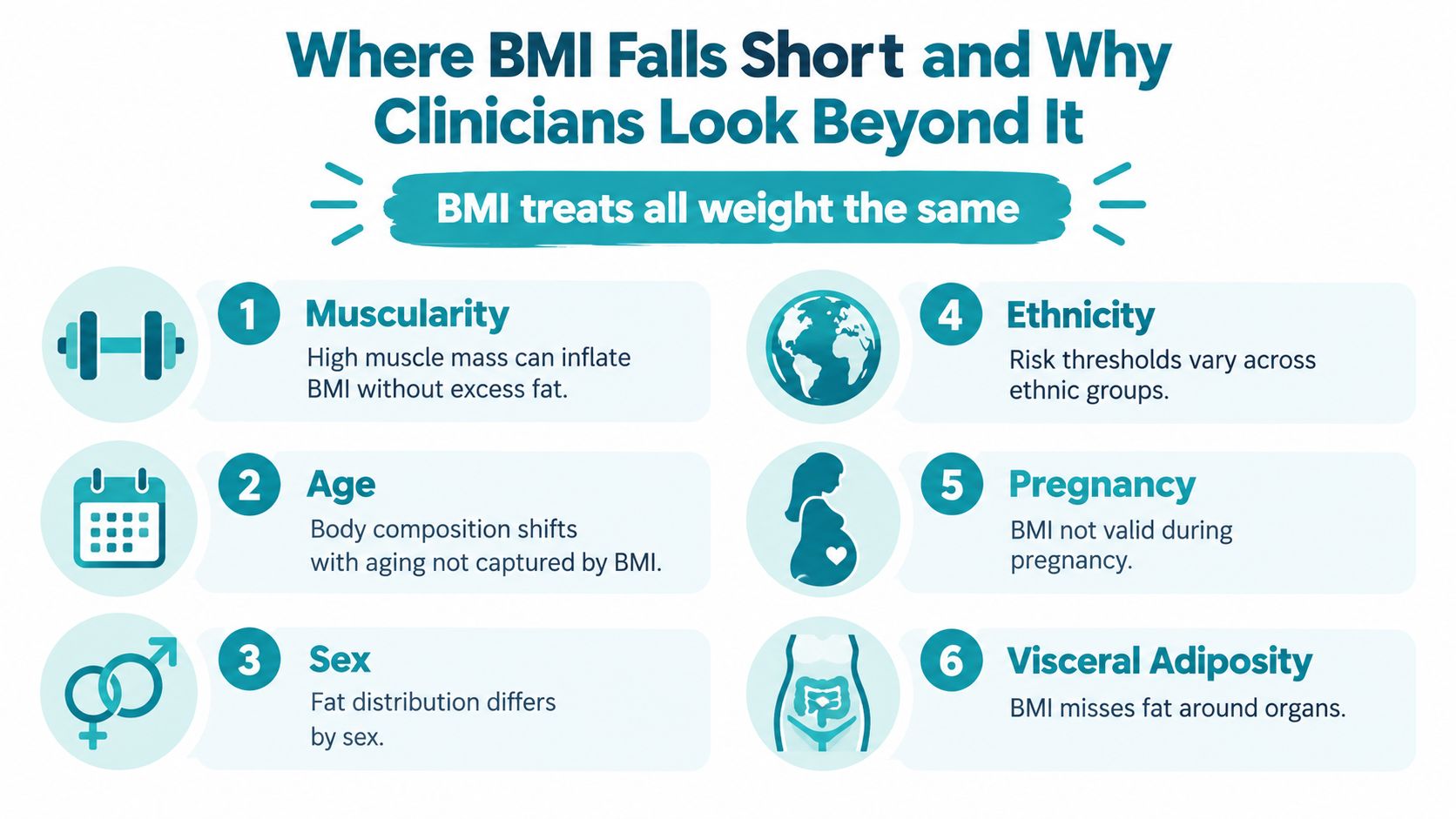
The CDC explains BMI as an indirect measure that correlates with body fat for many adults. It does not directly measure fat or diagnose a condition by itself. A clinician therefore asks different follow-up questions for a muscular adult than for an older adult with the same result.
Body composition also differs among populations. Global guidance recommends considering BMI alongside waist circumference, waist-to-height ratio, waist-to-hip ratio, or direct body-fat assessment, rather than treating the number as a complete assessment. (Global implementation guidance public review)
The clinical sequence is straightforward: verify the height and weight units, calculate BMI once, place it in the appropriate category, then add waist measurement, blood pressure, laboratory results, medical history, medications, and physical findings. Concern about glucose regulation may also make an explanation of insulin resistance useful. Only a clinician, with appropriate assessment and testing, can determine whether it is present.
Adding Waist, Ratios, and Body Composition to the Picture
BMI is a screening signal, not a personal verdict. It becomes more useful when clinicians pair it with measurements that answer different questions. Waist circumference examines central body size, ratios relate waist to height or hip circumference, and body-composition methods estimate the proportions of fat and lean tissue.
| Measurement | What It Captures | Key Limitation |
|---|---|---|
| Waist circumference | Central body size and an indirect signal of abdominal fat distribution | Technique, breathing, posture, and measurement site affect consistency |
| Waist-to-height ratio | Waist size in relation to height | A simple ratio isn't a diagnosis and still doesn't identify all body compartments |
| Waist-to-hip ratio | Waist size compared with hip size | Results depend on consistent measurement of both sites |
| Bioelectrical impedance | An estimate of fat mass and lean mass using electrical resistance | Hydration and device methods can affect readings |
| Skinfolds | An estimate based on measured skinfold thickness | Accuracy depends on technique and body areas assessed |
| Air-displacement plethysmography | An estimate of body volume and composition | Availability and interpretation vary |
| DEXA scanning | Estimates of bone, fat, and lean tissue distribution | It measures composition, not overall disease risk |
| Clinical assessment | Integrates appearance, history, function, examination, and other findings | It depends on the quality and completeness of the evaluation |
Waist circumference is measured at a defined anatomical location, often around the iliac crest, the upper border of the hip bone. Clinicians may use sex-specific cutoffs, but technique and the guideline followed affect interpretation. The measurement is useful because abdominal size can add information that BMI cannot provide by itself.
A waist-to-height ratio compares waist size with height. The simple idea of keeping waist size below half of height is sometimes discussed, yet the ratio remains a screening aid rather than a diagnosis. Waist-to-hip ratio describes body shape, but both sites must be measured consistently for the comparison to be meaningful.
Body-composition methods address another question: how much of total weight is fat compared with lean tissue? Bioelectrical impedance estimates these compartments through electrical resistance, while skinfolds use measured skinfold thickness. Air-displacement plethysmography estimates body volume, and DEXA scanning estimates bone, fat, and lean tissue distribution. Hydration, technique, availability, and interpretation can affect results, and none of these methods independently diagnoses obesity-related disease.
A single reading can mislead. Repeated measurements collected under reasonably consistent conditions often tell a more useful story.
The clinician does not need every available measurement. The useful choice depends on the question. Waist circumference may add more information when central adiposity is the concern. A body-composition assessment may help clarify an unexpectedly high BMI in a muscular adult.
These findings are then considered with blood pressure, laboratory results, medical history, medications, physical findings, and the person's goals. That sequence keeps BMI in its proper role: a starting point for screening, followed by clinical judgment rather than an automatic conclusion.
When a Deeper Physician-Led Evaluation Makes Sense
BMI is a screening signal, not a personal verdict. Its value appears when it leads to better questions: Was the measurement taken correctly? What category does it fall into? Do waist size, blood pressure, laboratory results, medical history, and personal goals point to a concern that needs attention?
A practical decision sequence
Verify the inputs. Confirm a measured height and weight, the units used, and whether both measurements are current and reliable. A unit error can change the result before any medical interpretation begins.
Calculate once and place it in context. Record the adult BMI category rather than repeatedly checking the calculator. A result in class 2 or class 3 obesity, a notably high waist measurement, or a relevant medical condition can support a fuller review. The category organizes the discussion. It does not decide treatment.
Layer health markers. When clinically appropriate, review waist circumference, blood pressure, fasting glucose or A1C, and a lipid panel. Medicines, family history, sleep, pain, mobility, and functional concerns can change how the same BMI should be understood.
Build a proportionate plan. Nutrition, physical activity, sleep, behavioral support, medication, or referral may be discussed. The appropriate combination depends on the complete assessment, not on BMI alone.
A fuller evaluation may examine secondary contributors, meaning medical conditions or treatments that may affect weight. Examples include hypothyroidism, Cushing disease, and medication-associated weight gain. Depending on symptoms and history, the clinician may also assess obstructive sleep apnea, fatty liver disease, or joint disease. The goal is not to force every person's weight into one explanation. It is to avoid overlooking a treatable contributor or a health issue that deserves care.
For readers comparing general health information with clinical review, the medical experts behind a resource offer background on professional evaluation. Educational material can support questions, but it cannot replace an assessment for one person.
The National Institute of Diabetes and Digestive and Kidney Diseases describes adult BMI categories as 18.5 to 24.9 for normal or healthy weight, 25 to 29.9 for overweight, 30 or higher for obesity, and 40 or higher for severe obesity. (NIDDK adult obesity information) These categories help identify useful questions. They do not dictate treatment.
A physician-led weight-loss evaluation can help adults review weight history, related medical factors, and possible next steps. Routine follow-up differs from emergency care. Seek urgent medical attention for severe or rapidly worsening symptoms, chest pain, severe shortness of breath, fainting, or other signs of an acute medical problem.
Using BMI as a Starting Point in Personalized Care
BMI is a screening signal, not a personal verdict. A clinician uses it to begin a structured review, then checks whether the number fits the person's health context.
The sequence is straightforward. First, verify the height and weight units. Next, calculate BMI once and place it in the relevant adult category. Then review waist circumference, blood pressure, glucose, lipids, medicines, weight history, sleep, body composition, and functional concerns. These details show whether BMI is a population-level screening result or a prompt for closer follow-up.
What a thoughtful review can clarify
- What changed: Weight history can show whether the current value reflects a recent change, a long-term pattern, or a shift after a medication or medical event.
- What risk is present: Blood pressure, glucose, lipid results, waist size, sleep, and family history may reveal concerns that BMI cannot show.
- What the patient wants to address: Goals may involve mobility, energy, metabolic health, sleep, or long-term maintenance rather than one target number.
- What follow-up should track: Trends in measurements, symptoms, function, and treatment response can provide more useful information than one isolated BMI value.
Dr. Chhatpar's documented role at Empire Medical Wellness includes physician-led obesity medicine evaluation and individualized weight-management planning. Lifestyle therapy, medication, or referral may be discussed when clinically appropriate. This article does not recommend a medication, dose, or treatment change for any individual. A qualified clinician must review approval status, contraindications, interactions, and monitoring requirements.
Supplement marketing can also distract from the clinical sequence. General information about organic matcha as a green tea capsule does not replace review of blood pressure, laboratory results, medicines, body composition, and medical history.
BMI remains useful because it gives clinicians a shared starting language. Its meaning becomes clearer when the number is held alongside the person, not treated as the person.
Empire Medical Wellness provides physician-led obesity medicine evaluations and individualized weight-management planning for adults, with telemedicine available to adults physically located in New York, New Jersey, Connecticut, Pennsylvania, or Virginia. Visit Empire Medical Wellness to review the obesity medicine service and request a personalized evaluation.
Byline: Empire Medical Wellness Editorial Team
Published: September 16, 2026
Updated: September 16, 2026
This article is educational and is not personal medical advice.