
Zepbound is taken once weekly as a subcutaneous injection, starting at 2.5 mg for 4 weeks and then titrated upward in 2.5 mg steps to a maintenance dose of 5 mg, 10 mg, or 15 mg. Every dose change belongs to the prescribing clinician, not the patient.
If you're trying to make sense of the dose schedule, you're probably at one of two points. Maybe you've just been prescribed tirzepatide, the active ingredient in Zepbound, or maybe you're trying to understand why your clinician didn't start at a higher dose. A careful zepbound dosage plan is built to balance tolerability with treatment goals, and the FDA label is the starting point for that conversation. For a broader medication overview, you can also compare this with a tirzepatide dosing guide and the clinic's weight loss treatment overview.
Table of Contents
- What Zepbound Dosage Means and Who Decides It
- Starting Dose, Pen Strengths, and How the Medication Is Built to Escalate
- The FDA-Approved Titration Schedule Step by Step
- Maintenance Dosing and How the Right Dose Is Individualized
- Administering Zepbound, Timing, and What to Do If You Miss a Dose
- Common Side Effects, Precautions, and Red Flags That Need Prompt Attention
- A Composite Example of How Dose Decisions Get Made in Real Practice
- Frequently Asked Questions and When to Reach Out to Your Clinician
What Zepbound Dosage Means and Who Decides It
A common point of confusion is that people hear “dose” and picture a pill count or a vague medication amount. For Zepbound, dosage means the weekly milligram strength of tirzepatide injected under the skin. Zepbound is a once-weekly dual GIP/GLP-1 receptor agonist, which means it acts on two hormone pathways involved in appetite and blood sugar regulation, and the dose is measured in milligrams, not units or clicks.
Practical rule: the dose you inject, the pen strength you receive, and the label's maintenance target are related, but they aren't interchangeable.
The FDA label sets the outer boundaries, including the starting dose, dose steps, and maximum approved dose of 15 mg once weekly Zepbound Prescribing Information. The prescribing clinician then decides whether a person should stay at a dose, move up, hold steady longer, or in some cases slow the pace because of tolerability or clinical response. That decision should reflect the treatment goal, other medical conditions, and how well the person is tolerating the medication.
The Zepbound obesity treatment page is a useful place to compare how a medication can be described in a clinic setting, but the actual dosing decision still belongs to the prescriber. If you're reading a patient portal, a pharmacy label, or a summary from a clinic, keep one distinction in mind. The pen strength is the product. The weekly dose is the prescribed amount. The prescriber is the one who chooses both within the FDA-approved range.
Why this matters before the first injection
People often expect the first dose to do the heavy lifting. That's not how Zepbound is designed. The dose starts low so the body can adapt, and the therapeutic goal usually comes later, after escalation. The next sections break down how that built-in ramp works, how maintenance doses are chosen, and what safety issues should prompt a prompt call to the clinician.
Starting Dose, Pen Strengths, and How the Medication Is Built to Escalate
Zepbound starts at 2.5 mg once weekly for 4 weeks FDA prescribing information. That starting dose is a starter dose, not the endpoint. Its main purpose is to help the body adjust, especially from a gastrointestinal standpoint, before the medication is increased.
People sometimes expect the first month to represent full treatment. It usually doesn't. The label's structure shows a planned step-up approach, not a jump straight to the highest strength. That's why the available pen strengths are arranged for escalation: 2.5 mg, 5 mg, 7.5 mg, 10 mg, 12.5 mg, and 15 mg per 0.5 mL Zepbound Prescribing Information. Each single-dose pen is built to deliver one fixed dose, so there's no dialing in the dose at the point of injection.
Clinician perspective: the starting dose is mainly about tolerability. It's not the dose most people are meant to stay on long term.
The FDA-approved structure is stepwise for a reason. The label specifies dose changes in 2.5 mg increments after at least 4 weeks on the current dose, which gives the prescriber room to pace escalation based on side effects and treatment response FDA prescribing information. In practical terms, that means the medication is built to be introduced gradually rather than all at once.
A helpful way to think about the pen is this. The pen strength is what's dispensed, but the weekly dose is what the patient receives after the clinician has selected the strength. The patient then injects that fixed amount once weekly, on the schedule agreed with the prescriber.
For more context on the product's structure, the clinic's GLP-1 medication page can help readers understand where Zepbound fits within obesity medicine. The key point remains the same. The label tells you where dosing can go. The prescriber decides how quickly to move.
Zepbound Single-Dose Pen Strengths
| Pen Strength | Weekly Dose | Schedule Position |
|---|---|---|
| 2.5 mg per 0.5 mL | 2.5 mg | Starting dose |
| 5 mg per 0.5 mL | 5 mg | Early escalation, possible maintenance |
| 7.5 mg per 0.5 mL | 7.5 mg | Intermediate escalation |
| 10 mg per 0.5 mL | 10 mg | Maintenance option |
| 12.5 mg per 0.5 mL | 12.5 mg | Intermediate escalation |
| 15 mg per 0.5 mL | 15 mg | Maximum approved dose, maintenance option |
The FDA-Approved Titration Schedule Step by Step
The full label-based titration schedule is straightforward once you see it in a table. The dose begins at 2.5 mg weekly, then increases by 2.5 mg every 4 weeks until a maintenance dose is reached or the maximum dose is chosen Zepbound Prescribing Information. The reason for this pace is tolerability, especially gastrointestinal tolerability.
FDA-Approved Zepbound Titration Schedule
| Week Range | Weekly Dose | Purpose of Step |
|---|---|---|
| Weeks 1 to 4 | 2.5 mg | Starter dose for initiation and tolerability |
| Weeks 5 to 8 | 5 mg | First escalation step, may become maintenance |
| Weeks 9 to 12 | 7.5 mg | Intermediate titration step |
| Weeks 13 to 16 | 10 mg | Maintenance option or further titration |
| Weeks 17 to 20 | 12.5 mg | Intermediate titration step |
| Week 21 onward | 15 mg | Maximum approved dose, may be maintenance |
This schedule reflects the key obesity trial design as well. In SURMOUNT-1, adults without type 2 diabetes received 5 mg, 10 mg, or 15 mg weekly after a 20-week dose-escalation period SURMOUNT-1 summary, and the trial program showed a clear dose-response pattern Weill Cornell summary. That doesn't mean every person needs the top dose. It does mean the label is intentionally designed so people can reach a dose that's both effective and tolerable.
The clinician can hold a dose longer if side effects are still settling, and the clinician can decide not to advance if the current dose is already meeting the treatment goal. Some people tolerate escalation smoothly. Others need more time at one step before moving to the next. The label gives the framework, but the person prescribing the medication decides how to use that framework safely.
If you're comparing branded tirzepatide products, the clinic's Mounjaro dosage guide may help you keep the brand names straight. Zepbound dosing still has to be individualized, even when the step pattern looks simple on paper.
Maintenance Dosing and How the Right Dose Is Individualized
A maintenance dose is the weekly dose a prescriber chooses once the medication has been titrated enough to meet the treatment goal and remain tolerable. For Zepbound in chronic weight management, the FDA-approved maintenance doses are 5 mg, 10 mg, or 15 mg once weekly FDA approval announcement. The lowest labeled starting dose, 2.5 mg, is not listed as a maintenance dose in the label Zepbound Prescribing Information.
The right maintenance dose isn't chosen by formula alone. Clinicians look at response, tolerability, adherence, and the broader medical picture. If side effects are active, a prescriber may slow escalation or keep a person at a lower dose longer. If the current dose is not enough and is well tolerated, the clinician may move upward within the label.
What “individualized” means in practice
Individualized doesn't mean improvised. It means a licensed prescriber weighs real-world clinical factors before deciding whether to continue, hold, or increase. In obesity medicine, that often includes the pattern of weight change, symptoms, and any coexisting conditions that matter to the treatment plan. The same medication can be used differently depending on the indication.
The label distinction matters here. For chronic weight management, the maintenance options are 5 mg, 10 mg, or 15 mg once weekly FDA approval announcement. For obstructive sleep apnea in adults with obesity, the FDA announcement identifies 10 mg or 15 mg as the recommended maintenance dose FDA approval announcement. That's a clear example of why the “right” dose depends on the goal, not just the drug name.
A lower maintenance dose can be the correct dose if it's the dose the person can actually tolerate and continue.
Zepbound Maintenance Dose Ranges by FDA-Approved Indication
| Indication | Approved Maintenance Doses | Clinical Notes |
|---|---|---|
| Chronic weight management | 5 mg, 10 mg, or 15 mg once weekly | Titration is individualized by response and tolerability |
| Obstructive sleep apnea in adults with obesity | 10 mg or 15 mg once weekly | FDA labeling for this indication emphasizes higher maintenance targets |
The evidence base behind Zepbound supports this dose-response logic. In SURMOUNT-1, weight loss varied across doses over 72 weeks, with the 15 mg arm showing the greatest average reduction Zepbound clinical data. That doesn't justify self-escalation. It does explain why clinicians think in terms of maintenance target, not just starting dose.
Administering Zepbound, Timing, and What to Do If You Miss a Dose
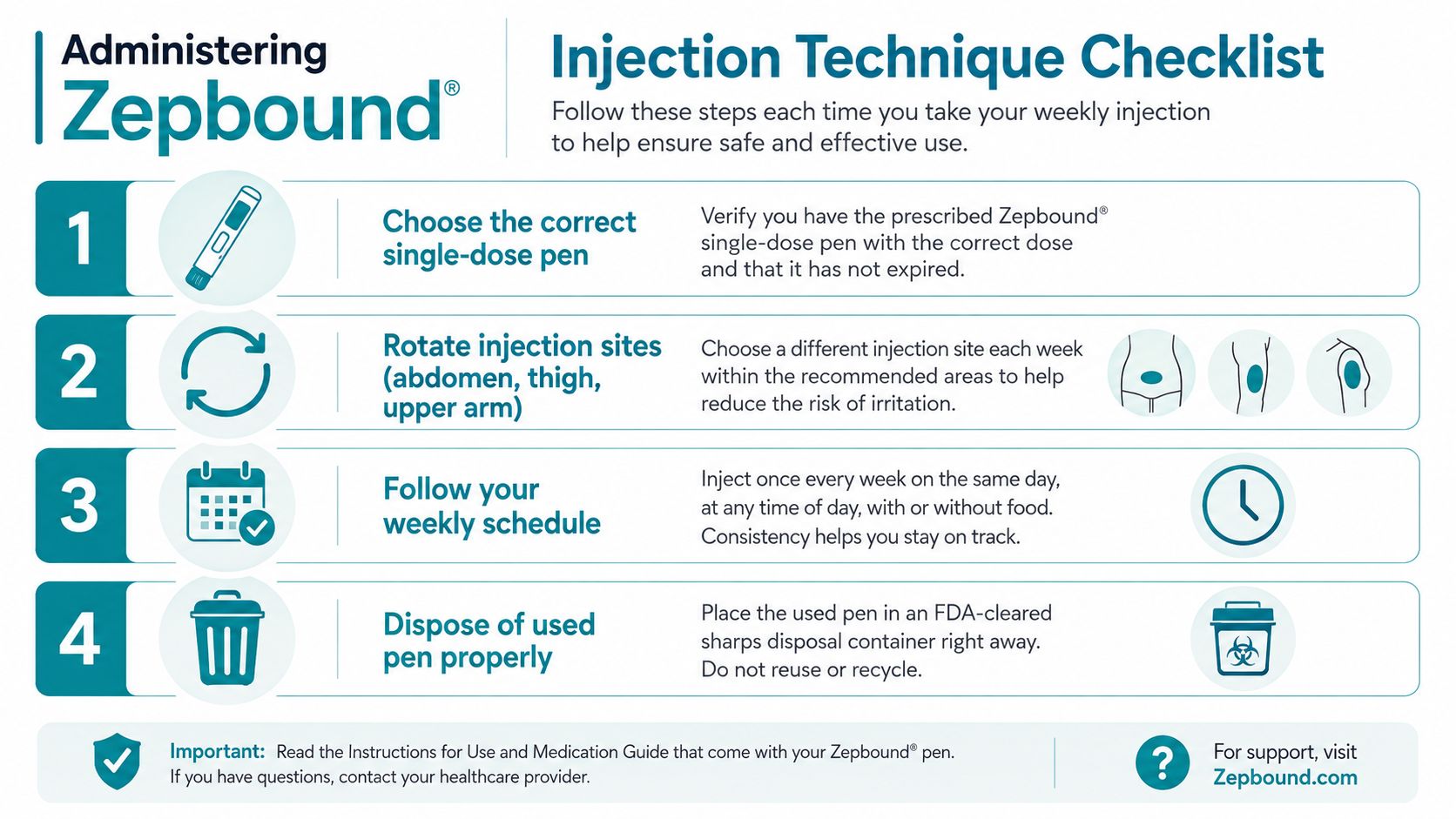
Zepbound is given as a subcutaneous injection, which means the medicine goes just under the skin. The FDA label allows injection into the abdomen, thigh, or upper arm, and sites should be rotated from week to week Zepbound Prescribing Information. The injection can be taken with or without food and on the same day each week Zepbound Prescribing Information.
The medication should be stored in the refrigerator at 36°F to 46°F, protected from light, or kept at room temperature up to 86°F for up to 21 days Zepbound Prescribing Information. If there's any uncertainty about storage, the package insert should be checked and the prescribing clinician or pharmacist contacted before use.
For missed doses, the label gives a simple rule. If the missed dose is remembered within 4 days, take it as soon as possible. If more than 4 days have passed, skip it and resume the next scheduled dose Zepbound Prescribing Information. Do not double up on doses to catch up.
A practical benefit of weekly medication is schedule flexibility, but that flexibility still has limits. Any change in dosing time or pattern should be discussed with the prescriber, especially if the person is having side effects or is moving through an escalation period. The clinic's Zepbound page is one place to review how the medication is framed in obesity medicine, but the dose plan itself still comes from the treating clinician.
Common Side Effects, Precautions, and Red Flags That Need Prompt Attention
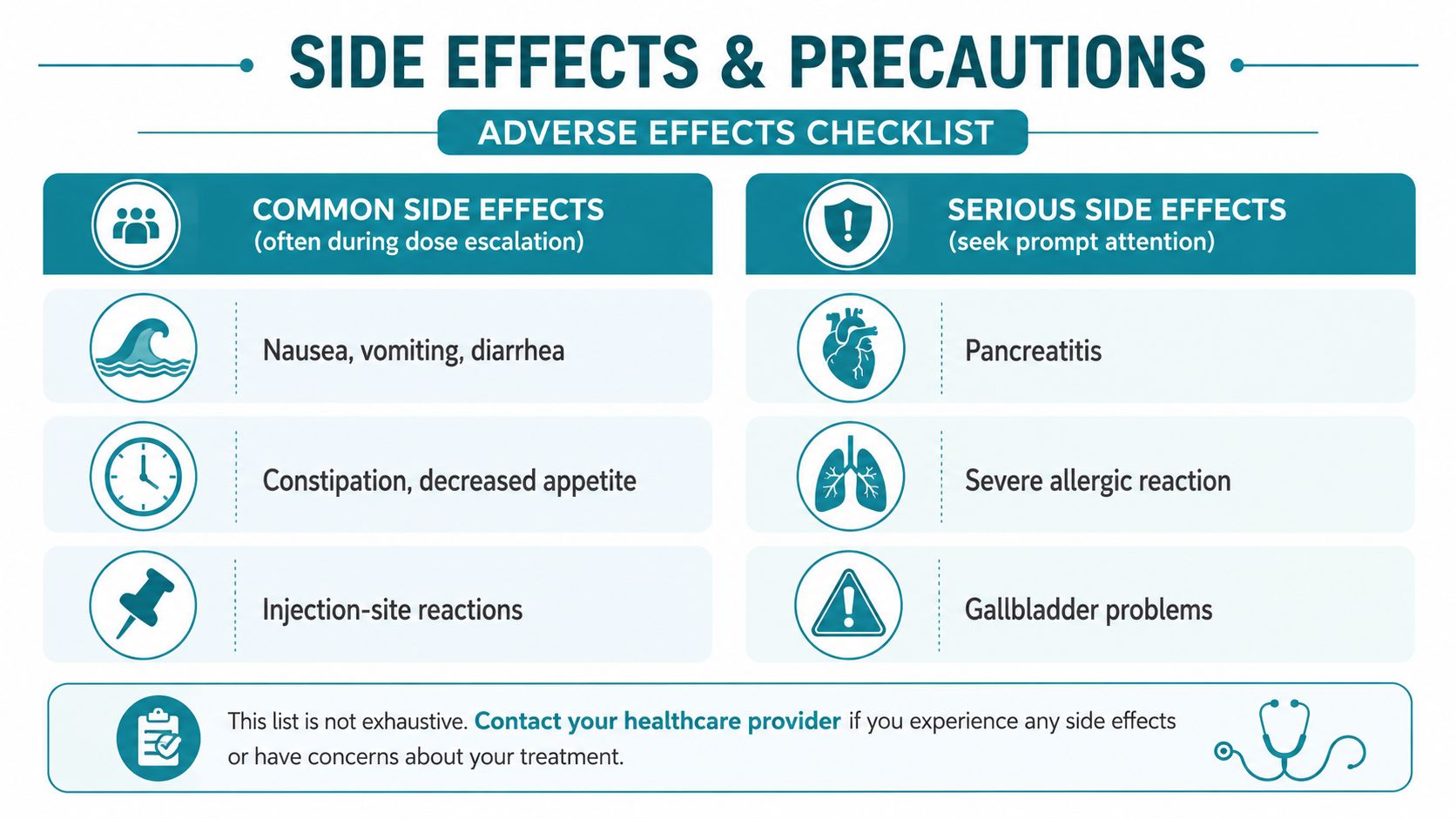
The most common side effects with Zepbound are nausea, vomiting, diarrhea, constipation, abdominal pain, decreased appetite, and injection-site reactions Zepbound side effect article. These symptoms often show up during dose escalation, which is one reason the label moves gradually rather than jumping straight to a maintenance dose Zepbound Prescribing Information.
Side effect tracking is more useful than guessing. If symptoms are mild, the prescriber may decide to keep the same dose longer. If they're persistent or severe, the clinician may slow escalation, hold the dose, or reassess whether continuing at that level makes sense. If you're organizing symptoms for a visit, a resource on tracking medication side effects can help you arrive with a clearer timeline.
Common versus serious effects
Some side effects are unpleasant but expected during titration. Others need prompt clinician contact because they may signal a more serious problem. Zepbound's safety information includes warnings for pancreatitis, gallbladder disease, acute kidney injury from dehydration, severe hypoglycemia when used with insulin or sulfonylureas, and hypersensitivity reactions Zepbound side effect article. The FDA label also warns against use in people with a personal or family history of medullary thyroid carcinoma or MEN 2 Zepbound Prescribing Information.
Red-flag checklist for prompt contact
- Persistent severe abdominal pain: This can be a warning sign for pancreatitis or gallbladder disease.
- Ongoing vomiting or inability to keep fluids down: Dehydration can become a kidney issue quickly.
- Yellowing of the skin or eyes: This can point to gallbladder or liver-related problems.
- Signs of allergic reaction: Swelling, hives, or breathing trouble need urgent attention.
- Vision changes: Especially important if there's underlying diabetes or eye disease.
- Pregnancy: The prescriber should know right away.
- Neck mass, trouble swallowing, or hoarseness: These need timely evaluation because of thyroid warning concerns.
The main point is simple. Don't troubleshoot red flags through an app or message board. Contact the prescribing clinician promptly so the symptom can be assessed in context. If symptoms are severe or rapidly worsening, urgent care or emergency evaluation may be appropriate.
A Composite Example of How Dose Decisions Get Made in Real Practice
Consider a composite hypothetical adult who has been on 7.5 mg weekly for several weeks and reports persistent nausea plus a weight plateau. That person is fictional, but the decision pattern is real. A prescriber would look at how severe the nausea is, whether the medication is being taken correctly, whether the current dose is already tolerable enough to continue, and whether the treatment goal is weight management or another FDA-approved indication.
The possible next step isn't automatic. The clinician might hold the dose longer, step back to a previously tolerated strength, or continue upward later if the symptoms settle. The label allows 2.5 mg stepwise changes and leaves room for prescriber judgment within the approved schedule Zepbound Prescribing Information.
The key question isn't “Why isn't the dose higher?” It's “What dose can this person safely stay on and still meet the goal?”
A plateau by itself doesn't prove the medication has failed. It may mean the dose is still being adjusted, the current dose is the right holding point, or the medication needs more time within the prescribed plan. No one should move the dose up on their own because another person tolerated a higher strength. Dose changes are individualized and need an in-person review.
Frequently Asked Questions and When to Reach Out to Your Clinician
Can Zepbound dose be split or adjusted at home?
No. The single-dose pen is designed to deliver one fixed weekly amount, and the label doesn't call for splitting doses Zepbound Prescribing Information.
Does alcohol change the titration schedule?
The label doesn't give a special alcohol-based dose schedule. If alcohol use worsens nausea, vomiting, or dehydration, that's a reason to discuss it with the prescriber before the next dose change.
When should someone consider stopping the medication?
That decision belongs to the prescriber. Common reasons include persistent intolerance, serious side effects, or a change in clinical goals. It shouldn't be a solo decision.
What should a patient bring to a follow-up visit?
Bring the exact dose, the injection day, a symptom log, and any missed-dose information. Those details help the clinician decide whether to hold, continue, or adjust the plan.
Contact the prescribing clinician promptly for severe gastrointestinal symptoms, signs of pancreatitis, vision changes, pregnancy, or any red-flag symptoms listed above. This article is educational and isn't personal medical advice.
If you're evaluating Zepbound as part of physician-led obesity care, Empire Medical Wellness can help you understand the medication in the context of a broader treatment plan. Visit Empire Medical Wellness to review obesity medicine care and discuss whether a supervised dosing plan is appropriate for your situation.