
If you're comparing GLP-1 vs phentermine, the key question isn't which one sounds stronger. It's whether you need a long-term obesity medicine plan or a short-term appetite tool while access, timing, and monitoring are sorted out. Those are not the same decision, and treating them as the same is where many side-by-side comparisons go wrong.
| Topic | GLP-1 medications | Phentermine |
|---|---|---|
| Main role | Chronic weight management | Short-term appetite suppression |
| How it works | Gut-brain hormone signaling | Stimulant effect on central nervous system |
| Typical side effects | GI symptoms, especially nausea, constipation, discomfort | Insomnia, dry mouth, faster heart rate, higher blood pressure |
| Monitoring focus | Titration tolerance, GI management, long-term maintenance | Cardiovascular screening, short-interval reassessment |
| Evidence pattern | Newer, longer-duration trials | Older, shorter-term trials |
Table of Contents
- What These Two Medications Are and Why People Compare Them
- How GLP-1 Drugs and Phentermine Work in the Body
- Weight-Loss Results From Clinical Trials
- Side Effects and What Monitoring Looks Like
- FDA-Approved Indications and Duration of Therapy
- Real-World Prescribing Trends in the United States
- Can Phentermine Be Used as a Bridge While Awaiting GLP-1 Therapy
- How a Physician Thinks About Patient Selection
- FAQ
What These Two Medications Are and Why People Compare Them
People usually ask about GLP-1 vs phentermine because they want to know whether the newer option is meaningfully different or just a newer label on an old idea. It is meaningfully different. These medications come from different eras of obesity treatment, work through different pathways, and raise different questions about timing, monitoring, and long-term use.
GLP-1 medications are hormone-based therapies
GLP-1 medications are a class of drugs that mimic a natural gut hormone involved in appetite and metabolic signaling. In plain language, they help many people feel full sooner and stay full longer. The FDA-approved obesity medicines in this group are designed for chronic weight management, so the conversation is usually about ongoing care rather than a brief course of treatment (FDA-approved chronic weight management framing).
For many patients, that makes GLP-1 therapy feel more like blood pressure medicine than a short burst of treatment. The goal is not only to start therapy, but also to adjust it carefully, watch tolerance, and plan for maintenance over time.
Phentermine is an older stimulant appetite suppressant
Phentermine is a different kind of tool. It is a sympathomimetic stimulant, which means it acts on the central nervous system to reduce appetite. Its clinical history is older, and the evidence base behind it comes from shorter, smaller studies. A commonly cited 1968 trial randomized only 64 patients, which is one reason it is still discussed as a short-term medication rather than a long-horizon obesity therapy (historical phentermine evidence).
That difference shapes how clinicians think about risk. With a stimulant appetite suppressant, the discussion often centers on appetite control, blood pressure, heart rate, and how long the medication should be used. With a hormone-based therapy, the discussion usually shifts toward dose adjustment, tolerability, and whether the treatment plan is built for maintenance.
A simple way to sort the two is this. GLP-1 medications are usually chosen as part of a chronic weight management plan, while phentermine is more often treated as a short-term tool. That is why the more useful comparison is not “which one is better,” but “which one fits the treatment goal, the patient's medical history, and the plan for follow-up.”
Access also matters. A patient may be a candidate for either medication on paper, yet the next step depends on availability, insurance coverage, and how the practice structures care. A review of obesity medicine services can help patients see how evaluation, prescribing, and monitoring are organized in real practice.
The basic distinction is clear. One medication is built around longer-term hormonal appetite control, and the other is an older stimulant option that often fits shorter-term use.
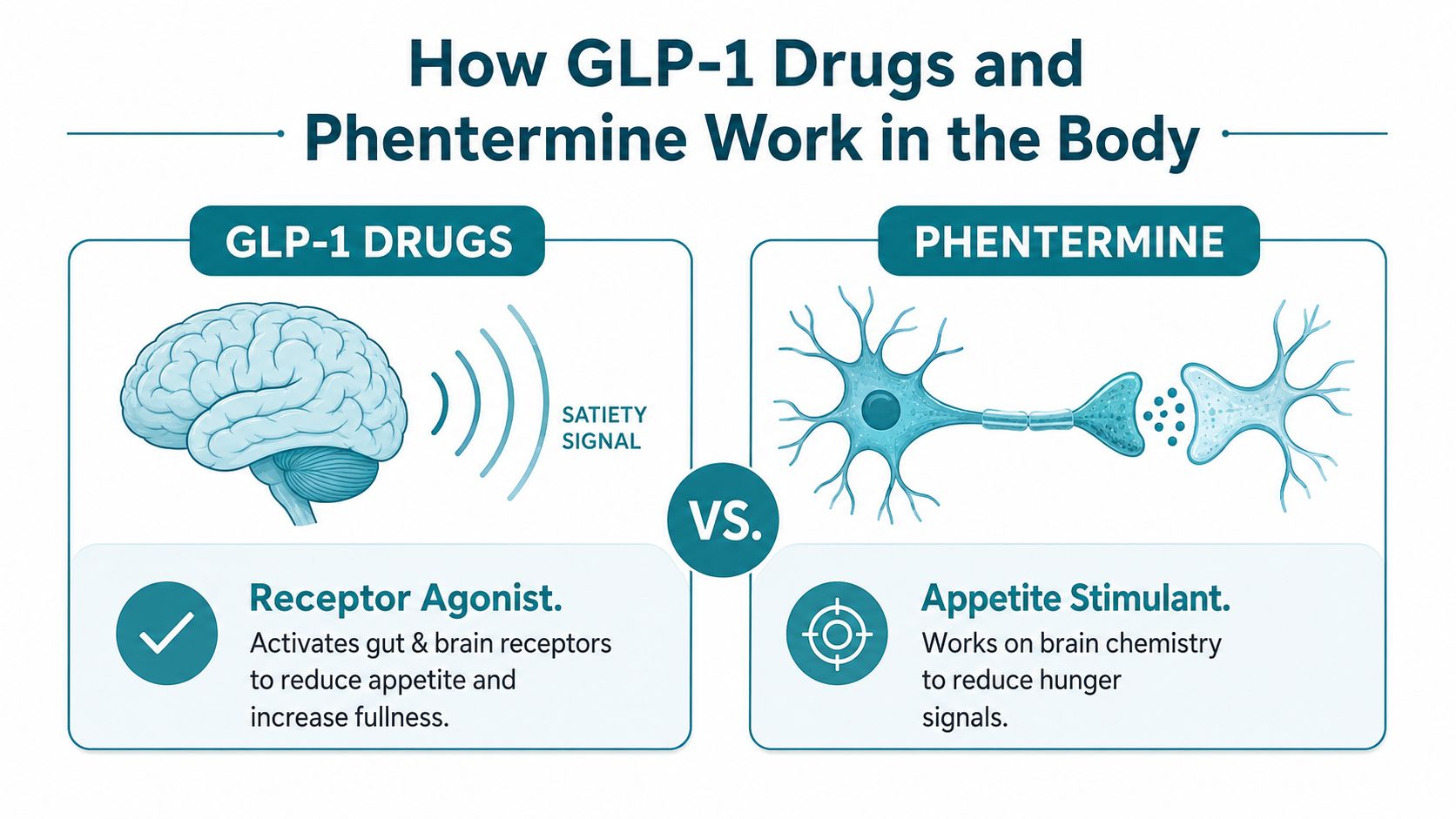
How GLP-1 Drugs and Phentermine Work in the Body
The mechanism difference is not just biology for biology's sake. It explains why one medication tends to raise questions about blood pressure and heart rate, while the other tends to raise questions about nausea and stomach tolerance. That is why clinicians don't evaluate these drugs the same way.
GLP-1 agents act through gut-brain signaling
GLP-1 therapy works through hormonal signaling between the gut and brain. After eating, that pathway helps shape fullness, appetite, and how quickly food leaves the stomach. In practical terms, the patient experience is often less like a stimulant hit and more like a gradual reduction in hunger cues.
That mechanism is one reason GLP-1 care often focuses on titration tolerance. The medication is usually adjusted over time so the body can adapt to the GI effects. The most common issues are nausea, constipation, and abdominal discomfort, which is why follow-up matters even when the medication is working as intended (GLP-1 side-effect pattern).
Phentermine changes appetite signaling through the nervous system
Phentermine works in a more direct, stimulant-like way. It influences norepinephrine signaling in the brain, which can lower perceived hunger. That can feel fast, and that speed is part of why some people look at it as an appealing short-term option.
The same mechanism also explains the tradeoffs. Because phentermine is a stimulant, clinicians pay closer attention to insomnia, dry mouth, increased heart rate, and blood pressure changes. In a physician-led setting, that typically means more attention to cardiovascular history before treatment and more frequent reassessment after treatment begins (phentermine safety and monitoring differences).
Why mechanism changes the visit itself
A person comparing these drugs may think the question is only about efficacy. In reality, the mechanism changes the entire monitoring strategy. For GLP-1 treatment, the visit often centers on GI tolerance, adherence over time, and whether the plan is sustainable. For phentermine, the visit usually centers on cardiovascular screening and whether a short-term stimulant fits the patient's history.
Bottom line: mechanism drives monitoring. That's why a provider may ask about reflux, nausea, or prior stomach issues before one medication, and blood pressure, palpitations, or sleep before the other.
That is also why these are not interchangeable versions of the same thing. They can both support weight loss, but they do it through different systems in the body, and those systems come with different risks and different follow-up needs.
Weight-Loss Results From Clinical Trials
The key comparison is not which drug has a louder reputation. It is how strong the evidence is, how long the studies lasted, and what outcomes those studies measured. That is the part of GLP-1 vs phentermine that makes the choice clearer.
The GLP-1 trial data is newer and longer
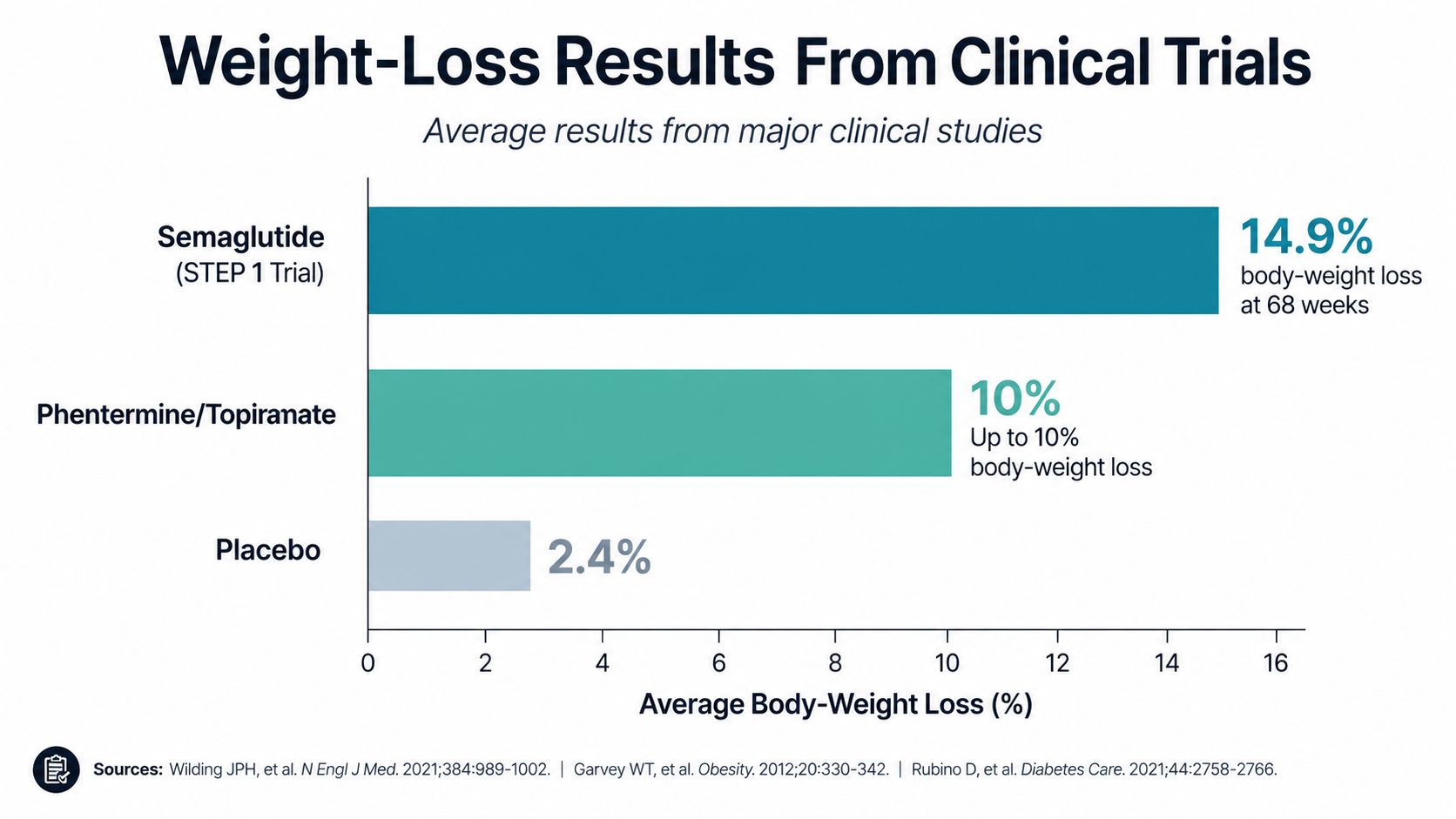
The STEP 1 trial published in 2021 studied adults without diabetes who received semaglutide 2.4 mg. At 68 weeks, participants lost 14.9% of body weight, compared with 2.4% on placebo, and the study included 1,961 participants (STEP 1 trial summary). That matters because the study was both large and long enough to show what sustained treatment can look like, instead of only a brief appetite change.
Modern comparative summaries also place GLP-1 agents in a higher-efficacy range overall, often around 15% to 22% mean weight loss in contemporary trials (comparative obesity pharmacotherapy summary). For people comparing treatment options, that range is one reason GLP-1 therapy is often discussed as a chronic obesity treatment rather than a short trial of appetite suppression. A physician looking at access and sequencing may also compare these results with practical care pathways, including whether a patient is better served through a clinic such as Empire Medical Wellness when ongoing monitoring is part of the plan.
Phentermine can work, but the evidence sits in a different era
Phentermine's results can look encouraging if you focus only on the percentage. Later summaries report about 13% body-weight loss at 36 weeks versus about 5% on placebo, and the older cited trial from 1968 enrolled only 64 patients (historical phentermine evidence). Other reviews describe phentermine as usually associated with about 5% to 8% short-term loss, or roughly 3% to 6% placebo-subtracted loss over short time horizons (comparative obesity pharmacotherapy summary).
The bigger distinction is durability. GLP-1 therapy has the stronger evidence base for sustained, multi-month weight reduction. Phentermine has the older, shorter-horizon profile, which is why clinicians often view it as a short-term tool rather than a long-term anchor for obesity care.
Why the numbers are not directly interchangeable
A 36-week study and a 68-week study do not describe the same clinical reality. Sample size, time horizon, and study design all shape what the result means for an individual patient. A chart can make the medications look close at first glance, while the evidence behind them points in different directions.
Physicians should avoid overselling either medicine. Phentermine can produce an early drop in appetite and weight, but the supporting studies are historically shorter and smaller. GLP-1 therapy is the newer standard when the goal is sustained obesity treatment rather than a brief appetite suppressant effect.
Side Effects and What Monitoring Looks Like
Side effects are where the comparison becomes personal in the most practical sense. Not personal as in individualized advice, but personal as in how a medication fits a person's health history, sleep, stomach sensitivity, and cardiovascular risk. The side-effect profile often matters as much as the expected weight-loss effect.
GLP-1 monitoring focuses on tolerance and maintenance
GLP-1 medications most commonly cause nausea, constipation, and GI discomfort (GLP-1 side-effect pattern). That is why follow-up often focuses on tolerance, hydration, eating patterns, and whether symptoms settle as the body adjusts. The clinical posture is usually long-term, with the medication framed as part of ongoing obesity care rather than a short burst.
Because the goal is chronic treatment, the monitoring conversation also includes whether the patient can stay on therapy in a sustainable way. That may sound obvious, but it is easy to miss when people only compare headline results. A medication that works on appetite still has to be livable month after month.
Phentermine monitoring leans harder on cardiovascular screening
Phentermine's side effects are more stimulant-like. Common concerns include insomnia, dry mouth, increased heart rate, and blood pressure changes. That is why a physician-led practice usually thinks about baseline cardiovascular screening before prescribing it and shorter-interval reassessment afterward.
Practical rule: if a patient already struggles with sleep, palpitations, or blood pressure control, a stimulant-based medication needs much more scrutiny than a hormone-based medication.
This does not mean phentermine is never appropriate. It means the monitoring burden is different. The clinician is not just checking whether appetite is lower. They are also watching for stimulant effects that can change the risk-benefit balance quickly. If you want a visit that focuses on whether phentermine or a GLP-1 option fits your situation, you can request an appointment with Empire Medical Wellness.
The side-effect pattern shapes the visit
A patient who wants a medication that is less likely to cause jitteriness may lean toward a GLP-1 option. A patient who wants a short-term appetite suppressant and can tolerate stimulant screening may ask about phentermine. Neither preference is trivial, because tolerability often determines whether a medication can be used as planned.
The clearest way to think about it is this. GLP-1 treatment asks whether the stomach and gut can adapt. Phentermine asks whether the heart, blood pressure, and sleep can tolerate a stimulant. Those are different clinical questions, and they should lead to different conversations.
FDA-Approved Indications and Duration of Therapy
The label is where much of the confusion starts. People hear both medications described as “for weight loss” and assume they can be used in the same way. They cannot, because the FDA-approved use and the intended duration are different.
GLP-1 obesity medicines are chronic therapies
The FDA-approved obesity indications for modern GLP-1-based medicines such as semaglutide and tirzepatide are for chronic weight management. That wording matters because it treats obesity as a long-term medical condition, not a short course problem with a fixed finish line.
That is why GLP-1 treatment is usually discussed as ongoing care. The prescribing framework assumes monitoring, maintenance, and periodic reassessment over time. The medication is meant to fit into a longer plan, not act as a temporary appetite fix.
Phentermine is a short-term medication
Phentermine, by contrast, is tied to short-term use. In practical terms, that makes it more of a short-horizon tool than a long-term obesity medication. The older evidence base and the stimulant profile both support that framing (historical phentermine evidence).
The label distinction also matters because phentermine's safety and effectiveness have not been established with other weight-loss products, which complicates overlap or transition strategies (bridge and transition considerations). That does not settle every real-world question, but it explains why clinicians are careful about how they sequence treatment.
Why this distinction changes the discussion
If a medication is approved for chronic use, the discussion naturally includes maintenance, long-term response, and follow-up. If it is approved for short-term use, the discussion shifts toward getting a temporary effect safely and deciding whether a longer-term plan is in place.
That is why many clinicians no longer ask only, “Which one is better?” They ask, “Which one fits the time horizon we need?” That small shift often matters more than a side-by-side ranking, because access, sequencing, and monitoring are part of the choice from the start.
Real-World Prescribing Trends in the United States
Prescribing patterns tell you something important about what clinicians and patients are choosing, not just what they're comparing online. In the U.S., the balance has shifted as GLP-1 drugs have become more widely used.
Phentermine has lost share as GLP-1 use has expanded
A population-based cohort study summarized in JAMA reported that among people without diabetes using a weight-loss medication in the U.S., about 40% were using phentermine at the start of 2021, but by the end of 2023 that share had fallen to fewer than 10% as semaglutide and tirzepatide use expanded (JAMA prescribing trend summary).
That is a major shift, but it should not be read as a moral verdict on phentermine. It is better understood as a change in the market and in prescribing behavior as newer medications became more available and more familiar.
Why the shift makes clinical sense
The same JAMA summary is consistent with comparative efficacy data showing that GLP-1 agents commonly produce roughly 15% to 22% mean weight loss in modern trials, while phentermine is usually associated with about 5% to 8% short-term loss (JAMA prescribing trend summary, comparative obesity pharmacotherapy summary). When clinicians see a medication with stronger long-duration data, the prescribing conversation naturally shifts toward that option for chronic obesity care.
That does not mean phentermine disappeared. It means its role got narrower. In practice, it is more likely to be discussed as a limited option, not the default long-term answer.
Access is part of the story
This trend also reflects access, not just preference. When newer medications are more widely used, clinicians must consider how patients transition between options and what the practical treatment path entails. That is where sequencing becomes more than a theoretical discussion.
The current U.S. pattern makes one thing clear. GLP-1 therapy is increasingly the long-term reference point, while phentermine sits in a more limited, short-horizon role.
Can Phentermine Be Used as a Bridge While Awaiting GLP-1 Therapy
This is the question many comparison articles skip. People don't always need a permanent answer right away. Sometimes they need a safe interim plan while they wait on prior authorization, supply, or cost decisions.
Bridge therapy is a sequencing question, not a shortcut
A short-term medication can feel appealing when access to a GLP-1 drug is delayed. Phentermine is inexpensive and fast-acting, which is why people ask whether it can serve as a bridge (bridge and transition considerations). The honest answer is that the idea exists in real-world practice, but it needs physician oversight because the evidence base for longer-term use is thinner and the label does not establish safety or effectiveness with other weight-loss products.
That means overlap or transition strategies are not something to improvise. They're something to discuss.
What a physician weighs before using a bridge
A careful clinician usually starts with the reason the GLP-1 plan is delayed. Prior authorization, medication shortages, and cost barriers are all different problems, and they can lead to different next steps. Then the clinician looks at cardiovascular history, sleep patterns, current medications, and how much monitoring the patient can realistically support.
If the short-term option creates more safety concerns than it solves, it is not really a bridge. It is just a detour.
That is especially important because a bridge medication should help the patient move toward a defined plan, not replace the plan entirely. If the long-term strategy is GLP-1 therapy, the short-term decision has to fit that trajectory.
Why overlap is not automatic
People often assume that because one medication is temporary and the other is chronic, they can be mixed freely. That assumption is risky. The label language around phentermine is more limited, and the transition question depends on medical history rather than convenience.
For adults comparing these options, the right question is not, “Can I take something cheaper until the medication arrives?” It is, “What is the safest temporary plan while the long-term plan is being arranged?” That is a physician question, not a self-directed workaround.
If you're looking at how private-pay care handles access, follow-up, and medication planning, the fees and how it works page is a useful reference for the process.
How a Physician Thinks About Patient Selection
A thoughtful obesity-medicine visit rarely begins with the medication name. It begins with the person's weight history, prior attempts, and health factors that change the safety and fit of each option. That's the most honest way to approach GLP-1 vs phentermine.
The main factors are broader than body weight
A physician-led evaluation usually looks at prior weight-management efforts, current health conditions, cardiovascular history, gastrointestinal history, sleep, and the time horizon the patient can realistically support. Those details matter because they change the risk-benefit equation. The same medication can be sensible for one adult and a poor fit for another.
Monitoring burden matters too. Some people can commit to a long-term treatment plan with regular follow-up. Others need something shorter and simpler because of work, travel, or access barriers. A good discussion acknowledges that reality instead of pretending every patient can follow the same path.
The decision is about fit, not labels
Phentermine may make sense when a clinician is looking for a short-term appetite suppressant and the patient's cardiovascular history supports that choice. GLP-1 treatment may make more sense when the goal is chronic management, the patient can tolerate gradual titration, and the treatment horizon is measured in months or longer.
What matters most is that the choice is made after a real evaluation. Not a guess, and not a trend.
A calm, physician-led conversation is the point
The best obesity-medicine care does not oversell fast results. It explains why one option is framed as a chronic therapy and the other as a short-term tool. It also takes access, sequencing, and monitoring seriously, because those are the parts that determine whether treatment can continue.
For adults in New York or New Jersey who want physician-led obesity medicine, the our practice page explains the care model in plain terms.
Empire Medical Wellness offers physician-led obesity medicine with careful evaluation, medication planning, and follow-up for adults who want a structured approach to weight management. If you're comparing GLP-1 vs phentermine and want help understanding how chronic treatment differs from a short-term option, visit Empire Medical Wellness to learn more about the obesity-medicine service page and next steps.
FAQ
Is GLP-1 better than phentermine for everyone?
No. GLP-1 medications have stronger long-duration evidence, but that doesn't make them right for every adult. The better choice depends on health history, monitoring needs, access, and whether the goal is chronic treatment or a short-term tool.
Why do clinicians describe phentermine as short term?
Because its approved role and evidence base are tied to short-term use, and the medication is a stimulant with side effects that require cardiovascular attention. That makes it different from chronic obesity medications designed for ongoing management.
Can I compare the two by percent of weight loss alone?
You can, but that can be misleading. A percent without the study duration, sample size, and medication class leaves out the most important context. The better comparison includes time horizon and monitoring burden.
Why do GLP-1 medications often require more follow-up?
Because the body usually needs time to adjust to the GI effects, and the medication is intended for chronic use. Follow-up focuses on tolerance, maintenance, and whether the treatment remains sustainable.
Is this article personal medical advice?
No. It's educational only and not a substitute for your own clinician's evaluation. If you're in immediate danger or have severe symptoms, seek urgent medical care right away.